

Selling goods or services is just one aspect of running an internet business. It takes a lot of effort for business owners to manage emails, reply to clients, post on social media, track sales, organize projects, handle bills, and do other time-consuming but vital repetitive duties. These pursuits frequently divert attention from strategic development and innovation.
Automation becomes a potent remedy in this situation. Businesses can increase overall productivity, minimize errors, reduce manual labor, and streamline routine procedures with the aid of automation systems. Entrepreneurs can concentrate more on strategy, revenue development, and client connections rather than spending hours on monotonous duties.
Automation tools are now used by companies of all sizes to increase productivity and maintain their competitiveness. Automation solutions are available for nearly every corporate activity, from accounting and project management to email marketing and customer service. The top online business solutions for automation will be discussed in this article, along with how they can improve your scalability.
Why Automation Matters for Online Businesses
For online businesses to stay competitive in the fast-paced digital world of today, automation has become essential. Automation helps remove monotonous chores and frees up teams to concentrate on strategic initiatives that propel growth, regardless of the size of your business.
Businesses may increase productivity, lower human error, and provide better customer experiences by automating repetitive tasks. Additionally, automation allows businesses to expand their operations without appreciably adding to their burden or expenses.
Key Benefits of Automation
- By automating repeated operations, it saves important time.
- Enhances operational precision and lowers human error.
- Facilitates business expansion without necessitating significant staffing expansions.
- Increases customer satisfaction by responding more quickly and interacting with customers in a personalized manner.
One of the best strategies for increasing productivity and creating a scalable internet business is automation.
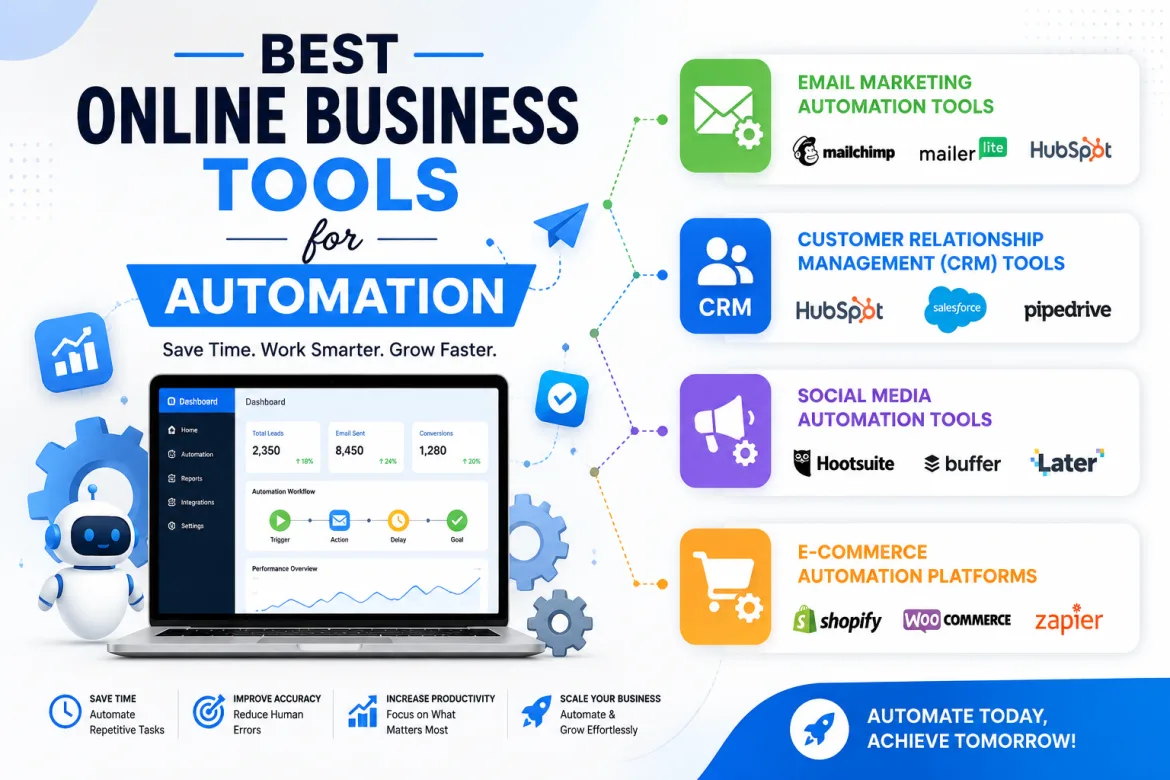
Email Marketing Automation Tools
For companies of all sizes, email marketing continues to be one of the most effective digital marketing techniques. However, when your audience increases, sending individual emails and manually maintaining subscriber lists might quickly become too much to handle.
Businesses may develop automated campaigns based on consumer behavior with email automation solutions like Mailchimp, ActiveCampaign, ConvertKit, and GetResponse. Mailchimp, for example, provides tools for creating email automation workflows and managing audience communications.
Reminders for abandoned carts, promotional offers, welcome emails, and client onboarding sequences can all be sent automatically by these platforms.
Benefits of Email Marketing Automation
- Automatically nurture leads with tailored email sequences.
- Improve conversions through targeted campaigns and follow-ups.
- Schedule and automate email distribution to save time.
- Improve consumer engagement via behavior-based communications.
When utilized appropriately, email automation may increase consistent sales while minimizing human marketing efforts.
Customer Relationship Management (CRM) Tools
CRM software enables firms to manage client data, track interactions, and automate sales procedures. As firms grow, managing leads manually becomes more difficult, necessitating CRM automation.
Platforms like HubSpot, Salesforce, Zoho CRM, and Pipedrive let firms automate lead tracking, follow-up reminders, customer segmentation, and sales pipeline management. HubSpot CRM provides CRM tools that help businesses organize customer data and automate routine sales and customer-management activities.
These tools ensure that no prospective opportunities are missed.
Advantages of CRM Automation
- Centralizes client data in one place.
- Automates handle nurturing and follow-up tasks.
- Boosts sales team productivity and efficiency.
- Offers vital insights into customer behavior.
A well-implemented CRM system enables firms to strengthen client relationships and improve sales success.
Social Media Automation Tools
Maintaining an active social media presence necessitates frequent posting and engagement. Many business owners find it difficult and time-consuming to manually manage various platforms.
Businesses can schedule content ahead of time with social media automation platforms like Buffer, Hootsuite, and Later. Instead of manually updating every day, users can schedule weeks’ worth of content in a single session.
These platforms also offer statistics to assist organizations understand audience behavior and optimize content initiatives. Automated reporting saves time and provides critical performance insights.
A small business owner may schedule updates for Facebook, LinkedIn, Instagram, and X all at once, assuring consistent brand presence without spending hours a day managing social accounts.
Project Management and Workflow Automation
Managing projects efficiently gets more difficult as teams grow and workloads increase. Workflow automation tools enable firms to streamline cooperation and increase productivity.
Asana, Trello, Monday.com, and ClickUp are platforms that automate task assignments, project updates, deadline reminders, and team communications. These capabilities decrease the need for manual collaboration and help projects run successfully.
Key Benefits of Workflow Automation
- Automatically assigns tasks and responsibilities.
- Enhances team collaboration and communication.
- Automated reminders help reduce delays.
- Improves project visibility and responsibility.
Workflow automation enables teams to stay organized and execute projects more efficiently.
Accounting and Financial Automation Tools
Accounting and financial automation solutions enable firms to reduce manual work and enhance accuracy in managing day-to-day financial operations. Companies that automate repetitive activities can save time, reduce errors, and have greater control over their financial health.
Invoicing, expense monitoring, payment reminders, and financial reporting can all be automated using software like QuickBooks, Xero, or FreshBooks. These solutions keep financial records organized while decreasing the need for ongoing human bookkeeping.
Automation also gives real-time information about cash flow, profitability, and general business success. This allows business owners to make more timely and educated financial decisions based on correct data.
For example, a freelance consultant can create recurring invoices and automated payment reminders to ensure timely payments while decreasing administrative workload and boosting cash flow consistency.
E-Commerce Automation Platforms
Inventory tracking, order processing, customer communication, and shipment management are among the many everyday processes that e-commerce enterprises undertake. These chores can become daunting without automation, particularly as order volume grows.
Shopify, WooCommerce, BigCommerce, and Magento all have built-in automation solutions that simplify these operations and increase operational efficiency.
Important E-Commerce Automation Features
- Automated inventory updates and alerts.
- Receive instant order confirmation and shipping notifications.
- Provide personalized product recommendations for customers.
- Automated review and follow-up emails.
E-commerce automation enables online stores to provide a consistent buying experience while decreasing manual strain.
Marketing Automation Platforms
Marketing automation goes beyond email marketing. Comprehensive solutions enable firms to automate lead generation, audience segmentation, and customer nurturing. These systems maintain continual communication with potential clients throughout the whole purchasing process.
Businesses can construct tailored customer journeys across many channels with solutions like HubSpot Marketing Hub, Marketo, and Pardot. Automated campaigns send relevant messages at the appropriate times based on user activity. This enhances targeting precision and boosts overall advertising efficacy.
This method increases engagement while lowering marketing workload. Instead of manually controlling each encounter, firms may develop sophisticated workflows that run continually. It also allows teams to focus more on strategy, creativity, and performance improvement.
A software corporation, for example, can leverage user interaction to automatically send educational information, product demonstrations, and trial reminders. This ensures that no leads are overlooked and that all prospects receive timely, relevant information.
Data and Reporting Automation Tools
Modern organizations rely significantly on data-driven decisions. However, manual data collection and analysis can be inefficient and time-consuming.
Google Looker Studio, Power BI, and Tableau are examples of reporting solutions that automate data collecting and visualization. These platforms collect data from various sources and provide reports automatically.
Business owners can track performance measures without manually creating spreadsheets. Real-time dashboards provide useful information on sales, marketing efficacy, customer behavior, and operational performance.
For example, an online store can automatically examine sales trends, conversion rates, and traffic sources from a single dashboard, allowing for faster decision-making.
Integration and Workflow Automation Platforms
Many firms utilize many software applications that do not readily interact with one another. This frequently results in inefficiencies and duplicating work.
Integration systems like Zapier, Make, and Integrately connect several apps and automate data flows across them. Zapier is an example of an integration platform designed to connect applications and automate repetitive workflows.
These tools provide seamless workflows between different corporate platforms.
Benefits of Integration Automation
- Eliminates manual data entering.
- Easily connects multiple business applications.
- Enhances process efficiency across departments.
- Minimizes errors caused by disconnected systems.
Integration platforms constitute the cornerstone of a fully automated corporate ecosystem.
Common Mistakes Businesses Make with Automation
Although automation has various advantages, many firms fail to attain the best results due to inadequate implementation tactics.
One common mistake is to automate inefficient operations. If a workflow is poorly planned, automation will simply exacerbate existing issues rather than solve them. Businesses should optimize procedures before automating them.
Another risk is leaning too heavily on technology and eliminating human connection entirely. Customers continue to value human communication, particularly when dealing with difficult situations or crucial decisions.
Some firms invest in too many instruments at once. Managing several platforms without a defined approach can lead to confusion and higher costs. It is usually more effective to begin with basic automation requirements and subsequently develop.
Finally, many firms disregard monitoring and optimization. Automation processes should be reviewed on a regular basis to ensure that they continue to produce the expected outcomes and adapt to changing business requirements.
Key Factors to Consider When Choosing Automation Tools
Selecting the appropriate automation tools necessitates a thorough assessment of corporate objectives and operational requirements. Not every platform is appropriate for every firm, so finding the correct fit is critical for long-term efficiency and success.
The ease of use is one of the most significant considerations. Employees may struggle to embrace a tool that is overly sophisticated, reducing productivity and limiting automation’s total benefits.
Decision-making relies heavily on integration capabilities as well. The finest automation technologies should integrate easily with current software systems and workflows to reduce interruption and increase operational efficiency.
- Easy user interface and adoption.
- Effective integration with existing tools.
- Scalability for future business expansion.
- Competitive pricing and ROI value.
- Reliable performance and support
Scalability: Businesses require tools that can expand with them without regular replacements or system upgrades. Cost should also be carefully considered, ensuring that the benefits and efficiency gained by automation justify the investment while also promoting long-term corporate sustainability.
The Future of Online Business Automation
Artificial intelligence, machine learning, and sophisticated analytics are helping to shape the future of automation. These innovations are making automation more intelligent and adaptable than ever before.
AI-powered systems can evaluate client behavior, forecast trends, tailor experiences, and automate decision-making. Businesses are increasingly using intelligent automation to boost productivity and competitiveness.
Emerging business automation trends are changing the way businesses function and service their clients. AI-powered customer service, virtual assistants, and predictive analytics enable businesses to increase efficiency and make better decisions. Furthermore, machine intelligence enables tailored marketing, whereas improved workflow automation optimizes procedures across departments.
Businesses that adopt current automation technologies today will have a better chance of long-term growth and success in the digital economy.
Conclusion
Automation has become a critical component of modern internet business success, allowing organizations to automate processes such as email marketing, customer assistance, bookkeeping, project management, and data analysis. These tools decrease human burden, save time, and boost overall efficiency, allowing firms to concentrate on strategy and growth. The greatest automation technologies help firms reduce repetitive activities while boosting customer and employee experiences, making them an important productivity driver in today’s digital economy.
Business owners should select tools that are aligned with their objectives, integrate well with existing systems, and leave room for future growth. Automation cannot replace human innovation, leadership, or relationship-building, but it does greatly improve productivity and operational efficiency. As competition in the digital arena heats up, implementing the correct automation solutions is no longer an option—it has become a prerequisite for developing a scalable, efficient, and lucrative online business.