

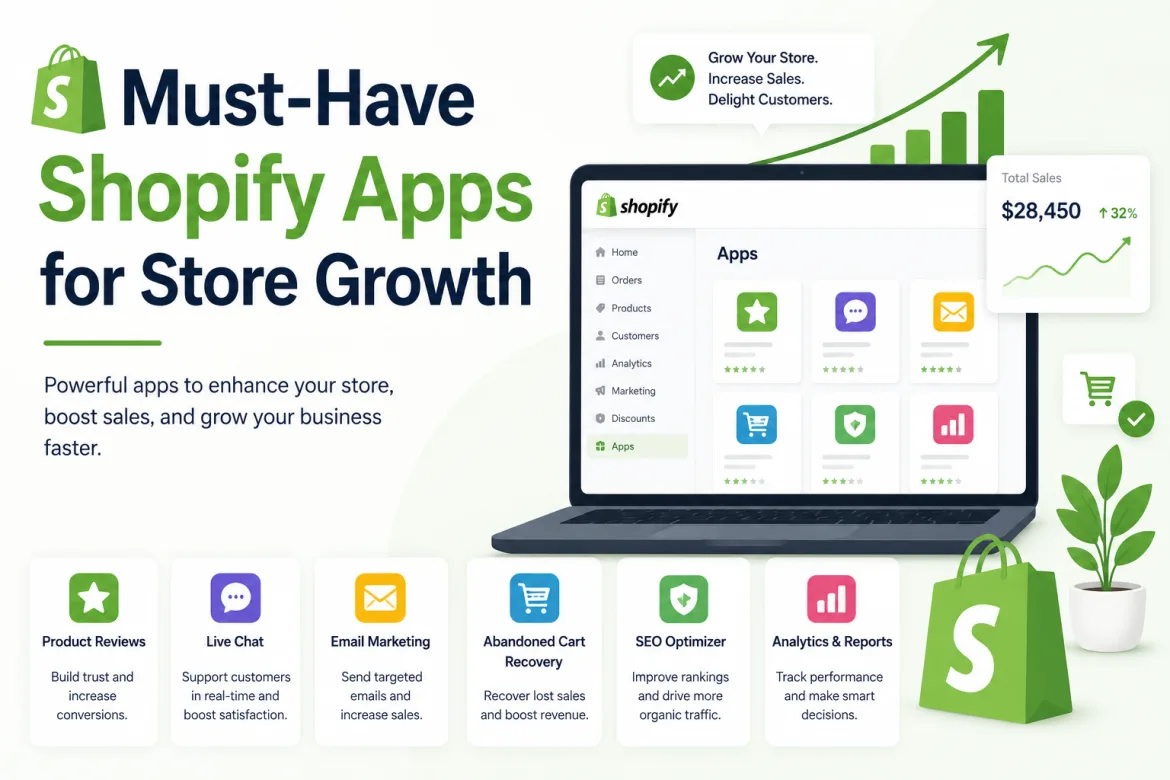
Building a successful Shopify business takes more than just visually appealing product pages and a functional website. As competition in eCommerce grows, businesses require technologies to improve customer experience, automate operations, increase revenue, and establish long-term customer connections. Shopify provides a robust ecosystem of apps that can assist store owners in achieving these objectives without requiring substantial technical skills.
The Shopify App Store provides thousands of programs that help many parts of an online business. From email marketing and customer assistance to inventory management and conversion optimization, the appropriate apps may make a big difference in a store’s performance. However, with so many options available, selecting the most useful apps can be difficult for expanding organizations.
This tutorial delves into the must-have Shopify apps for store growth, explaining how each category adds to increased income, enhanced productivity, and more customer satisfaction. Whether you’re a startup starting your first online store or an established business wanting to scale, these Shopify apps can help you lay a solid foundation for long-term success.
Why Shopify Apps Matter for Business Growth
Shopify offers a powerful core platform, but each business has unique needs. Apps extend Shopify’s functionality and enable merchants to tailor their stores to their individual goals. Rather than engaging in costly bespoke development projects, business owners may swiftly apply proven solutions via trusted applications.
Customer expectations are increasing as internet shopping behavior evolves. Buyers demand personalized experiences, quick assistance, easy checkout, and appropriate product recommendations. Shopify apps enable organizations to achieve these objectives while being operationally efficient.
Many successful Shopify stores use applications to automate monotonous activities. This automation minimizes manual burden, allowing business owners to concentrate on strategic activities like marketing, product development, and customer involvement. The end outcome is increased productivity and better resource allocation.
Shopify apps also give vital data and insights to help you make informed decisions. Businesses can increase their total profitability by better understanding consumer behavior, conversion patterns, and marketing performance.
Email Marketing Apps for Customer Retention
Email marketing is still one of the most efficient digital marketing tools for eCommerce organizations. It enables business owners to communicate with their customers, recover abandoned carts, promote products, and drive repeat purchases.
Klaviyo is one of Shopify’s most popular email marketing tools. The app allows businesses to develop targeted marketing based on client behavior, purchase history, and browser activity. Personalized emails typically have higher engagement and conversion rates than generic efforts.
Email marketing systems can allow automation workflows, which send messages at certain points in the customer journey. Customers may receive welcome emails after subscribing, reminders about abandoned carts, or product recommendations after completing a purchase.
As client acquisition costs climb, maintaining existing customers becomes more vital. Effective email marketing tools enable businesses to increase client lifetime value while keeping strong ties with their audience.
Benefits of Email Marketing Apps
- Automated customer communication.
- Abandoned cart recovery efforts.
- Offer personalized product recommendations.
- Customer segmentation and targeting.
- Encourages repeat purchases.
- Detailed performance analytics.
Review and Social Proof Apps
Customer reviews play an important influence in purchase decisions. Before making a purchase, many shoppers seek reassurance from prior customers. Review apps let businesses collect, present, and handle consumer feedback more effectively.
Apps like Judge.me and Loox enable merchants to display verified consumer reviews directly on product pages. Many of these applications also allow photo reviews, which provide further social proof and boost buyer confidence.
Positive reviews can boost conversion rates and search engine exposure. User-generated material frequently contains relevant keywords and new content, which search engines value. This can help to boost organic search performance.
Review applications can also help firms find areas for development. Customer feedback might identify product flaws, service difficulties, or areas where the overall purchasing experience should be improved.
Upsell and Cross-Sell Apps for Higher Revenue
Increasing the average order value is one of the quickest strategies to boost eCommerce sales. Upsell and cross-sell apps assist businesses push customers to buy more things during their shopping trip.
These apps leverage customer behavior and product relationships to suggest appropriate items. For example, a consumer buying a smartphone may be shown compatible accessories like cases, chargers, or screen protectors.
Many Shopify stores have effectively implemented post-purchase upsells. Rather than disrupting the purchasing process, buyers receive further offers soon after completing their purchase. This method frequently leads in greater acceptance rates.
Smart product recommendations provide a more personalized shopping experience while improving revenue. When applied properly, clients see these ideas as beneficial rather than obtrusive.
Live Chat and Customer Support Apps
Customer assistance has a big impact on purchasing decisions and brand loyalty. Before making a purchase, customers frequently ask questions regarding products, shipping rules, refunds, and payment methods.
Live chat apps offer instant assistance, allowing clients to fix issues without leaving the website. Faster responses can lower cart abandonment and increase conversion rates.
Popular support solutions like Shopify Inbox enable businesses to engage directly with their consumers in real time. Many apps also offer chatbot capability, which answers common inquiries automatically.
As a company grows, providing outstanding customer service gets more difficult. Customer support apps help to expedite communication, organize conversations, and ensure that concerns are promptly addressed.
Features to Look for in Customer Support Apps
- Live chat functionality.
- Automated chatbot responses.
- Multi-channel messaging support.
- History of customer conversations.
- Mobile support available.
- Tools for team cooperation.
SEO Apps for Better Search Visibility
Search engine optimization (SEO) is an important source of long-term traffic for Shopify merchants. SEO applications enable businesses to increase their presence in search results and attract qualified visitors without relying solely on paid advertising.
Many Shopify SEO tools make technical optimization jobs easier, such as meta tag management, picture optimization, structured data implementation, and broken link detection. These enhancements may contribute to better search performance.
SEO tools are particularly useful for firms with big product catalogs. Managing optimization manually for hundreds or thousands of goods can be time-consuming and error-prone.
By increasing search exposure, businesses can attract potential buyers who are actively looking for products. This generally results in higher-quality traffic and more conversion opportunities.
Inventory Management Apps
Inventory management becomes more complicated as product catalogs expand and sales volume increases. Poor inventory management can result in stock shortages, overselling, and disgruntled consumers.
Inventory management apps improve visibility of stock levels across items and sales channels. They enable organizations to watch inventory movement, estimate demand, and automate reorder operations.
Inventory synchronization is especially critical in organizations that sell through several channels. These apps ensure that stock information is correct across markets, websites, and retail stores.
Efficient inventory management boosts profitability by lowering carrying costs, preventing stockouts, and increasing operational efficiency across the supply chain.
Loyalty and Rewards Apps
Customer loyalty programs drive repeat purchases and foster stronger ties with existing customers. Acquiring new clients is frequently more expensive than retaining existing ones, making loyalty programs extremely beneficial.
Rewards applications enable businesses to provide points, discounts, exclusive advantages, and referral incentives. Customers can earn rewards for purchases, referrals, social participation, and other activities.
Well-designed loyalty programs boost consumer lifetime value while also providing great brand experiences. Customers feel valued and are more inclined to return for future transactions.
These apps can provide useful customer information by monitoring purchasing trends and engagement levels. Businesses can use this data to create better retention tactics.
Popular Loyalty Program Rewards
- Points for purchases.
- Referral bonuses.
- Exclusive deals.
- Birthday rewards.
- VIP membership benefits.
- Get early access to deals.
Analytics and Reporting Apps
Data-driven decision-making is vital for long-term corporate growth. Analytics applications provide precise information on store performance, customer behavior, and marketing efficacy.
While Shopify has built-in reporting capabilities, advanced analytics solutions frequently provide deeper insights and more configurable dashboards. Businesses can track key performance indicators to discover areas for improvement.
Understanding client journeys enables merchants to optimize conversion funnels. Analytics technologies tell where customers drop off, which products work best, and how different marketing channels affect sales.
As competition heats up, organizations who use data successfully gain a substantial advantage. Better insights lead to smarter investments, better customer experiences, and higher overall performance.
Conversion Optimization Apps
Driving traffic to a website is only one aspect of the growth equation. Businesses must also increase the percentage of visitors who become customers. Conversion optimization software can aid with this process.
These apps could contain countdown timers, trust badges, product recommendation widgets, exit-intent popups, and urgency indicators. When implemented properly, these features inspire customers to make purchases.
A/B testing is another useful feature. Businesses can test various page components, offers, and layouts to see which ones yield the best results. This data-driven method improves conversion rates and optimizes overall store performance.
Small gains in conversion rates can lead to significant revenue increases over time. This makes conversion optimization applications one of the best investments for expanding Shopify stores.
Shipping and Fulfillment Apps
Shipping experiences play an important impact in consumer satisfaction. Delays in deliveries, faulty tracking information, and unexpected charges can all have a negative influence on consumer perceptions. Clear communication and dependable shipping methods promote trust and encourage repeat transactions.
Shipping apps enable businesses automate fulfillment procedures, generate shipping labels, compute prices, and give tracking information. These capabilities increase efficiency while improving client experience.
Shipping becomes more challenging when businesses grow into new regions. Fulfillment tools make international delivery easier and help retailers handle logistics more efficiently. Reliable delivery practices increase client trust and encourage repeat transactions. Customers who receive things quickly and transparently are more likely to become repeat purchasers.
Key Benefits of Shipping Apps
- Automated label creation.
- Get real-time tracking updates.
- Accurate shipping rate calculations.
- Offers international shipping support.
- Faster order processing.
- Improved customer communication.
Key Factors to Consider When Choosing Shopify Apps
Choosing the proper Shopify apps needs serious consideration. Not every app will be appropriate for every organization, and excessive app installations can cause performance issues. Choosing only needed and well-optimized programs improves site speed and overall user experience.
Business owners should first determine their core goals. Whether the goal is to increase sales, improve customer retention, improve SEO, or streamline processes, app selection should be in line with strategic objectives.
Store performance should always be a consideration. Installing too many apps can slow down a website, reducing user experience and search rankings. Choosing high-quality apps with proven performance records is critical.
Cost is another essential consideration. While many apps provide free plans, premium features frequently require subscriptions. Businesses should consider the potential return on investment before committing to recurring expenses.
Common Mistakes Store Owners Make with Shopify Apps
One common problem is installing too many programs at once. While each app may serve a beneficial purpose, numerous installations might cause conflicts, slow loading times, and complicate store administration.
Another mistake is failing to track app performance. Business leaders occasionally install apps without reviewing whether they produce measurable returns. Regular evaluation ensures that resources are distributed efficiently.
Some merchants focus primarily on functionality, disregarding user experience. Apps should improve the consumer experience rather than provide distractions or confusion. Overuse of popups and promotional tools may have the opposite impact.
Businesses will occasionally reject app reviews in favor of quality. Choosing renowned providers with great customer support will help to avoid future operational concerns and ensure a smoother installation process.
The Future of Shopify Apps and eCommerce Growth
The Shopify ecosystem evolves at a quick pace as technology advances. Artificial intelligence is gradually being integrated into Shopify apps, allowing for greater customisation, predictive analytics, and automated customer interactions.
Machine learning enables organizations to provide more relevant product suggestions and marketing strategies. These tailored experiences can have a big impact on engagement and conversion rates.
Automation will continue to spread across inventory management, customer service, marketing, and fulfillment activities. Businesses that adopt automation can increase efficiency while scaling their operations.
As customer expectations rise, Shopify apps will play an increasingly more important role in keeping businesses competitive. The retailers that efficiently use these technologies will be in a better position for long-term growth and prosperity.
Conclusion
Shopify apps have become crucial tools for organizations seeking long-term eCommerce success. The correct applications, ranging from email marketing and customer assistance to SEO, analytics, loyalty programs, and fulfillment management, can dramatically increase operational efficiency and revenue growth.
Success is achieved by picking solutions that correspond with business goals and consumer demands, rather than downloading the most apps. By carefully selecting and optimizing the appropriate Shopify apps, business owners can improve shopping experiences, enhance customer retention, and lay a solid basis for long-term success in the competitive online marketplace.