

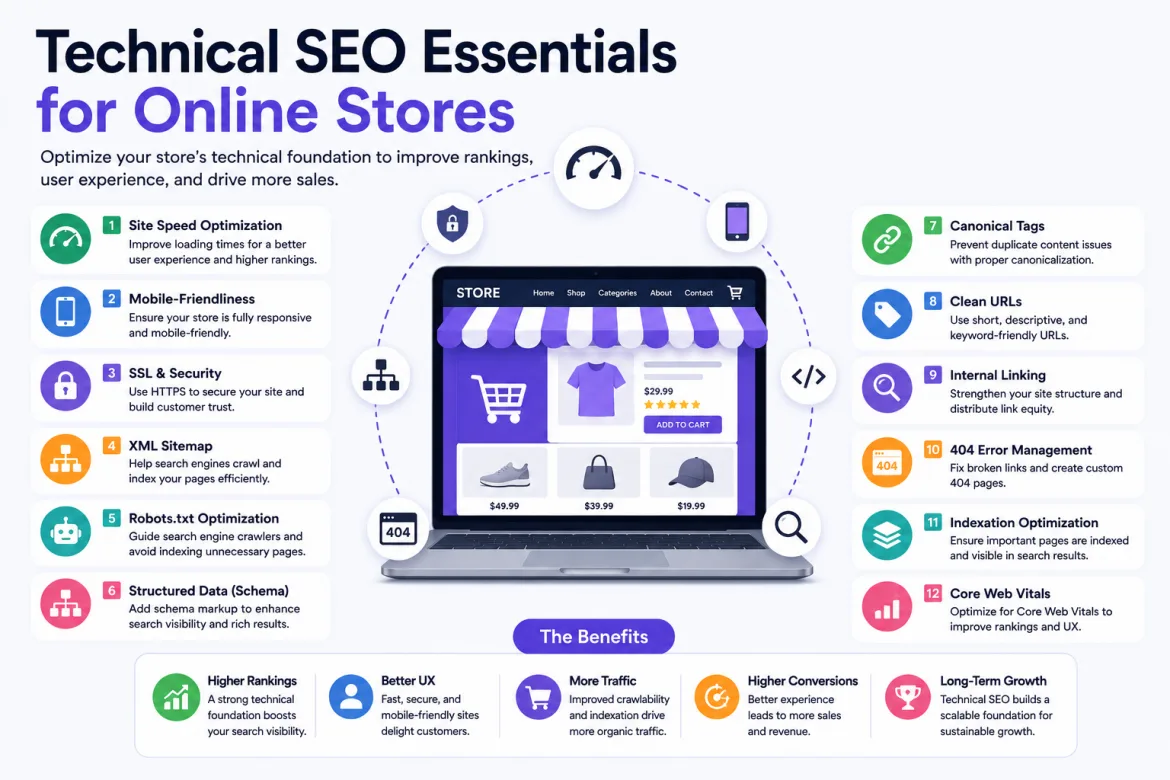
Operating an online store includes much more than simply displaying products and waiting for customers. In today’s highly competitive eCommerce industry, thousands of businesses compete for exposure in search results, thus it’s vital that your website is search engine optimized.
This is where technical SEO becomes crucial. It focuses on establishing a solid basis for your online store, allowing search engines to swiftly examine, evaluate, and rank your content. Website speed, mobile friendliness, site structure, security, structured data, and indexing are all important aspects that directly affect search performance.
Many organizations prioritize content marketing and paid ads above technical SEO, yet even high-quality content may not rank without adequate optimization. A technically sound website enhances both user experience and search visibility, thereby attracting quality traffic and increasing sales. Whether you manage a tiny business or a huge eCommerce platform, knowing technical SEO is critical to long-term success.
Understanding Technical SEO for eCommerce
Technical SEO is the process of enhancing a website’s infrastructure so that search engines can crawl, index, and rank pages more efficiently. Unlike content SEO, which focuses on keywords and content creation, technical SEO is concerned with the functionality and structure of the website.
Technical SEO is particularly important for online shops, who can have hundreds or thousands of pages. Product variations, category pages, filters, sorting options, and dynamic URLs can all result in technical challenges that affect search visibility. Without proper optimization, search engines may devote crawl energy to irrelevant pages while ignoring important product pages.
A well-optimized eCommerce website allows search engines to find products faster and comprehend how pages relate to one another. This enhances the possibility that products will appear in relevant search results when customers hunt for solutions.
Technical SEO makes a big contribution to the user experience. Customers connect with a store in various ways, including faster loading times, safe browsing, easy navigation, and mobile responsiveness. Better user experiences often result in increased engagement, trust, and conversion rates.
Website Speed and Performance Optimization
Website speed is one of the most essential technical SEO considerations for online retailers. Modern customers expect websites to load quickly, and even little delays can lead to missed transactions. According to studies, consumers quit websites that take too long to load.
Search engines also rank results based on page speed. Websites with faster loading times provide better user experiences and are more likely to rank higher in search results. Speed improvements for online companies can have a direct impact on ranking and revenue.
Large product images are typically one of the primary causes of slow eCommerce websites. High-quality images help clients evaluate products, but unoptimized image files can significantly increase page load time. Compressing photographs and using newer formats can help improve efficiency while keeping quality.
Another prevalent concern is the overuse of scripts, plugins, and third-party tools. While these technologies may improve functionality, they can also slow down the website if not correctly maintained. Regular performance audits help discover factors that have a detrimental impact on loading speed and overall site performance.
Creating a Strong Site Architecture
Site architecture refers to how pages are organized and linked on a website. A well-organized structure in eCommerce businesses allows both users and search engines to explore the site more easily, hence enhancing usability and SEO performance.
Typical eCommerce Structure:
- The homepage
- Category pages
- Subcategory pages
- Product pages
This hierarchy helps users discover products while also assisting search engines in understanding the relationship between different sections of your site.
Clear and simple navigation menus are necessary for technical SEO. Users should be able to navigate to crucial pages with a few clicks. Complex navigation can be annoying and raise bounce rates, but a straightforward structure improves engagement and use.
Internal linking strengthens site architecture by connecting related objects, categories, and information. This helps to disperse SEO authority around the website and ensures that search engines correctly recognize and crawl all important pages.
Mobile Optimization for Modern Shoppers
Mobile commerce grows year after year as more consumers shop on their smartphones and tablets. Search engines now favor mobile experiences when evaluating websites, therefore mobile SEO is critical for online stores.
A responsive design guarantees that sites instantly adjust to various screen sizes. Customers should be able to browse products, read descriptions, and complete purchases with ease regardless of the device they use.
Mobile consumers are generally less patient with slow-loading websites. Optimizing pictures, removing extraneous features, and increasing site speed become even more critical for mobile users. Faster mobile experiences lead to increased engagement and conversion rates.
Online retailers should also make sure that their buttons, menus, and forms are user-friendly on smaller displays. Simple checkout processes and clear navigation reduce cart abandonment while increasing overall consumer satisfaction.
Optimizing Crawlability and Indexing
Search engines use automated bots to crawl websites and find content. If these bots meet problems, key pages may never appear in search results. Proper crawlability and indexing are thus essential components of technical SEO.
XML sitemaps assist search engines understand which pages are available on a website. Sitemaps provide a clear roadmap for huge online stores with thousands of products, allowing search engines to quickly identify relevant pages.
The robots.txt file also instructs search engine crawlers. It helps to determine which parts of the website should be crawled and which should be excluded. The proper setting prevents search engines from wasting resources on low-quality pages.
Indexing issues may emerge when pages are incorrectly limited or contain incorrect directives. Regular monitoring of search engine webmaster tools can help identify and resolve indexing issues before they affect rankings.
For additional guidance, refer to Google’s crawling and indexing documentation.
Managing Duplicate Content Issues
Duplicate content is a prevalent issue for eCommerce websites, and it is frequently created by product variations, category filters, and sorting choices that generate many URLs containing similar or identical material. This causes confusion for search engines when determining which version to rank. As a result, ranking signals may become diluted, lowering overall search performance and making it more difficult for key pages to acquire attention.
Common Causes of Duplicated Content:
- Product changes, such as size and color.
- Options for filtering and sorting categories.
- Identical or duplicated product descriptions.
Canonical tags are one of the most effective ways to address duplicate content issues. They help define the preferred version of a page and consolidate ranking authority, allowing search engines to focus on the correct URL.
Another key step is to avoid using duplicate manufacturer descriptions. Writing unique and original product content boosts SEO performance, page relevancy, and user engagement.
For more information, see Google’s documentation on consolidating duplicate URLs.
Structured Data and Rich Results
Structured data allows search engines to better understand page content. It gives online stores more information about products, prices, availability, ratings, and reviews.
When used effectively, structured data can produce rich search results. These upgraded listings frequently include product data immediately in the search results, making them more appealing to potential shoppers.
For example, a product listing that includes price, availability, and customer ratings may get more hits than a conventional search result. This improved visibility can lead to higher click-through rates and more traffic.
Structured data also facilitates communication between websites and search engines. Businesses that provide clear context enhance the likelihood that search engines will correctly comprehend and show their material.
Online stores can also review Google’s structured data guidelines when implementing structured data.
HTTPS and Website Security
Security is a key issue among internet customers. Customers want their personal and payment information to be kept secure throughout the shopping process.
HTTPS encryption enables safe communication between users and websites. HTTPS is recognized as a ranking indication by search engines, which generally prefer secure websites over non-secure alternatives.
An SSL certificate not only secures client data, but it also increases confidence. Many consumers may quit a website if they see browser warnings about security dangers. A secure website instills confidence and encourages transactions.
Security should extend beyond HTTPS. Regular software upgrades, secure payment gateways, and strict password rules all help to protect business operations and consumer data from potential dangers.
Technical SEO Key Factors for Online Stores
- Improved page loading performance across all devices.
- The website design is mobile-friendly and responsive.
- Implemented a proper XML sitemap.
- Use secure HTTPS encryption.
- Effective internal connection approach.
- Improved URL structure and navigation.
These elements combine to improve crawlability, user experience, rankings, and overall website performance. Businesses that constantly focus on these areas tend to earn better long-term SEO outcomes.
URL Structure and Navigation Best Practices
URL structure may appear to be a minor element, yet it is crucial for technical SEO. Clean, descriptive URLs help consumers and search engines understand page content before they view it.
Instead of utilizing convoluted sequences of numbers or symbols, online retailers should establish URLs that properly represent their products and categories. Meaningful URLs boost usability while aiding SEO efforts.
Navigation should be consistent throughout the website. Visitors should always know where they are in the store and how to get back to prior areas. Clear navigation avoids confusion and promotes further investigation.
Breadcrumb navigation is very useful for eCommerce sites. It helps consumers understand their position in the site hierarchy while also giving more internal linking opportunities for search engines.
Core Web Vitals and User Experience
Core Web Vitals are increasingly being used by search engines to emphasize user experience data. These measures assess loading performance, interaction, and visual stability.
A page that loads rapidly yet shifts unexpectedly when users interact with it can be frustrating. Improving visual stability promotes better surfing experiences and higher user satisfaction.
Interactive elements, such as buttons and menus, should respond promptly to user input. Delays can lower engagement and conversions, particularly on product and checkout pages.
Optimizing Core Web Vitals helps online retailers improve both SEO performance and customer pleasure. Businesses that provide a smooth browsing experience frequently notice increases in engagement and sales.
Common Technical SEO Mistakes Online Stores Should Avoid
Many eCommerce organizations unintentionally commit technical SEO blunders that reduce their search visibility and revenue potential. These issues are commonly overlooked, yet they can have a substantial impact on rankings, traffic, and overall website performance.
Some of the most typical mistakes are:
- Large image files can cause slow page loading times.
- Navigational difficulties and broken internal linkages.
- Missing or inaccurate canonical tags.
- Poor mobile optimization.
- Improper redirection management.
Although these issues may appear small on their own, when combined, they can have a substantial impact on rankings, user experience, and overall website performance. Regular technical audits assist in identifying and resolving these issues before they become major hurdles.
The Future of Technical SEO for Online Stores
Technical SEO evolves as search engines get more complex. Future success will be based on delivering exceptional user experiences while retaining solid technical foundations.
Artificial intelligence is already affecting how search engines evaluate content and user intent. To stay competitive in ever-changing search environments, online shops will need more structured, organized, and accessible websites.
Voice searches and conversational questions are becoming increasingly common. Websites with clear frameworks and well-organized content will be better able to capitalize on these developments.
As mobile commerce grows, performance optimization will be a primary priority. Businesses who invest in fast, secure, and user-friendly websites now will be better prepared for future search engine updates and changing client expectations.
Conclusion
Technical SEO is the foundation of any successful online store. While content, goods, and marketing campaigns are crucial, they cannot achieve their full potential without a well-optimized technological foundation. Focusing on website performance, mobile usability, crawlability, structured data, security, and site layout improves both search visibility and user experience, frequently resulting in higher ranks, more organic traffic, and higher conversions.
Technical SEO is a continuous process that requires constant monitoring, audits, and upgrades to keep up with changing search engine algorithms. For online businesses looking for long-term growth, investing in technical SEO boosts website performance, improves navigation, and promotes sustained commercial success.