

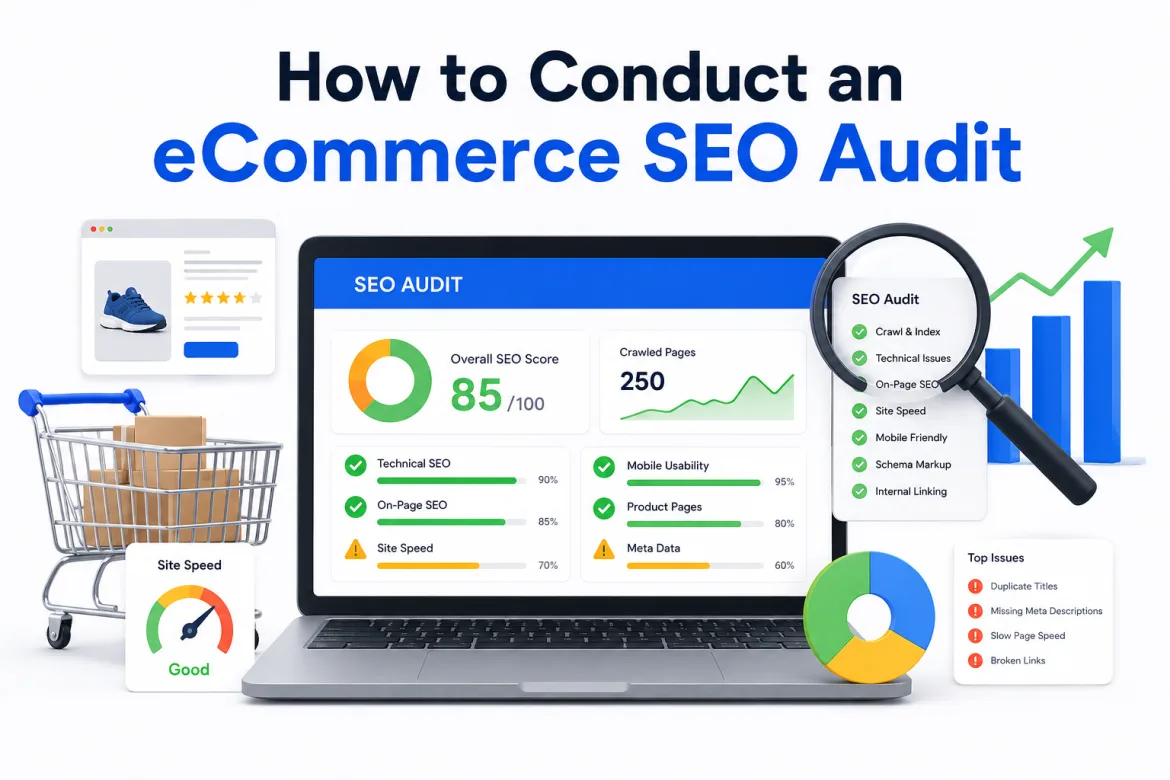
Operating an eCommerce business nowadays is more competitive than ever. Thousands of online stores vie for visibility in search engines, making it challenging for businesses to attract quality visitors and grow sales. While many store owners invest in SEO methods, they frequently overlook one key step that ensures long-term success: undertaking a full eCommerce SEO audit.
An eCommerce SEO audit is a thorough analysis of your online store’s search engine performance. It identifies technical flaws, content gaps, keyword opportunities, user experience issues, and other variables that may hinder your website from ranking better in search results. Without frequent audits, even well-designed online stores can lose significant traffic and revenue over time.
Consider an SEO audit to be your website’s health checkup. Online stores, like businesses, should examine their SEO health on a regular basis. A structured audit can assist identify underlying issues, prioritize improvements, and develop a strategy for long-term organic growth.
What Is an eCommerce SEO Audit?
An eCommerce SEO audit is a thorough examination of all SEO factors influencing an online store’s visibility in search engines. The purpose is to discover strengths, problems, and possibilities for increasing rankings, traffic, and conversions. Unlike a traditional website audit, an eCommerce SEO audit focuses on product pages, category pages, site structure, and large-scale content management.
Online retailers can have hundreds or even thousands of pages. Product listings, category pages, filters, navigation systems, and dynamic URLs all present distinct SEO issues. An audit ensures that search engines can crawl, index, and interpret these pages while maintaining a favorable user experience.
The method usually includes technical SEO, on-page optimization, content quality, keyword targeting, site architecture, internal linking, mobile performance, and backlink profiles. Each area contributes to overall search visibility and should be thoroughly analyzed.
Businesses that do frequent SEO audits can react swiftly to ranking decreases, algorithm modifications, shifting customer behavior, and new market opportunities. This proactive approach often results in a considerable competitive advantage.
Why SEO Audits Are Important for eCommerce Stores
Search engines are continually updating their ranking algorithms to give people with improved search experiences. Websites that do not adjust to these updates may see falling rankings and organic visitors. Regular SEO audits help firms stay on track with best practices and sustain visibility.
An audit may discover issues such as broken links, duplicate content, slow-loading pages, missing information, poor mobile usability, and indexing concerns. These concerns may appear minor on their own, but when combined, they can have a major impact on rankings and user engagement.
Every ranking improvement for eCommerce organizations might result in more income. When product and category sites rank higher, they attract more qualified buyers who are already looking for similar items. This generally leads to higher conversion rates than other marketing strategies.
SEO audits also help with decision-making. Rather than guessing which upgrades to prioritize, business managers can use data-driven insights to better allocate resources and maximize SEO results.
Step 1: Analyze Website Indexing and Crawlability
The first step in an eCommerce SEO audit is verifying that search engines can correctly crawl and index your website. If essential pages cannot be viewed or indexed, they have a low likelihood of appearing in search results.
Begin by reviewing the indexed pages in search engines. Compare the amount of indexed pages to the total number of valuable pages on your site. Significant variances could suggest crawl difficulties, duplicate pages, or indexing errors.
Examine your robots.txt file and XML sitemap to confirm they are properly configured. Important product and category pages should be easily accessible, however unneeded pages like internal search results or duplicate filter pages may require limits.
Large eCommerce companies frequently suffer with creep budget control. When search engines spend too much time crawling low-value pages, essential pages may get less attention. Identifying and correcting crawl inefficiencies can increase overall site visibility.
For additional guidance on eCommerce crawling, indexing, site structure, and SEO best practices, see Google Search Central’s eCommerce SEO Best Practices.
Step 2: Review Technical SEO Performance
Technical SEO is the core of any successful eCommerce website. Even high-quality content may struggle to rank if technological issues keep search engines from correctly recognizing the site.
Check the website’s speed on desktop and mobile devices. Slow-loading pages can have a detrimental impact on both the user experience and search rankings. Product pages that include huge pictures, scripts, and third-party integrations are major speed bottlenecks.
Examine HTTPS implementation throughout the website. Secure browsing is critical to customer trust and search engine rankings. All pages should load securely and without mixed-content warnings.
Step 3: Evaluate Site Architecture and Navigation
A well-structured website allows both visitors and search engines to rapidly access essential material. Poor navigation can result in less engagement, lower rankings, and missed conversion opportunities.
The organization of categories, subcategories, and product pages should be organized in a logical hierarchy. This configuration should match how customers typically browse and search for products in your store.
- Make crucial pages easily accessible from the homepage.
- Avoid deep page architectures that hinder crawl efficiency.
- Organize categories depending on user shopping habits.
- Improve internal linking with structured navigation.
Clear menus, breadcrumbs, and category systems enhance the user experience while also assisting search engines in understanding site relationships, resulting in improved indexing and visibility.
Step 4: Audit Keyword Targeting
Keyword research is a key component of any eCommerce SEO audit. Search behavior evolves over time, so businesses must continually ensure that their pages target relevant and high-performing search phrases. This helps to keep visibility in competitive search results.
Review category pages first, as these frequently produce significant organic traffic. Ensure that primary keywords match customer search intent and appropriately describe the products being sold. This increases both ranking and user relevance.
Next, check the product pages for keyword relevancy. Product descriptions, titles, headings, and metadata should organically incorporate target search terms while avoiding unnecessary duplication. This enables better indexing and higher click-through rates.
Step 5: Review On-Page SEO Elements
On-page SEO allows search engines to grasp each page’s content, structure, and relevancy. Proper optimization guarantees that all critical pages comply with SEO best practices and user intent.
- Ensure title tags are clear, keyword-focused, and click-worthy.
- Meta descriptions should showcase page value and drive clicks.
- Headings (H1, H2, H3) must have a clear hierarchical structure.
- Optimize images with informative alt text for better accessibility and SEO.
Consistent optimization of key on-page features increases search visibility, user experience, and overall website performance.
Step 6: Analyze Product Page Optimization
Product pages are the most valuable revenue-generating assets on any eCommerce website. During an SEO audit, they should be thoroughly examined to verify that they are adequately optimized for both search engines and users. Strong product pages have a direct impact on visibility and conversion rates.
Assess product descriptions for novelty, clarity, and quality. Many websites employ manufacturer-provided material, which can result in duplicate content issues and poor search performance. Writing creative descriptions increases both relevancy and SEO value.
Examine important details such as product photos, specifications, FAQs, reviews, and structured data. Rich, thorough product pages tend to rank higher in search results and help clients make informed purchasing decisions.
For more information about product structured data and how it can help search engines understand product information, see Google’s Product Structured Data documentation.
Step 7: Assess Category Page Performance
Category pages frequently rank for high-volume commercial keywords, serving as significant traffic sources for eCommerce websites. They play an important function in connecting users to appropriate product collections. Proper optimization can greatly increase visibility and sales.
Examine the category page content to ensure that it gives context beyond product lists. Including short opening text helps search engines better understand the page’s topic. It also boosts the relevance of chosen keywords.
Check your filtering and sorting choices carefully, as dynamic parameters can cause duplicate content or indexing issues. Proper treatment of these items results in cleaner URLs and improved crawl efficiency.
Step 8: Examine Content Quality and Relevance
Content is critical for boosting organic traffic and supporting the complete consumer experience. A thorough SEO audit should look at both informational and commercial material to verify it fits user needs and search intent.
- Review blogs, guidelines, FAQs, and comparison pages.
- Update outdated content.
- Identify and fill content gaps.
- Increase readability and usefulness.
High-quality, relevant content boosts results while also increasing trust, topical authority, and long-term organic visibility.
Step 9: Evaluate Internal Linking Structure
Internal linking is a frequently overlooked feature of eCommerce SEO. A good internal linking strategy distributes authority throughout the website and increases content discoverability.
Check the links between category pages, product pages, blog entries, and informational resources. Relevant links should assist visitors naturally through the purchasing process.
Check for orphan pages that have little or no internal link support. These pages frequently fail to obtain notice, despite the fact that they provide significant content.
Use descriptive anchor text to provide context to both users and search engines. Generic phrases like “click here” provide little SEO benefit.
A well-designed internal linking structure can boost crawl efficiency, subject relevance, and page authority distribution.
Step 10: Analyze Mobile SEO Performance
Mobile commerce continues to develop rapidly, making mobile optimization critical to eCommerce success. A seamless mobile experience has a direct impact on user pleasure, engagement, and conversions.
Examine website responsiveness across various screen sizes and devices. Pages should be displayed accurately and fully functional independent of device kind. Consistent design allows consumers to navigate without errors or layout concerns.
Search engines typically index and rank mobile versions of webpages. This means that mobile performance significantly influences total SEO visibility and organic traffic. Poor optimization might lead to a large drop in search ranks.
Step 11: Review Backlink Profile and Authority
Backlinks are an important ranking element since they communicate trust, authority, and trustworthiness to search engines. A healthy backlink profile enhances search visibility and overall SEO effectiveness. Websites with quality backlinks tend to rank higher in competitive search results.
Evaluate the quality, relevancy, and diversity of websites that link to your store. High-quality backlinks from reputable and niche-relevant sources have a much higher SEO value than a huge number of low-quality connections. This promotes long-term ranking growth.
Identify potentially hazardous or spammy backlinks that may have a negative impact on your search results. Removing or disavowing poisonous links will assist protect your website’s authority and ensure long-term ranking stability. Regular monitoring is critical for SEO success.
Key Factors for a Successful eCommerce SEO Audit
Several factors influence whether an SEO audit yields useful findings.
- Reliable SEO tools provide accurate data collection.
- Comprehensive technical analysis.
- Strong emphasis on user experience.
- Regular auditing schedule.
- Clear prioritizing of concerns.
- Alignment with corporate goals.
- Continuous performance monitoring.
Businesses that treat audits as continuing procedures rather than one-time projects tend to have better long-term SEO results.
Common Mistakes During an eCommerce SEO Audit
Many firms conduct audits but fail to achieve real improvements due to typical errors.
- Prioritizing ranking over revenue impact.
- Ignoring technical SEO concerns.
- Neglecting category page optimization.
- Neglecting the mobile user experience.
- Inadequate audit frequency.
Avoiding these issues can boost SEO efficacy and yield measurable business outcomes.
The Future of eCommerce SEO Audits
As search technology advances, SEO audits will get more sophisticated. Artificial intelligence, machine learning, and user behavior monitoring are already influencing how search engines rank websites. These innovations make audits more data-driven and precise.
Future audits will most likely prioritize user experience, content quality, entity-based search, and consumer intent over traditional keyword-focused optimization alone. This move assures that relevance and satisfaction become the primary ranking signals.
Voice search, visual search, and AI-powered search experiences may all result in new evaluation criteria. Businesses that respond quickly to these developments will be better positioned to maintain high exposure in competitive markets.
Conclusion
Conducting an eCommerce SEO audit is one of the most beneficial actions that an online firm can undertake. It gives a comprehensive picture of technical performance, content effectiveness, keyword potential, user experience issues, and overall search exposure. Businesses can lay a solid foundation for long-term organic growth by rigorously identifying and correcting problems.
SEO is not a one-time project, but a continuous process of progress. Regular audits help online retailers stay competitive, react to changing search patterns, and increase their capacity to attract eligible customers. When done consistently and properly, an eCommerce SEO audit may be an effective tool for increasing traffic, conversions, and income.