

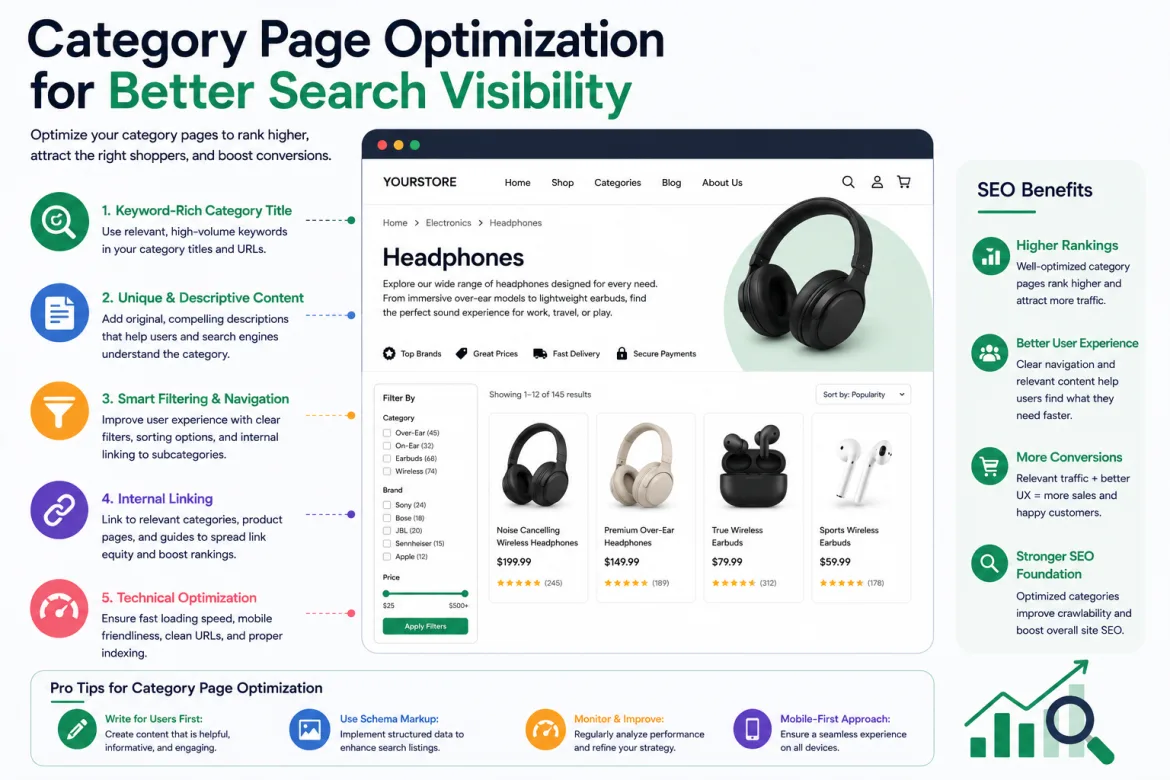
Category pages are among the most significant assets on any eCommerce website. While many firms prioritize product pages and blog content, category pages frequently have a higher potential for organic traffic because they target broader search phrases with higher search volume. They serve as a link between users looking for products and the exact things accessible in the store.
A well-optimized category site helps search engines understand the variety of products within a category while also making it easier for customers to discover relevant options. When properly structured, these pages can rank for competitive keywords, improve site navigation, and help users make purchasing decisions. Search engines frequently prefer category sites for commercial inquiries because they meet a broader search purpose.
Many online stores disregard category page SEO, expecting that product pages alone will drive rankings. However, investing in category SEO can result in more organic traffic, improved user engagement, and higher conversions. Category pages can be effective long-term growth drivers by combining good content, technical SEO, user-friendly navigation, and keyword optimization.
Understanding the Role of Category Pages in SEO
Category pages act as organizing hubs for eCommerce websites. They group related products together, allowing consumers and search engines to better comprehend the website’s structure. Rather than leading visitors to a single product, category pages provide various possibilities based on their search intent.
For example, a consumer searching for “running shoes” may not be sure which product they want. A category site featuring several running shoes from different companies is a better experience than a single product page since it provides options and allows for comparison. Search engines understand this value and frequently rank category sites for broad business keywords.
Category pages also improve website architecture by dispersing authority across the site. Internal links from category pages help search engines find and index product pages more efficiently. This enhances crawlability and leads to better overall SEO performance.
Category pages help businesses improve both customer experience and revenue growth. They direct visitors deeper into the website, boosting the chances of product discovery. As a result, improving these pages can have a big impact on both search visibility and revenues.
Conduct Thorough Keyword Research
Keyword research is the foundation of successful category page optimization. Understanding what people search for enables firms to connect their category pages with actual search demand. Instead of targeting random keywords, category sites should focus on terms that are relevant to user intent and product offerings.
Search terms for category sites are frequently broader than product-specific keywords. For example, users may search for “wireless headphones” rather than a specific headphone model. These broader phrases usually have a larger search traffic and attract consumers who are still considering their alternatives.
Businesses should identify primary, secondary, and associated search phrases that are relevant to their respective categories. This method facilitates the creation of content that naturally addresses various search queries while avoiding keyword stuffing. The idea is to provide comprehensive relevancy rather than overusing the same phrase.
Keyword research should take into account customer behavior trends and seasonal demand. Monitoring search patterns might reveal chances to update category pages with new content, goods, or keyword goals that are relevant to changing market trends.
Create Unique and Valuable Category Page Content
One of the most common mistakes organizations make is leaving category pages with little to no information. Search engines require strong textual context to comprehend the purpose and relevance of a page; without it, category pages frequently fail to rank for competitive search phrases. Effective category page text should describe the products available, their benefits, and the main points to consider before making a purchase.
The content should be instructive rather than promotional, with a focus on answering frequently asked issues and providing useful insights. This technique enhances the user experience while enhancing the likelihood of ranking for both informational and commercial search inquiries. Businesses should also strike a balance between content and usability, employing concise introductions and ordered layouts to prevent overloading users.
- Clearly communicate product availability and significant benefits.
- Include considerations to consider before purchasing.
- Provide informative content rather than just promotions.
- Use brief text with organized or expandable parts.
Well-optimized category content enhances search visibility, user engagement, and overall eCommerce performance.
Optimize Category Page Titles and Meta Descriptions
Title tags and meta descriptions remain significant ranking and click-through criteria. They give search engines and users an overview of the page’s content and purpose. Well-written metadata can boost visibility and increase clicks from search results.
Category page titles should include the major keyword while staying concise and engaging. They should provide accurate descriptions of the products offered in the category. Avoid titles that are too generic and fail to distinguish the page from competitors.
Meta descriptions should give a short summary of the category while emphasizing its unique selling characteristics. Although meta descriptions may not have a direct impact on rankings, they can greatly increase click-through rates by enticing visitors to visit the page.
Regularly reviewing metadata performance can help identify areas for improvement. Testing various messaging tactics may assist to enhance organic traffic and engagement over time. Businesses can monitor search performance and analyze search queries using Google Search Console.
Improve Internal Linking Structure
Internal linking is an important aspect of category page SEO since it allows search engines to understand how different sites are related. It also distributes authority throughout the website, which boosts overall SEO performance.
A well-planned internal linking structure simplifies navigation for consumers by connecting relevant pages in a logical order. This enhances both discoverability and user experience, encouraging visitors to try out more products.
- Connect category sites with subcategories and related categories.
- Include links to top-selling products.
- Link important informational content and guides.
- Develop a clear and logical navigation structure.
Strong internal linking increases crawlability, user engagement, and supports higher ranks for your eCommerce store.
Enhance User Experience and Navigation
Users’ experiences have a direct impact on SEO performance. Search engines are progressively prioritizing websites that offer visitors a smooth, intuitive experience. Category pages should be built so that users may quickly find the products they require.
Clear navigation menus, filtering options, and sorting capabilities enhance usability. Customers should be able to narrow their product choices based on price, brand, size, color, and other relevant factors. This lowers friction and improves the overall purchasing experience.
Mobile usability is also vital because a large amount of internet shopping now takes place on mobile devices. Category pages should load quickly, look good on smaller devices, and have touch-friendly navigation.
An effective user experience not only benefits SEO but also boosts customer satisfaction. When visitors can quickly traverse a category page, they are more likely to stay on the site and look at other products.
Optimize Images and Visual Elements
Images are crucial components of category sites since they allow users to swiftly evaluate products. However, improperly optimized photos can have a severe influence on site speed and search performance.
Businesses should utilize high-quality photographs that effectively depict their products while maintaining file size optimization. Compressed photos contribute to faster download times without sacrificing visual quality.
Image alt text adds context to search engines and enhances accessibility for users with disabilities. Descriptive alt text can also help images stand out in search results.
Visual uniformity across category pages gives a more professional image and promotes the business identity. A consistent visual experience can boost trust and promote deeper engagement with the website. Businesses can check page performance and loading speed using Google PageSpeed Insights.
Key Factors That Influence Category Page Rankings
Several critical SEO and user experience elements influence category page rankings, combining to improve visibility and performance. When properly optimized, these aspects assist search engines better understand the page while also allowing people to easily find and explore relevant products.
- Effective keyword targeting linked with user intent.
- Contextualized and unique content.
- Fast page loading on all devices.
- Effective internal linking and navigation structure.
- Use high-quality photos with detailed alt text.
When these elements are effectively executed, category pages are more likely to rank higher in search results, attract quality traffic, and provide a better overall user experience.
Common Category Page SEO Mistakes
Many organizations unwittingly degrade the effectiveness of their category pages by committing typical SEO blunders that impair visibility, user experience, and ranking. Avoiding these difficulties is critical for optimizing search results and increasing organic traffic.
- Use duplicate content on several category pages.
- Creating thin pages with minimal descriptive content.
- Neglecting page speed optimization.
- Unnatural use of keywords.
- Failure to optimize metadata.
These flaws can lower rankings, impair user engagement, and limit organic traffic potential. Regular SEO audits can assist discover and solve these issues before they have a substantial impact on performance.
The Future of Category Page Optimization
Search engines continue to change, with a greater emphasis on user experience, relevancy, and content quality. To stay effective, category page optimization tactics must evolve in response to these changes.
Artificial intelligence influences how search engines read information and human intent. Future category pages will need to include more contextual information while remaining organized and usable. Businesses that focus on actually assisting customers will be better positioned for long-term growth.
Personalization is becoming increasingly crucial. As technology progresses, category pages may dynamically display products and content in response to user behavior, preferences, and search history. This can increase engagement and conversion rates while also providing more relevant purchasing experiences.
Voice search and conversational search trends are altering how users engage with search engines. Category pages tailored for natural language inquiries may gain visibility as these technologies become more frequently used.
Businesses should treat category page optimization as a continuous effort rather than a one-time project. Maintaining excellent search performance in an ever-changing digital market will require continuous improvement, testing, and adaptability.
Conclusion
Category page optimization is one of the most effective strategies for increasing search exposure, attracting qualified traffic, and improving the overall shopping experience. These pages frequently target valuable commercial keywords, connecting businesses to potential clients who are actively looking for products. Keyword research, high-quality content, technical optimization, internal linking, and user-centered design are all necessary for successful category page SEO. When all of these characteristics are properly integrated, category pages can please both search engines and users.
Businesses that focus category page SEO can enhance their rankings, engagement, and conversions. Category pages should not be treated as mere product listings, but rather as strategic assets for long-term growth. As search algorithms evolve, the importance of well-optimized category pages will only grow, allowing businesses to have a better online presence and remain competitive in the future.