

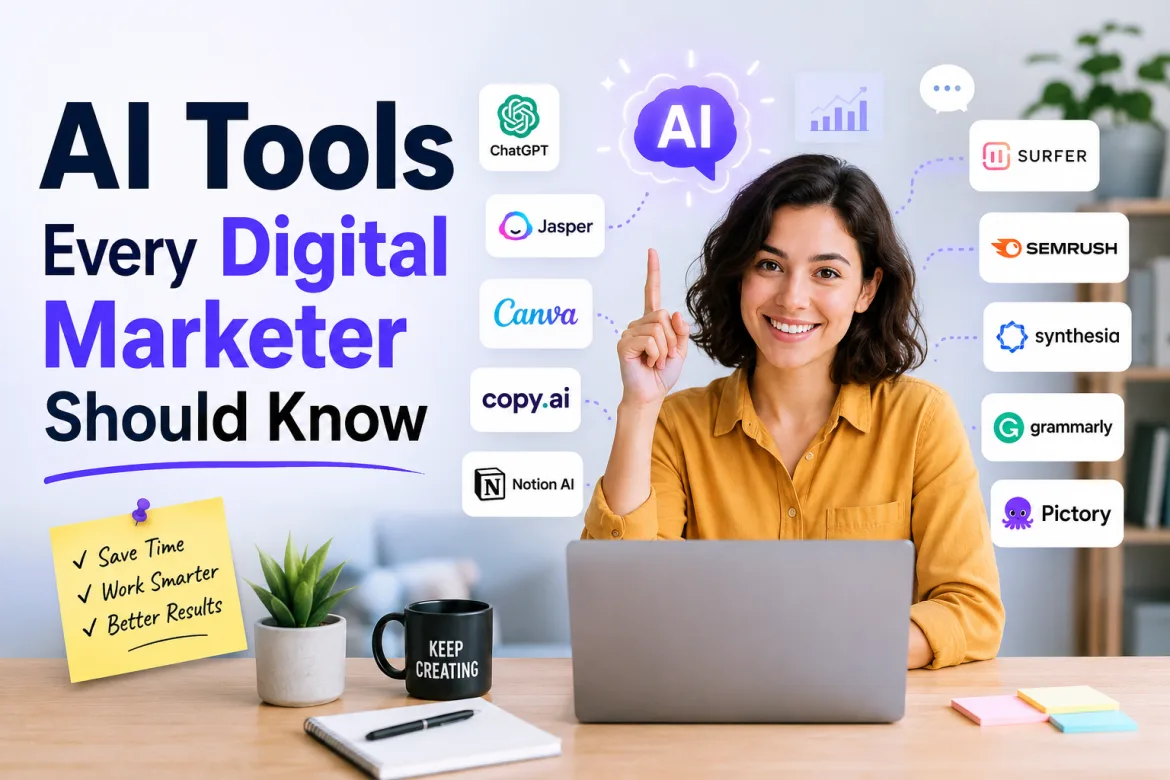
Artificial intelligence (AI) is no longer a future concept limited to huge technological businesses. Today, it is an integral component of modern digital marketing. Businesses of all sizes are utilizing AI-powered solutions to increase efficiency, develop better content, study customer behavior, and make more informed marketing decisions. As competition increases across digital channels, marketers who effectively use AI can gain a considerable advantage.
The development of AI has altered the way marketing teams operate. Tasks that once needed hours of human labor can now be completed in minutes. AI tools assist marketers in saving time while enhancing results in areas such as content production, SEO optimization, customer assistance, and data analysis. However, with hundreds of AI solutions on the market, it can be difficult to determine which technologies actually bring value.
This tutorial looks at some of the most critical AI tools that every digital marketer should be familiar with. Understanding these tools, whether you are a business owner, marketing manager, or digital marketing specialist, can help you increase productivity, improve customer experiences, and drive better business outcomes.
Why AI Has Become Essential for Digital Marketing
Every day, massive amounts of data are generated through digital marketing. Customer interactions, website visits, social media participation, email marketing, and search activity all generate useful data. Manually analyzing this data might take a long time and is often impracticable.
AI enables marketers to process enormous datasets fast and uncover trends that might otherwise go unreported. It can forecast customer preferences, automate tedious operations, personalize user experiences, and provide insights to help make better decisions. As a result, marketers may concentrate on strategy and creativity rather of spending too much time on operational tasks.
Some of the most significant advantages of employing AI in digital marketing are:
- Accelerated content production and campaign execution.
- Improved client targeting and segmentation.
- Improved customization across marketing channels.
- Data-driven decision-making.
- Improved productivity and reduced manual workload.
- Enhanced customer experience and engagement.
- Improved accuracy in performance tracking and reporting.
Businesses that use AI into their marketing processes frequently report increased efficiency, higher engagement rates, and greater returns on marketing investments.
AI Content Creation Tools
Content is still one of the most crucial aspects of digital marketing. Blogs, website pages, email campaigns, social media posts, and ad copy all demand regular content creation. AI content creation tools assist marketers in developing ideas, drafting material, and improving writing quality.
ChatGPT is one of the most popular artificial intelligence writing tools. Marketers utilize it to come up with blog themes, write articles, create email campaigns, generate social media content, and design marketing plans. It can drastically cut the time needed to complete initial drafts while retaining quality and relevance.
Other content-focused AI solutions, such as Jasper and Copy.ai, are explicitly built for marketing purposes. These systems offer templates for commercials, landing pages, product descriptions, and marketing emails. They enable firms to generate marketing material faster while retaining a consistent brand voice.
Although AI can speed up content creation, human assessment remains critical. Marketers must constantly refine AI-generated content to ensure accuracy, uniqueness, and alignment with company objectives.
AI Tools for Search Engine Optimization (SEO)
SEO is still one of the most successful strategies to acquire organic visitors, but it requires ongoing research, tweaking, and monitoring. AI-powered SEO tools enable marketers to expedite these procedures and make better optimization decisions.
Surfer SEO and Frase are two tools that scan top-ranking pages and make actionable recommendations to improve content quality. They assist marketers in determining keyword placement, content depth, search intent, and competitor strategies.
AI SEO tools are very beneficial for:
- Conducted keyword research and identified opportunities.
- Recommendations for content optimization.
- Competitor analysis.
- Content planning and topic clustering.
- Analyzing user search intent.
- Conduct SEO audits and provide technical recommendations.
- Identify content gaps.
Rather than relying entirely on manual research, marketers can leverage AI insights to create more successful SEO tactics and increase their chances of ranking better in search results.
AI Tools for Social Media Marketing
To manage social media effectively, you must create consistent content, engage your audience, and analyze your performance. AI-powered technologies enable marketers to manage these obligations more efficiently while maintaining a strong online presence.
Platforms like Predis.ai, Buffer AI, and Hootsuite provide capabilities that make social media management easier. These tools may generate content ideas, write captions, suggest hashtags, schedule posts, and track audience participation.
Key advantages of AI social media platforms are:
- Faster content planning and scheduling.
- AI-generated captions and post suggestions.
- Audience behavior analysis.
- Provide hashtag and trend recommendations.
- Automated posting workflows.
- Performance tracking and reporting.
- Improved content consistency.
Businesses that use AI can spend less time managing regular processes and more time developing meaningful interactions with their customers.
AI Tools for Graphic Design and Creative Content
Digital marketing relies heavily on visual content. Businesses require photos, infographics, ads, presentations, and social media graphics to properly engage consumers. AI-powered design tools make visual content production faster and easier.
Canva AI is a popular choice among marketers since it streamlines creative work while providing professional-quality templates. Users may produce graphics, presentations, social media visuals, and marketing materials with little design knowledge.
AI image-generation solutions, such as Midjourney and Adobe Firefly, enable marketers to generate bespoke graphics based on text input. These tools enable firms to create distinctive creative materials without relying solely on traditional design procedures.
For small organizations with limited design resources, AI-powered creative tools can boost productivity while lowering expenses.
AI Tools for Email Marketing
Email marketing remains one of the most effective digital marketing platforms in terms of ROI. AI improves email marketing by allowing firms to send more targeted and tailored communications.
Modern email marketing platforms utilize artificial intelligence to evaluate client behavior and automatically optimize campaigns. These technologies can suggest subject lines, estimate the optimum times to send, and segment subscribers based on their interests and interaction history.
AI-powered email marketing features include:
- Provide personalized email content recommendations.
- Smart audience segmentation.
- Analyzing client behavior predictively.
- Optimizing subject lines.
- Optimizing send times.
- Automated customer journeys.
- Insights for conversion-focused campaigns.
These capabilities enable marketers to improve open rates, click-through rates, and overall campaign performance while providing better customer experiences.
AI Tools for Customer Support and Chatbots
Customer experience has become a critical competitive aspect in digital marketing, and AI-powered chatbots are changing the way firms manage support. These solutions respond instantly to consumer inquiries while decreasing the pressure on human support teams, making service faster and more efficient.
AI systems such as Intercom, Drift, and other chatbot solutions may answer frequently asked questions, assist consumers in making product or service decisions, and collect vital lead data. They are available 24 hours a day, seven days a week, regardless of time zone or business hours.
- Offer immediate customer help without human intervention.
- Assist users with buying decisions and product selection.
- Automatically capture leads and customer data during discussions.
- Improve engagement by interacting with website visitors in real-time.
As conversational AI evolves, chatbots become more powerful and capable of handling complicated conversations while maintaining a seamless and good user experience.
AI Tools for Marketing Analytics and Data Insights
One of AI’s most significant uses is the ability to convert raw data into meaningful insights. AI-powered analytics technologies can help marketing teams better evaluate their performance and uncover growth prospects.
AI is used by platforms such as Google Analytics, HubSpot, and advanced business intelligence solutions to identify trends, anticipate outcomes, and make real-time suggestions.
AI analytics technologies assist marketers:
- Understand customer journeys.
- Assess campaign effectiveness.
- Predict future marketing trends.
- Identify top performing channels.
- Optimize marketing budgets.
- Improve conversion rates.
- Identify audience behavior trends.
Instead of spending hours manually examining data, marketers may instantly gain actionable insights to help them make better business decisions.
Key Factors to Consider When Choosing AI Marketing Tools
With hundreds of AI solutions available, choosing the appropriate one might be difficult. Businesses should prioritize solutions that correspond with their specific goals over merely embracing the latest technology trends.
Before you invest in an AI marketing platform, consider:
- Define business goals and objectives.
- Ease of implementation.
- User-friendly interface.
- Integration capabilities.
- Scalability for future expansion.
- Ensuring data security and privacy compliance.
- Available customer help.
- Estimated pricing and ROI.
- Reporting and analytics features.
- Team training required.
The finest AI technologies address individual business needs rather than merely following industry trends. A deliberate approach ensures that technological investments yield significant returns.
The Future of AI in Digital Marketing
AI technology is continuously evolving, and its impact on marketing will only grow in the next years. Future AI systems will provide greater personalization, more precise predictive analytics, advanced automation, and better customer interactions. As tools become more intelligent, firms will be able to make more timely and data-driven marketing decisions.
Marketers who adopt AI early will be better able to adapt to shifting consumer expectations and market circumstances. Human ingenuity, strategic thought, and emotional understanding will continue to be required for successful marketing. AI should be considered as a valuable tool rather than a complete replacement for human skill.
At the same time, AI will play an important role in content generation, consumer segmentation, campaign optimization, and real-time performance monitoring. This would enable marketers to concentrate on strategy and innovation while automation performs repetitive jobs.
The mix of human understanding and AI-driven efficiency is likely to shape the future of digital marketing success. Businesses that mix the two will have a significant competitive advantage in an increasingly digital and automated world.
Conclusion
AI has become a crucial component of modern digital marketing. From content production and SEO optimization to customer assistance and analytics, AI tools enable businesses to work smarter, more efficiently, and with better outcomes. Organizations who understand how to properly apply these technologies can gain a major competitive advantage in an increasingly digital economy.
The trick is to choose tools that are aligned with your business goals and marketing approach, rather than adopting every available AI solution. By incorporating the correct AI tools into their daily operations, marketers can save time, improve customer experiences, and focus on high-value strategic objectives. As AI advances, keeping up with the most beneficial technologies will be important for long-term marketing success.