

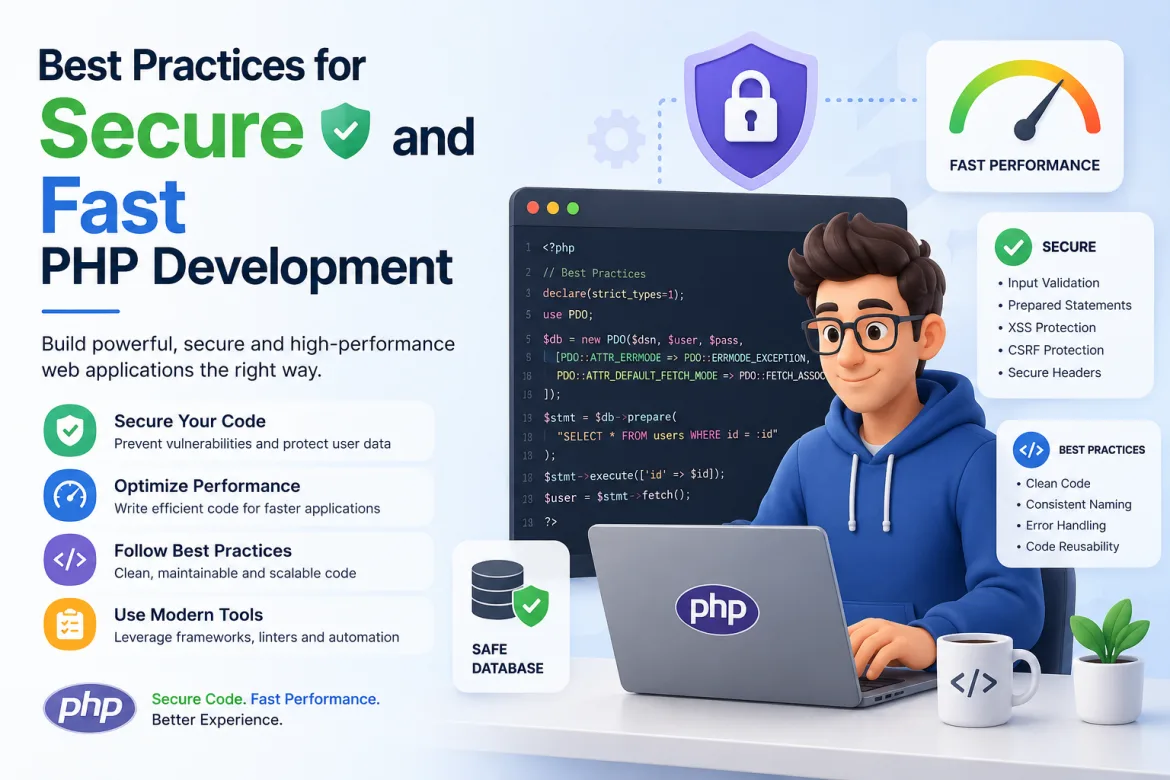
PHP continues to remain one of the most reliable backend technologies in 2026 because of its flexibility, scalability, and affordability. Businesses use PHP for SaaS platforms, eCommerce websites, enterprise portals, and custom business applications. Modern frameworks like Laravel and Symfony make development faster, more secure, and cloud-ready. Its large ecosystem and community support also help businesses scale applications efficiently.
PHP remains one of the most dependable backend technologies in 2026 due to its versatility, scalability, and cost. Businesses utilize PHP to build SaaS systems, eCommerce websites, enterprise portals, and custom business apps. Modern frameworks, like as Laravel and Symfony, accelerate development while also making it more secure and cloud-ready. Its extensive ecosystem and community support also enable organizations to scale apps easily.
Businesses should use PHP programming practices that allow for long-term scalability and easy maintenance. Choosing the correct development partner ensures optimal architecture, cybersecurity compliance, and seamless interfaces. Continuous updates, automated testing, and DevOps approaches help to increase application stability and speed. Companies that adhere to modern PHP best practices can create secure and high-performing digital solutions for future growth.
Why Secure and Fast PHP Development Matters in 2026
Modern businesses operate in a highly competitive digital environment where speed and security affect customer happiness, operational efficiency, and revenue development. A slow website or unsecure application can result in negative user experiences, compliance concerns, financial losses, and a tarnished company reputation.
Performance has become an important ranking criteria for search engines and a key factor in client retention. Research regularly demonstrates that users quit websites and programs that take too long to load. In areas such as eCommerce, healthcare, finance, and SaaS, a few seconds of delay can drastically affect conversion rates.
At the same time, cyber risks have advanced. Businesses are more vulnerable to ransomware attacks, SQL injections, data breaches, API vulnerabilities, and cloud security misconfigurations. Secure PHP development enables enterprises to avoid these risks while preserving customer trust and regulatory compliance. Developers can refer to the OWASP Top 10 security risks to understand common web application vulnerabilities.
In 2026, secure and rapid development is more than just a technical prerequisite. This is a business strategy.
Understanding Modern PHP Development
PHP has evolved tremendously in recent years. Modern frameworks, cloud-native development approaches, AI integrations, and DevOps automation have converted PHP into a powerful enterprise technology stack.
Today’s PHP development focuses on:
- Performance optimization
- API-first architecture
- Secure coding standards
- Cloud deployment
- AI integration capabilities
- Scalable microservices
- Automated testing and CI/CD pipelines
- Real-time analytics and monitoring
At the same time, cyber dangers have increased. Businesses are increasingly vulnerable to ransomware attacks, SQL injections, data breaches, API flaws, and cloud security configuration errors. Secure PHP programming helps businesses avoid these dangers while maintaining customer trust and regulatory compliance.
In 2026, secure and speedy development are more than just a technical requirement. This is a business strategy.
Best Practices for Secure PHP Development
Use the Latest Stable PHP Version
One of the most critical security strategies is to keep PHP updated. Older PHP versions eventually stop receiving security updates and performance enhancements, leaving applications exposed to assaults.
Modern PHP versions offer:
- Better execution speed
- Improved memory usage
- Enhanced encryption libraries
- Stronger error handling
- Advanced security features
Businesses should collaborate with IT service providers who actively maintain and upgrade their infrastructure rather than depending on out-of-date technologies.
For example, many businesses who have upgraded from PHP 7.x to later versions have realized significant gains in application performance and lower server costs. Developers should consult the official PHP supported versions page to check current support and security updates.
Follow Secure Coding Standards
PHP apps’ cybersecurity is built on secure code. Developers should adhere to established standards and frameworks that minimize vulnerabilities and increase maintainability. Regular code reviews and vulnerability assessments can help detect security vulnerabilities before they are deployed. Using secure authentication, input validation, and encrypted data handling improves application security against cyber attacks.
Important secure coding practices include:
- Input validation and sanitization
- Prepared SQL statements
- Output escaping
- Secure session management
- Password hashing using modern algorithms
- CSRF protection
- API authentication mechanisms
- Secure file upload validation
Even a single vulnerable code block can compromise valuable corporate information. This is especially important for sectors such as banking, healthcare, legal services, and eCommerce platforms.
Modern frameworks like Laravel have security measures that assist developers avoid typical vulnerabilities.
Protect Against SQL Injection Attacks
SQL injection is still one of the most prominent cybersecurity issues in web development. Poorly constructed database queries enable attackers to alter databases and obtain unauthorized access to sensitive data.
Businesses should ensure developers always use:
- Prepared statements
- ORM systems
- Parameterized queries
- Database access restrictions
For example, a SaaS company that handles client subscriptions may face serious financial and legal ramifications if user data is stolen owing to insecure database operations.
Security should never be considered an afterthought during construction.
Implement Strong Authentication and Authorization
Modern applications require sophisticated identity management solutions. Weak authentication mechanisms increase the likelihood of illegal access and account breaches. Businesses should use multi-factor authentication, role-based access control, and secure session management to increase application security.
Businesses should implement:
- Multi-factor authentication (MFA)
- Role-based access control (RBAC)
- OAuth authentication
- Secure password policies
- Login rate limiting
- Session expiration mechanisms
Enterprise applications may include many departments and user roles. Proper permission ensures that users only access data and functionality relevant to their roles.
This becomes even more crucial as firms transition to remote work settings and cloud-based solutions.
Encrypt Sensitive Data
Global data protection standards are always evolving. Customers also expect firms to protect their data properly. Encrypting sensitive data in transit and at rest helps to prevent data breaches and improves compliance with security standards.
Sensitive data should always be encrypted:
- During transmission using HTTPS/TLS
- At rest within databases
- Inside backups and cloud storage
Businesses that handle payment information, medical records, or personal customer data must prioritize encryption to ensure compliance and customer trust.
Cloud-native PHP applications should employ secure cloud key management technologies to handle encryption.
Best Practices for Fast PHP Development
Optimize Database Performance
Databases are frequently the primary bottleneck in PHP applications. Poor database architecture causes slow response times and server overload. Proper indexing, query optimization, and database scalability procedures all contribute to faster application performance and overall system efficiency.
Performance optimization strategies include:
- Query optimization
- Proper indexing
- Database caching
- Reducing unnecessary joins
- Connection pooling
- Database replication for scaling
For example, an eCommerce site with thousands of daily users may encounter significant slowdowns during sales events if database performance is not properly adjusted.
Fast applications improve the consumer experience and enable corporate scalability.
Use Caching Mechanisms
Caching enhances application performance significantly by eliminating repetitive database calls and server processing. Technologies such as Redis, Memcached, and OPcache contribute to faster response times and better user experiences.
Popular caching solutions include:
- Redis
- Memcached
- OPCache
- CDN-based caching
Modern enterprises require real-time application performance. Caching allows apps to handle huge traffic spikes while maintaining performance.
This is especially important for:
- Online marketplaces
- SaaS platforms
- Enterprise dashboards
- Media platforms
- AI-powered analytics systems
Adopt Cloud-Based Infrastructure
By 2026, cloud services will be important for scalable PHP programming. Businesses are increasingly relying on cloud-native infrastructure to enable digital transformation and operational agility.
Benefits of cloud-based PHP deployment include:
- Auto-scaling capabilities
- Better disaster recovery
- High availability
- Faster deployment
- Reduced infrastructure costs
- Global performance optimization
Cloud providers such as Amazon Web Services, Google Cloud, and Microsoft Azure continue to dominate enterprise infrastructure due to their dependable scalability and strong security capabilities.
Businesses should verify that their PHP development partners have extensive cloud deployment experience.
Use API-First Development
Modern applications rarely operate in isolation. Businesses increasingly connect a variety of technologies, including CRMs, ERPs, AI platforms, mobile apps, payment gateways, and analytics tools. API-first development increases scalability, simplifies integrations, and allows for seamless connection between various business systems.
API-first development helps businesses:
- Improve scalability
- Enable mobile integration
- Support third-party services
- Accelerate innovation
- Simplify future upgrades
PHP frameworks such as Laravel offer robust API development features that support modern digital ecosystems.
This method is extremely valuable for startups considering future expansion.
The Role of AI in PHP Development
Artificial intelligence (AI) is revolutionizing software development procedures across sectors. PHP applications are progressively incorporating AI-powered features for automation, personalization, analytics, and operational efficiencies.
AI-powered PHP applications can support:
- Chatbots and customer support
- Predictive analytics
- Fraud detection
- Smart recommendations
- Process automation
- Business intelligence dashboards
To improve user engagement and increase sales, eCommerce organizations are already incorporating AI-powered recommendation engines into PHP-based systems.
However, AI integration raises the need for more robust cybersecurity and scalable cloud infrastructure.
Scalability Considerations for Modern PHP Applications
Businesses sometimes misjudge future scalability requirements during initial development. Applications that function well for 1,000 users may fail under enterprise-level load if scaling strategy is not followed.
Key scalability practices include:
Modular Architecture
Rather than using monolithic codebases, applications should employ modular and maintainable architecture. This simplifies future changes and increases system flexibility.
Load Balancing
Load balancing spreads traffic across different servers to ensure application performance during peak demand periods.
Containerization
Docker and Kubernetes enable enterprises to run scalable PHP applications consistently across cloud environments.
Asynchronous Processing
Background job processing improves performance for resource-intensive tasks such as:
- Email notifications
- AI processing
- Data imports
- Payment processing
- Report generation
Scalable architecture allows for long-term business development without necessitating major system rebuilds.
Common PHP Development Mistakes Businesses Should Avoid
Choosing Cheap Development Over Quality
Many firms prioritize short-term cost savings over long-term value creation. Cheap development frequently leads to poor code quality, security flaws, and costly maintenance difficulties later.
Investing in competent developers and dependable IT partners lowers long-term risk.
Ignoring Security During Early Development
Businesses may delay cybersecurity deployment until after launch. This generates significant vulnerabilities that are more difficult and expensive to address later.
Security should be embedded throughout the entire development process.
Using Outdated Frameworks and Libraries
Outdated frameworks expose programs to security and compatibility vulnerabilities. Businesses should keep their technology stacks updated and actively maintained.
Lack of Documentation
Poor documentation causes maintenance issues and hinders future development. Proper documentation enhances cooperation, onboarding, and scalability.
How to Choose the Right IT Service Provider for PHP Development
Evaluate Technical Expertise
Businesses should assess whether the provider has experience with:
- Modern PHP frameworks
- Cloud deployment
- Cybersecurity
- AI integration
- API development
- DevOps automation
- Enterprise scalability
A solid technical basis guaranties long-term project success.
Review Industry Experience
Each industry has unique compliance needs, procedures, and operational issues.
For example:
- Healthcare requires strict data security
- Fintech demands regulatory compliance
- eCommerce needs scalability and performance optimization
Choosing a vendor with industry-specific experience lowers development risk.
Assess Communication and Transparency
Successful software projects rely greatly on communication and teamwork.
Businesses should choose providers that offer:
- Transparent project management
- Regular reporting
- Agile development workflows
- Dedicated support teams
Strong communication increases project productivity and minimizes misunderstandings.
Check Security Practices
Cybersecurity should be a primary consideration when choosing an IT service provider.
Businesses should ask about:
- Secure coding standards
- Vulnerability testing
- Compliance practices
- Cloud security policies
- Backup and disaster recovery systems
A trusted technology partner prioritizes security from the start.
PHP Development Trends Businesses Should Watch in 2026
The PHP ecosystem continues to evolve in tandem with modern digital transformation trends.
Key trends include:
AI-Powered Business Applications
Businesses are progressively using AI into their customer service, analytics, and automation systems.
Serverless PHP Deployment
Serverless cloud architecture enables enterprises to decrease infrastructure expenses while increasing scalability.
Headless Architecture
Headless systems remove backend functionality from frontend experiences, resulting in more flexibility across web and mobile platforms.
Increased Focus on Cybersecurity
Security-first development methods are becoming the norm across sectors.
Green and Efficient Computing
Businesses are now prioritizing energy-efficient cloud infrastructure and optimal code performance to support sustainability efforts.
Conclusion
PHP is still one of the most dependable and scalable technologies for modern corporate applications in 2026. However, successful PHP development now entails more than just creating functional programs. To be competitive in today’s digital landscape, businesses must prioritize security, performance, cloud readiness, automation, and AI integration. Secure and optimized PHP applications enhance consumer trust, operational efficiency, and long-term scalability.
From cloud deployment and database optimization to cybersecurity and DevOps automation, every development decision has a direct impact on business growth and application reliability. Whether it’s a startup launching a SaaS product, a SME modernizing internal systems, or an enterprise expanding global operations, selecting the proper development strategy and technology partner is key to accomplishing effective digital transformation.