

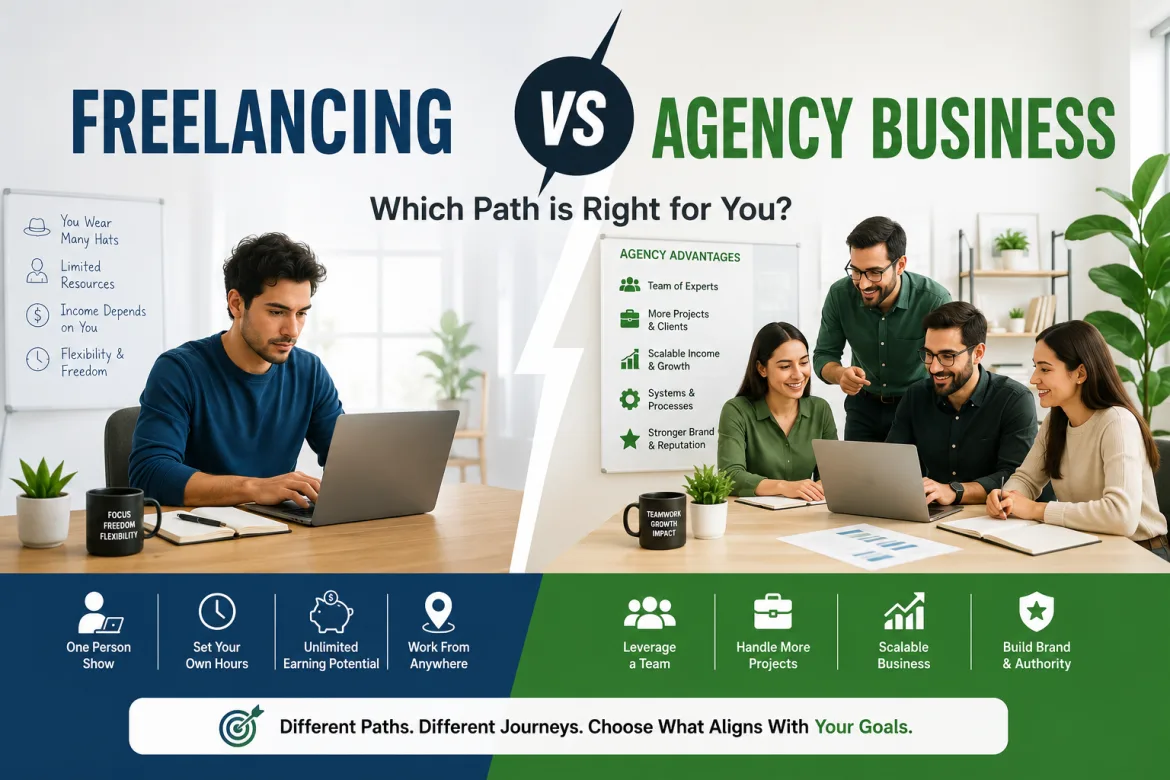
In today’s digital economy, earning money online is no longer limited to traditional employment. Freelancing and owning an agency are two of the most common career pathways for professionals and entrepreneurs. Both models provide flexibility, earning potential, and independence, but they function fundamentally differently.
Freelancing is frequently viewed as the entry point for many people into the online business environment. It enables one person to provide talents directly to clients and get compensated per project or hour. In contrast, an agency business is a more structured approach in which a team provides services to several clients on a large scale.
Choosing between freelancing and starting an agency is about more than just money. It also considers lifestyle preferences, long-term goals, risk tolerance, and leadership ability. This article will go over both models in detail so you can see which one best fits your long-term objectives.
Understanding Freelancing: A Solo Skill-Based Business
Freelancing is a self-employment paradigm in which an individual provides services such as writing, design, development, marketing, or consulting to clients directly. The freelancer does everything on their own, from locating clients to providing work and handling payments.
It is one of the most straightforward ways to launch an internet profession because it needs little cost and no team setup. Many professionals start freelancing as a side hustle before transitioning into a full-time career.
Key Points About Freelancing
- Low startup costs and quick market access.
- Full control over work hours and clientele.
- Time and effort directly affect income.
- Ideal for those with strong technical or creative skills.
Freelancing provides independence and flexibility, but it also restricts scalability because income is based on personal working capability.
Understanding Agency Business: A Scalable Service Model
An agency business is a structured organization in which a team collaborates to provide services to several clients. Instead of one person handling everything, tasks are distributed to professionals such as designers, marketers, developers, and managers.
This model is highly focused on systems, delegation, and scalability. Agencies can handle bigger workloads since numerous individuals are working on different aspects of the same project at the same time.
Key Points About Agency Business
- Designed for scalability and team cooperation.
- Delegation allows for simultaneous handling of multiple customers.
- Involves leadership, management, and operational systems.
- Higher earning potential, but also increased obligations.
Agencies are more than just service providers; they function as whole business systems built for growth and long-term viability.
Key Differences Between Freelancing and Agency Business
| Factor | Freelancing | Agency Business |
|---|---|---|
| Structure | Freelancing is individual-driven, where one person handles all client work independently. | Agency business is system-driven, relying on teams, processes, and delegation. |
| Work Approach | Focuses on personal skills and direct execution of tasks. | Focuses on managing projects, teams, and scalable systems. |
| Income Model | Earnings are based on hours worked or individual project fees. | Revenue comes from multiple clients, retainers, and scalable service packages. |
| Scalability | Limited growth as income depends on personal time and availability. | High scalability through hiring, outsourcing, and automation. |
| Risk Level | Lower financial risk but limited long-term growth potential. | Higher operational complexity but greater long-term earning potential. |
| Client Management | Handles clients directly with minimal support structure. | Uses account managers, systems, and structured communication processes. |
Income Potential: Freelancing vs Agency
Income is one of the most important considerations when deciding between freelancing and agency. Freelancers can earn a good living depending on their skill level and demand, particularly in high-value domains such as design, development, and marketing.
However, freelance income has a natural limit because one person can only do so many assignments at a time. Even high-paying freelancers eventually reach a capacity limit.
Agencies, on the other hand, can increase revenue by adding new clients and expanding their personnel. This permits revenue to increase without being constrained by a single individual’s time.
Key Points on Income
- Time constraints limit freelancers’ earning capacity.
- Agencies can produce various revenue streams simultaneously.
- Freelancers rely on skill-based pricing, while agencies use scaling systems.
- Agencies have better income potential but higher operational expenditures.
Skills Required for Freelancing vs Agency Building
Freelancing necessitates advanced technical or creative skills. Your ability to consistently create high-quality work is critical to your success in any field, including writing, coding, design, and marketing. These talents have a direct impact on client happiness and long-term reputation.
Soft skills such as communication, time management, and negotiation are also essential, especially when interacting directly with clients. Strong interpersonal skills enable freelancers to create trust and secure repeat contracts.
Agency development necessitates a larger, more strategic skill set. In addition to service knowledge, you must be able to lead, manage a team, sell, develop marketing strategies, and plan operations. These capabilities allow you to effectively manage expansion and coordinate with multiple clients.
An agency owner must think like a company leader rather than a service provider, prioritizing processes and scalability over execution. This shift in thinking is frequently the most difficult barrier for freelancers migrating into agencies.
Workload and Lifestyle Differences
One of the most significant advantages of freelancing is the ability to control one’s workload. You choose how many clients to take and when to work. This makes it ideal for individuals who value flexibility and freedom. It also improves work-life balance for people who have personal priorities.
However, freelancers frequently have uneven workloads. Some months may be extremely profitable, but others may be slow. This volatility might complicate financial planning over time.
Agency owners often have more regimented workloads. While the responsibility is greater, responsibilities are divided among a team, which reduces personal execution pressure. This makes it easier to manage several clients on a large scale.
However, agency owners frequently work longer hours initially, particularly during the expansion phase. Managing clients, staff, and operations can be difficult until processes are correctly implemented. Over time, these systems contribute to more stable and predictable operations.
Scalability: The Biggest Divider Between the Two Models
The most significant distinction between freelancing and agencies is their potential to scale. Individual capacity limits freelancers’ progress, implying that time and energy are constraints.
Even the most successful freelancers confront restrictions since they can’t take on more clients without losing quality or burnout.
Agencies address this issue by creating procedures and employing staff. This allows them to accept more clients without increasing the founder’s burden directly.
Key Scalability Insights
- Freelancers grow linearly, whereas agencies develop rapidly.
- Delegating tasks helps agencies increase capacity.
- Freelancers rely on personal availability.
- Agencies are designed for long-term scaling.
Client Acquisition and Business Growth
Personal branding, recommendations, freelance platforms, and social media are common methods used by freelancers to find clients. Growth is mainly reliant on individual work and reputation. Long-term success depends on developing strong relationships and consistently producing high-quality work.
Agencies employ more organized marketing techniques, such as sponsored advertisements, SEO, outbound sales, partnerships, and lead creation systems. This allows them to acquire new clients and expand their operations outside personal networks.
However, agencies face increased competition and require stronger branding to establish confidence. Clients frequently expect agencies to provide greater dependability, faster turnaround, and higher professionalism than individual freelancers. Over time, robust systems and marketing procedures enable agencies to achieve more predictable and scalable growth.
Over time, agencies that successfully deploy organized marketing systems and client acquisition procedures can lessen their reliance on individual labor and generate more predictable revenue streams. This change enables them to increase operations, serve more clients efficiently, and provide a solid long-term economic foundation.
For professionals exploring freelance marketplaces, Upwork provides access to freelance projects and clients.
Another widely used platform for independent professionals is Fiverr, where freelancers can offer services directly to customers.
Common Challenges in Freelancing
Despite its simplicity, freelance work has a number of problems. The most significant issue is income volatility, as work is not always continuous throughout the year. Another problem is working alone, which can lead to isolation and decreased motivation over time. Freelancers frequently struggle to manage several clients and handle modifications.
Key Challenges
- Unstable and unpredictable income flow.
- Scalability is limited owing to time constraints.
- Difficulty managing multiple clients alone.
- Risk of burnout due to continual workload.
To thrive in freelancing over time, you must have excellent discipline and self-management skills.
Common Challenges in Agency Business
Running an agency presents more difficult obstacles than freelancing. It might be tough to hire the correct team members and sustain quality across projects. Agencies also experience cash flow challenges because expenses such as personnel, tools, and marketing must be controlled even when client payments are delayed.
Key Challenges
- Recruiting and keeping skilled team members.
- Manage operational costs and financial flow.
- Ensure continuous service quality.
- Eliminating dependence on the founder.
Despite these limitations, agencies have a stronger long-term growth potential when managed appropriately.
Future of Freelancing and Agency Models
The future of both freelancing and agency businesses is bright, especially given the rise of remote work and digital transformation. These trends are expanding global opportunities, enabling people and enterprises to work across borders.
Freelancing is anticipated to expand as more businesses seek flexible, on-demand talent over full-time labor. Platforms and digital marketplaces will provide additional chances for skilled workers.
Simultaneously, agency models are transforming into increasingly specialized, niche-focused businesses. Instead of providing broad services, modern agencies specialize in specialized industries or solutions, such as performance marketing, AI automation, or SaaS growth.
Surprisingly, many freelancers eventually shift to agencies once they achieve capacity. This hybrid evolution is becoming a prevalent trend in the digital business environment.
Automation and artificial intelligence are also altering both approaches. Tasks that traditionally required physical labor are now being automated, allowing freelancers and agencies to concentrate on strategy and creativity.
Which One Should You Choose?
The decision between freelancing and an agency firm is based on your personal objectives, talents, and risk tolerance. Both approaches can be successful, but they serve distinct stages in an entrepreneur’s journey.
If you like flexibility, low risk, and freedom, freelancing is an excellent starting point. It enables you to develop abilities, earn money rapidly, and obtain real-world customer experience without incurring significant costs.
If you want to achieve long-term growth, increase your earning potential, and build a scalable system, an agency model is more suited. It demands more responsibility yet provides more opportunity for growth and teamwork.
Many successful businesses begin as freelancers, gain expertise, and then move to agencies once they grasp client demands and market dynamics. This process reduces risk while strengthening business fundamentals.
There is no “perfect” option—only the best one for your current stage, resources, and long-term goals.
Conclusion
In today’s digital economy, there are two major models: freelancers and agencies. While freelancing emphasizes individual expertise and flexibility, agency firms prioritize scalability, systems, and team development.
Both ways can lead to financial freedom, but they require distinct attitudes and approaches. Freelancing is good for starting small and acquiring experience, whereas agencies are intended to establish long-term, scalable businesses.
Finally, the best method is to match your choice to your objectives, talents, and long-term vision. Whether you start as a freelancer or go straight to an agency, consistency and ongoing learning are what genuinely determine success.