

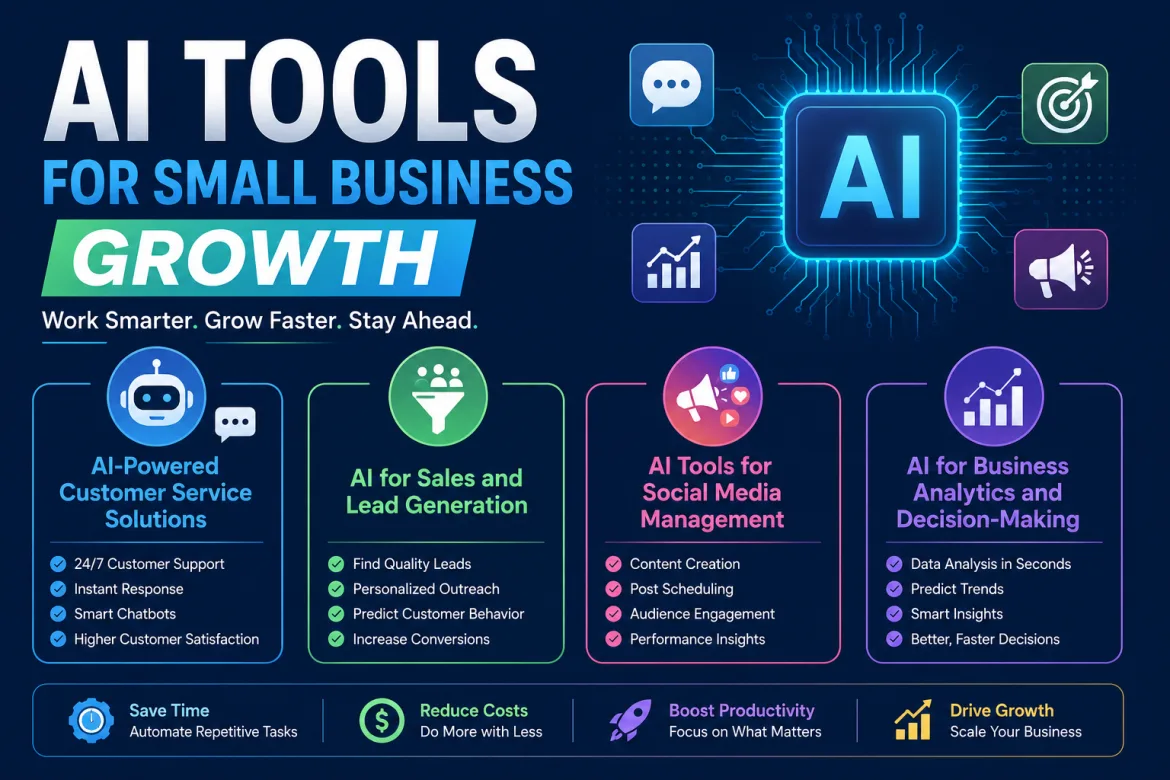
Artificial intelligence (AI) is no longer just for giant enterprises with big expenditures. Small firms may now employ AI solutions to automate regular activities, improve customer service, develop marketing content, analyze data, and boost productivity without recruiting large teams. As rivalry increases across industries, AI has emerged as one of the most significant resources for business owners seeking to save time and accelerate growth.
Many small business owners confront common issues, including restricted resources, a shortage of labor, rising client demands, and the need to be visible online. AI systems can assist address these issues by automating repetitive tasks, offering insights, and allowing firms to function more efficiently. Whether you manage an online store, a consulting firm, a local service provider, or a startup, AI can help you accomplish more with less resources.
The rapid growth of AI technology has made powerful tools available and affordable. From content production and customer service to sales forecasting and inventory management, AI technologies are changing the way organizations function. Understanding how these technologies function and how they integrate into your overall business plan is becoming increasingly crucial.
This guide looks at the best ways for small businesses to use AI tools for growth, the benefits they offer, typical pitfalls to avoid, and what the future holds for AI-powered business operations.
Why AI Matters for Small Businesses
Small firms frequently face obstacles such as tight finances, smaller personnel, and increased competition from larger corporations. AI helps to close this gap by offering low-cost solutions for automating mundane operations, increasing productivity, and facilitating better decision-making. Instead of spending hours doing repetitive tasks, business owners may concentrate on growth, client relationships, and strategic planning.
Another significant benefit of AI is its capacity to process and evaluate enormous amounts of data fast. This enables firms to better analyze customer behavior, recognize market trends, and make informed decisions based on actual data rather than assumptions. As a result, small enterprises are better able to compete and adjust to changing market conditions.
Some of the main advantages of AI for small enterprises are:
- Automating repetitive tasks to save valuable time.
- Improving customer service with speedier responses.
- Offering data-driven insights to improve decision-making.
- Reducing operational costs and enhancing efficiency.
When implemented effectively, AI may be a valuable business partner, allowing small businesses to expand quicker, work smarter, and remain competitive in today’s digital marketplace.
AI Tools for Content Creation and Marketing
Marketing is a key growth engine for small businesses, but regularly producing high-quality material may be challenging and time-consuming. AI-powered content creation solutions enable businesses to create blog posts, social media postings, email campaigns, product descriptions, and advertising text more efficiently.
These tools can help you with content planning, keyword research, grammar improvement, and SEO optimization. Instead of starting from scratch each time, business leaders can utilize AI to accelerate content creation while maintaining quality and consistency across marketing platforms.
Popular advantages of AI content and marketing technologies are:
- Accelerated blog, email, and social media material production.
- Improved SEO with keyword suggestions and optimization.
- Ensure consistent brand messaging across numerous platforms.
- Optimized content planning based on trends and user preferences.
By decreasing the workload associated with content development, AI enables firms to concentrate on strategy, client interaction, and revenue generation.
AI-Powered Customer Service Solutions
Customer service is critical to every business’ success. Modern customers demand prompt responses and help anytime they require assistance. However, many small firms fail to provide 24-hour customer support due to a lack of people and resources.
AI-powered chatbots and virtual assistants can help address this issue by automatically resolving typical consumer inquiries. These systems can respond to typical questions, provide order updates, book appointments, and walk clients through basic operations without requiring human participation.
Key advantages of AI customer service tools include:
- 24/7 customer assistance.
- Improved response time for consumer inquiries.
- Reduced workload for support teams.
- Increased consumer satisfaction and loyalty.
For example, a local service provider can deploy an AI chatbot to handle booking questions even after business hours, capturing leads that would otherwise go unnoticed.
AI for Sales and Lead Generation
Quality leads are critical for corporate success, and AI can greatly improve the process. AI-powered sales solutions monitor consumer behavior, identify potential buyers, and assist organizations in focusing on high-converting prospects.
Sales teams frequently spend significant time researching prospects and managing customer data. AI decreases this labor by automatically categorizing data, recording interactions, and proposing the best next steps for sales reps.
Businesses can also utilize AI-powered CRM systems to personalize communications and increase client engagement. These systems use previous contacts to assess client preferences and recommend appropriate products or services.
For example, a consulting firm can utilize AI to evaluate website visitor activity and identify users with high purchasing intent. This helps the sales staff to focus on high-value offers and increase conversion rates.
AI Tools for Social Media Management
Social media has emerged as a vital marketing medium for organizations of all sizes. However, managing several platforms can be time intensive. AI solutions make social media administration easier by automating content scheduling, performance monitoring, and audience engagement.
Businesses can utilize AI to discover the best publishing times, develop new ideas, and assess engagement numbers. This increases reach and improves campaign efficacy.
AI can also track crowd attitude and detect patterns in customer feedback. Understanding how people perceive a brand enables businesses to make educated decisions and build their reputation.
A small business that manages accounts across multiple social media sites can employ AI solutions to ensure consistent engagement without devoting significant resources to daily content maintenance.
AI for Business Analytics and Decision-Making
Data has emerged as one of the most significant assets for modern enterprises. However, gathering information is only beneficial if firms can convert it into actionable insights.
AI analytics technologies process vast amounts of data fast and uncover patterns that would be difficult to detect manually. These insights assist business leaders better understand client behavior, sales success, and operational efficiency.
Some important ways AI supports business analytics include:
- Identifying profitable products/services.
- Tracking client purchase trends.
- Measuring marketing campaign performance.
- Forecasting future business prospects.
Businesses may use AI-driven insights to make better decisions, decrease risks, and allocate resources more efficiently.
AI in Email Marketing
Email marketing remains one of the most effective digital marketing platforms in terms of ROI. AI improves email marketing by making campaigns more tailored and successful.
Traditional email marketing frequently send the identical message to all subscribers. AI enables businesses to segment audiences based on their behavior, hobbies, and purchasing history, ensuring that recipients receive more relevant content.
AI may also optimize subject lines, recommend content, and establish optimal sending times. These enhancements frequently result in higher open rates, engagement, and conversion rates.
For small firms aiming to improve marketing performance without adding workload, AI-powered email marketing is a practical and cost-effective solution. Businesses can also explore Google Analytics to better understand customer behavior and marketing performance.
Common Mistakes Businesses Make When Using AI
While AI has numerous benefits, many firms fail to obtain the intended results due to inadequate implementation tactics. Understanding typical pitfalls can help firms get the most out of their AI investments.
One prevalent misconception is that AI can entirely replace human competence. AI is most effective when it helps employees rather than replacing them. Human judgment remains essential for strategic planning, relationship management, and complex decision-making.
Businesses should also avoid these common AI adoption mistakes:
- Using too many AI tools simultaneously.
- Neglects employee training and onboarding.
- Using low-quality or incomplete data.
- Unclear business aims.
A useful starting point for understanding responsible AI implementation is the NIST AI Risk Management Framework, which provides guidance for managing risks associated with AI systems.
Avoiding these problems improves business outcomes and guarantees that AI becomes a viable long-term asset rather than an underutilized technology.
Key Factors for Successful AI Adoption
Successful AI implementation requires a strong grasp of business objectives. Rather than adopting AI because it is popular, businesses should define specific challenges to solve and use solutions that are aligned with those goals.
Selecting the appropriate AI solution is only the first step. Organizations must also construct quantitative performance metrics to determine whether the technology is producing real results. Regular monitoring helps to uncover areas for improvement and optimization.
Several factors contribute to successful AI implementation:
- Clear business objectives and implementation plan.
- Selection of tools based on organizational needs.
- Provide employee training and continuous assistance.
- Continuous monitoring and performance evaluation.
Businesses that approach AI strategically are more likely to achieve long-term growth, increased efficiency, and greater competitiveness.
The Future of AI Tools for Small Business Growth
The future of AI in small businesses looks incredibly promising. As technology advances, AI systems will become more cost-effective, user-friendly, and capable of tackling increasingly complicated jobs.
Future AI systems are projected to provide even more customisation, enabling firms to develop highly tailored customer experiences. Marketing efforts, product recommendations, and client interactions will become more targeted and efficient.
Voice assistants, predictive analytics, and intelligent automation are anticipated to become more important in day-to-day company operations. These technologies will enable firms to anticipate client wants, optimize workflows, and identify growth opportunities before competitors.
AI-powered decision support systems will continue to grow, offering business leaders with increasingly detailed insights and projections. This will make strategic planning more data-driven and rely less on guessing.
As AI becomes more interwoven into practically every business function, firms that carefully implement these tools will be better positioned for long-term growth and competition.
Conclusion
Artificial intelligence tools are changing the way small businesses operate, market, sell, and serve customers. What was formerly considered advanced technology is now available to businesses of all sizes, providing prospects for increased productivity, deeper customer relationships, and long-term success.
AI provides practical solutions to many of the difficulties that small businesses encounter on a daily basis, including content production and social media management, as well as customer support, analytics and operational automation. The idea is to intentionally implement AI, focusing on business objectives and demonstrable outcomes rather than merely following industry trends.
Businesses that embrace AI while retaining human characteristics like leadership, innovation, and customer service can gain a significant competitive advantage. As AI technology advances, small firms that learn to properly use these tools will be well-positioned to prosper in an increasingly digitized and competitive market.