

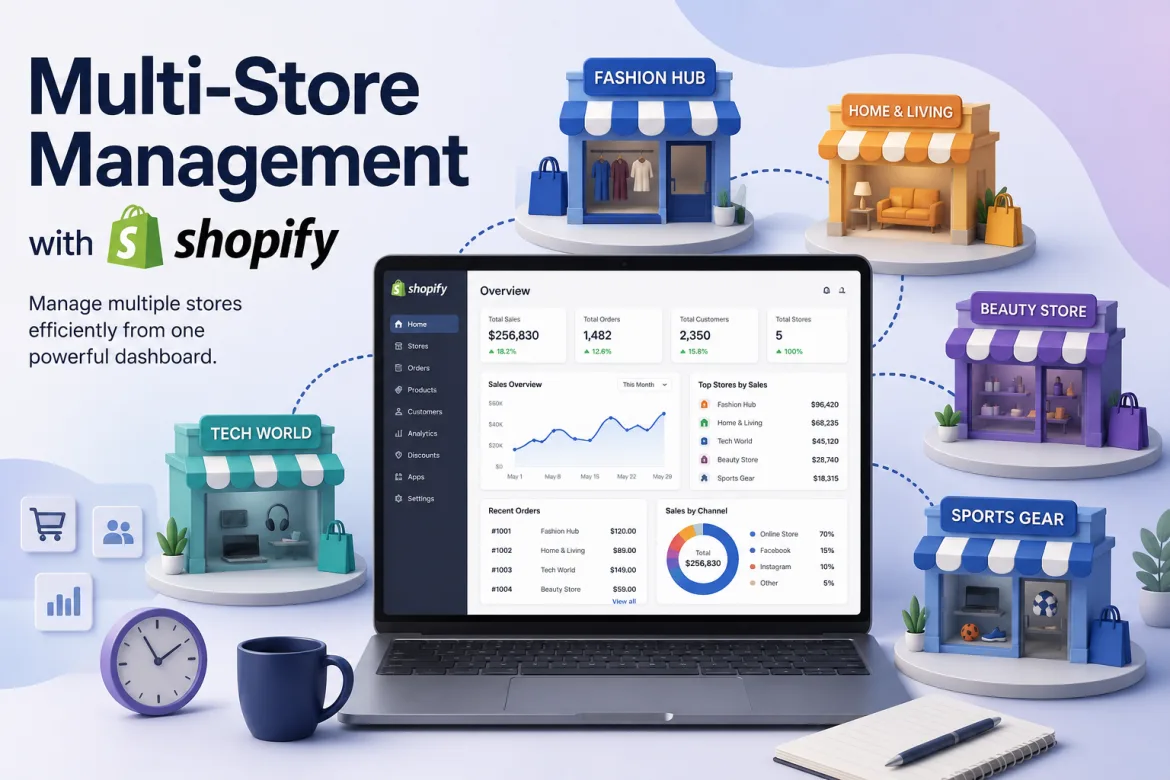
As eCommerce businesses expand, many store owners find that running just one online store is no longer enough. Various consumer demographics, international markets, product categories, and business models frequently demand separate storefronts. This is where multi-store management comes into play as a critical strategy for successfully developing an online business. Shopify has become one of the most popular platforms for managing many online stores due to its flexibility, scalability, and extensive ecosystem.
Multi-store management with Shopify allows businesses to run numerous independent stores while maintaining consistent branding, streamlining operations, and improving customer experiences. Whether a company is targeting many regions, running wholesale and retail operations independently, or managing multiple brands under one organization, Shopify can help it grow.
However, operating many stores poses unique challenges. Inventory synchronization, order management, customer data processing, marketing consistency, and operational efficiency all become more challenging as the number of locations increases. Understanding the proper strategies and best practices can help firms gain the benefits of having several locations while avoiding frequent issues.
Understanding Multi-Store Management in Shopify
Multi-store management is the process of running and managing several Shopify stores from a commercial viewpoint. Each store operates autonomously, with its own products, settings, themes, customers, and checkout procedure. Businesses frequently employ numerous stores to target different markets, languages, currencies, or consumer segments.
For example, a fashion company may have separate Shopify stores for North America, Europe, and Asia. Each store can offer specialized content, region-specific promotions, and pricing in local currencies. This technique boosts client trust and creates a more personalized buying experience.
Another common use case concerns businesses that manage many brands. A company selling skincare, cosmetics, and wellness items may set up distinct Shopify stores for each brand. This helps them to preserve distinct brand identities while taking use of consolidated business management processes.
The Shopify ecosystem supports these tactics with connectors, automation tools, and advanced management features. Although each store runs separately, organizations can develop procedures to streamline administration across all locations.
Why Businesses Choose Multiple Shopify Stores
Business expansion frequently necessitates the need for more specialized customer experiences. Operating various stores allows businesses to better tailor their offerings to the needs of specific consumers.
International expansion is a primary reason why organizations use a multi-store strategy. varied countries have varied client preferences, payment methods, tax laws, and delivery restrictions. A customized Shopify store for each region can boost consumer satisfaction and conversion rates.
Another cause is product segmentation. Businesses with a wide product line may find it more convenient to offer and handle products through separate stores. This helps to reduce client confusion while also providing a more concentrated purchasing experience.
Multi-store management also facilitates B2B and B2C transactions. Wholesale purchasers often have different pricing structures, ordering requirements, and customer journeys than retail consumers. Separate Shopify storefronts enable businesses to tailor experiences for separate audiences.
Companies that merge, acquire, or expand their brands commonly employ numerous Shopify stores. This structure enables them to retain different brand identities while leveraging shared operational resources.
Key Benefits of Multi-Store Management with Shopify
Managing numerous Shopify stores has several benefits that directly impact business growth and operational efficiency. It enables firms to scale faster, target different audiences effectively, and streamline operations across several regions.
Better Market Segmentation
Businesses can provide highly customized experiences to specific client segments. Different stores can offer personalized messaging, products, pricing, and promotions for certain audiences. This customisation frequently leads to increased customer engagement and sales.
Enhanced Brand Positioning
Separate storefronts allow firms to maintain clear brand identities. Instead of integrating various product categories into a single website, each brand has its own specialized section. This increases brand identification and builds customer trust.
Improved International Expansion
International customers generally want to shop in their own language and currency. Multi-store management enables firms to localize content, pricing, shipping methods, and customer assistance, resulting in a more enjoyable shopping experience.
Greater Marketing Flexibility
Different stores might run their own marketing efforts based on their target audiences. Businesses get greater control over their SEO tactics, advertising budgets, content marketing initiatives, and promotional activities.
Operational Scalability
As organizations expand, distinct storefronts can help to minimize complexity by better organizing items, personnel, and workflows. This framework facilitates expansion while ensuring operational control.
Common Multi-Store Management Scenarios
Businesses use Shopify multi-store setups in many ways, depending on their growth strategy and target audience. These configurations enable brands to manage varied markets, customer types, and product lines more efficiently. A well-planned structure increases flexibility and scalability.
Each use case is intended to address unique company demands while improving overall operational control. Choosing the appropriate model is determined by the company’s goals, client segmentation, and long-term strategy. Proper implementation leads to smoother management across all stores.
- Regional stores for certain countries or markets.
- Provide separate stores for wholesale and retail consumers.
- Individual storefronts for multiple brands inside one organization.
- Stores focusing on specific categories or products.
Each scenario provides distinct benefits based on company requirements. The optimal multi-store approach boosts efficiency, consumer targeting, and overall business performance.
Managing Inventory Across Multiple Shopify Stores
Inventory management is one of the most important aspects of running several stores. Without adequate coordination, organizations risk overselling, stock shortages, and consumer discontent.
A unified inventory method promotes consistency throughout all stores. Many organizations employ inventory management software that synchronizes stock levels automatically. When a product is sold at one store, inventory levels are updated across all connected locations.
Businesses selling abroad frequently use regional warehouses to decrease shipment delays and costs. Inventory visibility is very critical in these scenarios. Accurate stock tracking allows firms to efficiently fulfilll orders while avoiding operational disruptions.
Forecasting demand becomes much more critical in a multi-store system. Different stores may encounter different sales trends due to geography, seasonality, or client preferences. Businesses that closely monitor inventory data can make more informed purchase decisions and prevent costly stock concerns.
Order Management and Fulfillment Strategies
As the number of stores increases, order management might get more complicated. Customers demand quick, accurate, and transparent fulfillment regardless of which store they buy from.
A consolidated order management solution allows organizations to track orders from multiple Shopify stores in one place. This increases visibility and allows teams to better prioritize fulfillment efforts.
Automation plays an important role in expediting order processing. Automated processes can route orders to the proper warehouses, update tracking information, and alert customers about shipment status without the need for personal involvement.
Businesses that operate several fulfillment centers benefit from efficient delivery techniques. Orders can be routed to the nearest warehouse, resulting in shorter delivery times and lower shipping costs. This not only improves consumer satisfaction, but also increases profits.
Consistent fulfillment methods across all stores assist to protect brand reputation and ensure that consumers receive the same level of service regardless of location.
Maintaining Consistent Branding Across Multiple Stores
Brand consistency is essential for building confidence and familiarity among several Shopify stores. Even when targeting different groups, businesses must maintain a consistent image. This ensures that customers can easily recognize and connect with the brand.
Visual identity is vital for maintaining consistency across all stores. Logos, colors, font, and design style should all be consistent wherever possible. This provides clients with a familiar and professional experience.
- Ensure consistent logo and visual identity.
- Ensure consistent color schemes and typography.
- Use consistent design concepts throughout stores.
- Align product descriptions with brand messaging.
Regular brand audits help discover anomalies before they affect consumer impression. Shared tools and established workflows guarantee that all teams adhere to the same standards. This increases brand integrity and promotes long-term growth.
SEO Strategies for Multiple Shopify Stores
When you manage many stores, search engine optimization gets more challenging. However, a well-thought-out SEO strategy can greatly boost visibility and traffic.
Each Shopify store should focus on distinct keywords that are relevant to its audience and market. Avoiding duplicate content is critical since search engines may struggle to decide which retailer should rank for specific terms.
Localized SEO is especially useful for overseas stores. Businesses should optimize their content for regional search behavior, local language variances, and geographical keywords. This increases search visibility in targeted markets.
Content marketing remains an effective technique for multi-store organizations. Publishing useful articles, guides, and tools increases organic traffic while also establishing authority in specialized niches.
Technical SEO should be given regular attention. Site speed, mobile friendliness, organized data, and clean website architecture all help improve search results across numerous retailers. Businesses can also refer to Google Search Central documentation for search optimization guidance.
Key Factors for Successful Multi-Store Management
Managing numerous Shopify stores successfully necessitates detailed planning and business objectives. Each store should have a clear goal, target audience, and operational plan. This clarity reduces confusion and increases overall efficiency.
Strong systems and processes are required for managing inventory, branding, and performance tracking across several stores. Automation and centralized tools can greatly reduce manual labor while increasing consistency. Regular monitoring ensures that all stores operate effectively.
- Established clear business objectives for each store.
- Centralized inventory and order management systems.
- Effective data analytics and performance tracking.
- Automation can reduce repetitious tasks.
- Effective team communication and collaboration.
Businesses that prioritize these critical criteria can scale more effectively and maintain better control across all locations. This leads to increased profitability, more efficient operations, and long-term growth.
Common Mistakes to Avoid
Many businesses face issues when growing into several Shopify stores. Understanding typical mistakes can help you avoid costly setbacks.
One common mistake is to open several stores without a defined plan. Each store should serve a distinct purpose and contribute to the broader corporate objectives. Creating stores without clear goals typically results in confusion and inefficiency.
Another mistake is insufficient inventory coordination. Inaccurate stock data could lead to overselling and customer dissatisfaction. Businesses should consider investing in technologies that provide real-time inventory visibility.
Some firms overlook the importance of content localization. Simply translating content may not be enough to engage with local audiences. Cultural preferences, shopping patterns, and geographic expectations must all be considered.
Finally, failure to adopt automation often results in unnecessarily high operational costs. As the number of stores increases, manual operations become more difficult to manage, necessitating the usage of automation for scaling.
The Future of Multi-Store Management with Shopify
The future of multi-store management is inextricably linked to improvements in automation, artificial intelligence, and unified commerce technology. Businesses are increasingly searching for centralized platforms to handle complicated operations and increase efficiency.
AI-powered analytics will continue to assist organizations understand client behavior across numerous locations. These insights can help improve marketing decisions, inventory management, and product development strategies.
Automation tools are expected to become increasingly complicated. Routine tasks such as inventory updates, order routing, customer segmentation, and reporting will need less manual effort, allowing teams to focus on growth targets.
Personalization will also play a larger part in multi-store strategies. Businesses will be able to offer highly tailored buying experiences based on their consumers’ interests, region, and purchasing history.
As global eCommerce increases, Shopify’s ecosystem is likely to expand to provide cross-store administration. This will make it easier for businesses of all sizes to manage several stores efficiently while still offering excellent customer service. More information about Shopify’s platform and capabilities can be found on the Shopify Enterprise page.
Conclusion
Shopify’s multi-store administration offers businesses a comprehensive framework for growth, market expansion, and consumer segmentation. Whether managing numerous brands, supplying international markets, or separating wholesale and retail operations, a well-planned multi-store strategy can provide significant competitive advantage.
Strong operational processes, centralized management systems, consistent branding, successful SEO strategies, and clever automation are all critical to success. Businesses that invest in these areas may securely expand, improve consumer experiences, and lay a solid basis for long-term eCommerce success.