

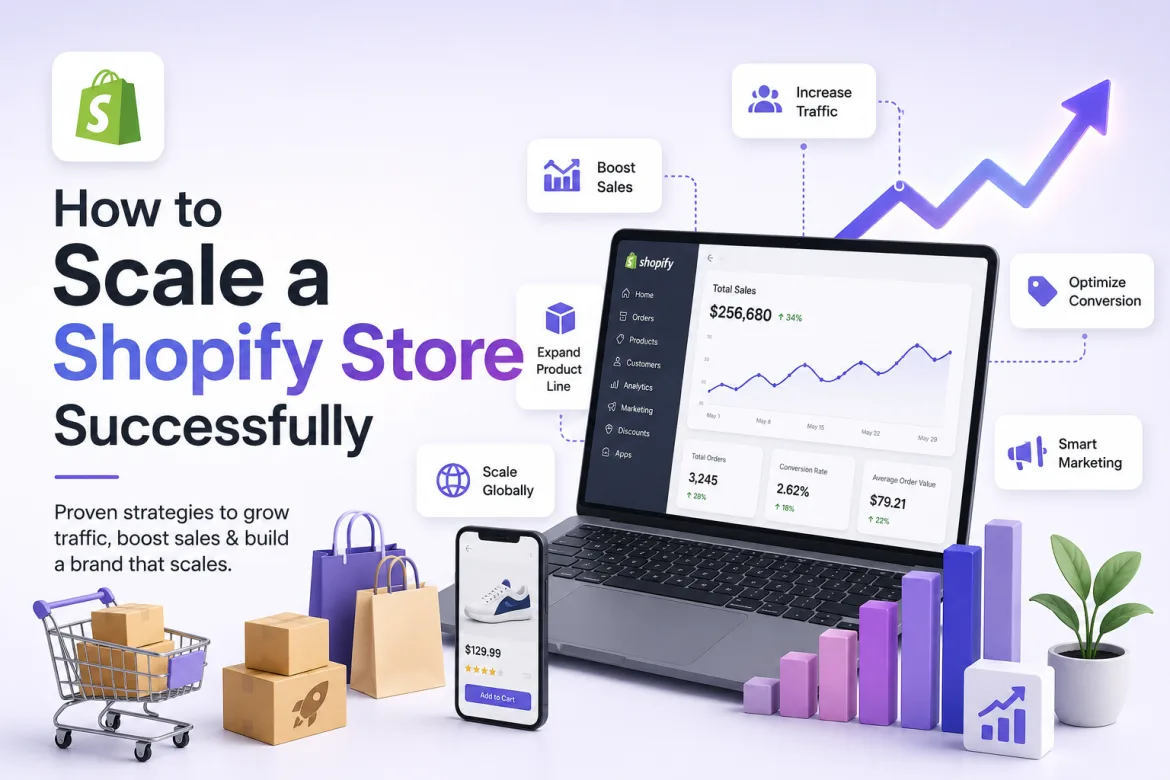
Building a Shopify store is merely the first step toward launching a successful eCommerce business. Many entrepreneurs open their establishments with enthusiasm, attracting their first clients and making first sales. However, the true issue arises when they attempt to transition from a tiny company to a large and profitable business. Scaling involves more than just growing traffic or adding products. It include developing processes, improving customer experiences, and making strategic decisions to promote long-term growth.
A Shopify store that scales successfully can handle rising demand while maintaining customer happiness, operational efficiency, and profitability. Businesses that prioritize long-term growth are frequently better positioned to compete in crowded marketplaces and adapt to shifting consumer patterns. Whether a store processes a few hundred orders per month or thousands, the concepts of scalability are basically the same.
Today’s eCommerce landscape provides numerous potential for expansion, but it also creates severe competition. Customers want fast-loading websites, flawless purchasing experiences, dependable deliveries, and personalized interactions. Shopify is a tremendous platform for expansion, but business owners must execute the correct methods to fully realize its potential. Understanding how to properly scale a Shopify store allows organizations to boost revenue while keeping operational control.
Understanding What Scaling Really Means
Many business owners believe that scaling means increasing sales. While revenue growth is undoubtedly crucial, genuine scaling is boosting sales while maintaining or enhancing productivity. A store that doubles income while tripling expenses is expanding, but it is not scaling successfully.
Successful scaling entails developing systems that enable a company to serve more consumers while incurring no additional expenditures. This can include automation, smarter marketing methods, better inventory management, and increased client retention initiatives. The goal is to develop a business model that increases profitability as it expands.
For example, a Shopify business that automates email marketing, customer support responses, and inventory management can handle increased order volumes while reducing human costs dramatically. This operational efficiency is directly related to scalability.
Business owners should also understand that scaling is not a one-time affair. It is a continuous process that necessitates regular examination and adaptation. Markets evolve, customers’ expectations shift, and new competitors emerge on a regular basis. Continuous improvement is critical to long-term success.
Strengthening Your Shopify Store Foundation
Before investing extensively in expansion strategies, businesses must verify that their Shopify store has a solid base. Scaling a store that already has flaws generally exacerbates rather than resolves issues.
Website performance should be the first priority. Slow-loading pages can lead to higher bounce rates and lower conversions. Customers want speedy and seamless purchasing experiences, particularly on mobile devices. Optimizing images, removing unneeded programs, and utilizing efficient themes can all help to enhance overall efficiency.
Product pages should also be thoroughly evaluated. High-quality product photos, clear descriptions, customer reviews, and straightforward pricing all contribute to increased trust and conversions. Strong product pages become even more vital as traffic volume grows.
Checkout optimization is equally important. Complex checkout processes frequently result in abandoned carts. Shopify’s fast checkout mechanism is beneficial, but businesses should continuously test and tweak the user journey to decrease friction and boost completion rates.
Finally, maintaining mobile responsiveness is critical. Smartphones now account for a large share of all online purchases. A store that performs poorly on mobile devices may struggle to scale effectively, despite extensive marketing efforts.
Scaling Traffic Through Multiple Marketing Channels
Increasing quality traffic is critical to Shopify store growth. Depending on a single marketing channel might pose considerable risks if platform algorithms or advertising costs change suddenly.
The most successful eCommerce brands often diversify their traffic sources through multiple channels:
- Search Engine Optimization (SEO)
- Paid ad campaigns
- Email Marketing
- Social media marketing.
- Influencer partnerships
- Content marketing
SEO helps stores rank for relevant search queries, which increases their long-term visibility. Although results may take time, organic traffic frequently yields high returns in the long run.
Paid advertising networks enable firms to rapidly scale by targeting specific audiences. However, campaigns should be closely managed to ensure profitability as expenditure rises.
Email marketing remains one of the most effective channels because it targets clients who have previously expressed interest in the company. Well-designed email campaigns can increase repeat sales and improve customer relationships.
Social media platforms enable businesses to increase brand exposure and communicate directly with customers. Consistent content creation and community interaction can help to drive long-term growth.
Diversifying traffic sources decreases reliance on a single platform, resulting in a more resilient economic strategy.
Leveraging Data for Smarter Growth
One of the most significant benefits of operating a Shopify business is access to vital customer and sales data. Businesses that use data successfully can make better judgments and grow more efficiently.
Analytics can help you determine which products generate the most profit, which marketing channels provide the best return on investment, and which customer segments are the most valuable. These insights help business owners allocate resources more effectively.
For instance, if email marketing consistently generates higher conversions than paid advertising, increasing investment in email campaigns may produce better results than expanding advertising budgets. Data-driven decisions reduce guesswork and improve profitability.
Customer behavior data also reveals opportunities for improvement. Monitoring abandoned cart rates, bounce rates, average order values, and customer lifetime value can highlight areas requiring attention. Small improvements across these metrics often lead to significant revenue growth over time.
Businesses should develop a process for reviewing analytics and performance reports. Consistent monitoring ensures that growth initiatives remain in line with current customer behavior and market trends.
Expanding Product Offerings Strategically
Adding more products can increase revenue opportunities, but expansion should be done strategically rather than at random. Successful Shopify stores frequently expand by adding products that complement their existing offerings.
Customers who trust a brand are more likely to buy similar products. This provides opportunities for cross-selling and upselling. For example, a fitness equipment company may expand into workout accessories, apparel, or nutritional products.
Product expansion should be driven by market research and customer demand. Business owners can gather insights through surveys, customer feedback, sales data, and industry trends.
Testing new items before making major inventory commitments can help reduce risk. Limited product releases provide useful information about client interest while avoiding financial risk.
A concentrated product approach is frequently more effective than aiming to serve every available client category. Maintaining a distinct brand identity promotes client trust and long-term growth.
Improving Customer Retention
Acquiring new clients is crucial, but keeping old ones is typically more profitable. In comparison to new consumers, repeat customers tend to spend more, convert faster, and demand lesser marketing costs.
Providing an outstanding shopping experience is the first step toward building consumer loyalty. Customer satisfaction is enhanced by fast shipment, accurate product descriptions, timely customer service, and consistent product quality.
Loyalty programs can drive repeat purchases by rewarding clients for their ongoing patronage. Discounts, special deals, and reward points encourage customers to return.
Personalization has a significant impact on retention. Businesses can use purchase history and customer preferences to offer relevant items and develop personalized marketing campaigns.
Some effective retention strategies include:
- Personalized email campaigns
- Loyalty and rewards programs
- Subscription-based offerings
- Exclusive customer promotions
- Post-purchase follow-up communications
Customer retention should be considered as a growth strategy, not just a support role. Strong client relationships can often provide a considerable competitive advantage.
Automating Business Operations
Manual processes can become major roadblocks as order quantities rise. Automation enables Shopify stores to scale more efficiently while decreasing operational complexity. It also saves time, reduces errors, and increases overall corporate productivity.
Many monotonous operations can be automated by leveraging Shopify’s ecosystem of apps and APIs. Inventory updates, order confirmations, shipment notifications, customer segmentation, and marketing workflows can all be optimized.
Automation increases uniformity while reducing human error. Customers receive timely information, inventory is accurate, and staff may focus on higher-value tasks.
Customer support automation can also increase efficiency. Frequently asked questions can be answered via knowledge bases, chatbots, and automated responses. This enables support teams to focus on more complex inquiries.
As firms expand, automation becomes increasingly vital for maintaining service quality while dramatically lowering operating expenses.
Building a Strong Brand Identity
Strong brands typically scale more successfully than businesses that compete purely on price. Customers are more likely to recall, trust, and recommend brands that clearly explain their value proposition.
Brand identity encompasses visual design, messaging, customer experience, and company values. Consistency across all customer touchpoints strengthens brand recognition.
A strong brand also supports premium pricing. Customers who trust a brand may be willing to pay more for products because they perceive greater value beyond the product itself.
Storytelling can be particularly effective in building emotional connections with customers. Consumers increasingly support brands that align with their values and provide meaningful experiences.
As competition increases within the Shopify ecosystem, branding becomes an increasingly important differentiator. Businesses that invest in brand development often achieve stronger long-term growth.
Optimizing Inventory and Fulfillment
Inventory management becomes more challenging as sales volumes increase. Poor inventory practices can result in stockouts, overstocking, delayed shipments, and dissatisfied customers. Efficient tracking systems help maintain accurate stock levels and ensure smoother order fulfillment.
Accurate forecasting is critical for keeping inventory balanced. When determining inventory levels, businesses should consider historical sales trends, seasonal patterns, and promotional schedules.
Key inventory management practices include:
- Monitoring stock levels regularly
- Forecasting demand accurately
- Maintaining supplier communication
- Tracking product performance
- Planning for seasonal fluctuations
Fulfillment efficiency has an impact on customer satisfaction. Fast and dependable delivery greatly enhances customer satisfaction and encourages repeat purchases.
Businesses with significant growth may benefit from third-party logistics providers who can handle storage, packing, and shipping more efficiently.
Key Factors That Influence Shopify Store Scalability
Several factors consistently influence whether a Shopify store will scale successfully over time.
- Website speed and performance
- Customer acquisition efficiency
- Customer retention rates
- Operational automation
- Brand reputation
- Inventory management
- Data-driven decision-making
Each factor contributes to a company’s overall ability to meet increased demand while remaining profitable.
Ignoring any of these areas can create bottlenecks that limit growth.
Business owners should regularly evaluate these factors and identify opportunities for improvement. Even small enhancements can create meaningful long-term results when applied consistently.
Scalability is rarely determined by a single breakthrough strategy. More often, it results from continuous improvements across multiple aspects of the business.
Common Mistakes Businesses Make While Scaling
Many Shopify store owners encounter challenges because they attempt to scale too quickly or without proper preparation. One common mistake is increasing advertising spending before optimizing conversion rates. Driving more traffic to a poorly performing website often leads to wasted marketing budgets.
Another frequent issue is neglecting customer service. As order volumes increase, support requests often rise as well. Businesses that fail to invest in customer experience may experience declining satisfaction and negative reviews.
Additional scaling mistakes include:
- Expanding product lines too quickly
- Ignoring cash flow management
- Relying on a single traffic source
- Failing to automate processes
- Overlooking customer retention
Avoiding these mistakes can significantly improve the likelihood of sustainable growth. Careful planning and strategic execution are essential throughout the scaling journey.
The Future of Shopify Store Growth
The future of Shopify growth will be influenced by evolving technology, changing customer expectations, and increasing competition. Businesses that remain adaptable will be better positioned for long-term success.
Artificial intelligence is expected to play a larger role in personalization, customer service, and marketing automation. Brands that effectively use these technologies may gain competitive advantages through improved efficiency and customer experiences.
Mobile commerce will continue to expand as consumers increasingly shop through smartphones and mobile applications. Optimizing mobile experiences will remain a critical priority for growing businesses.
Customer expectations regarding speed, convenience, and personalization are also likely to increase. Businesses that invest in innovation and customer-centric strategies will be better equipped to meet these demands and maintain growth momentum.
Conclusion
Scaling a Shopify store successfully requires a combination of strategic planning, operational efficiency, customer focus, and continuous improvement. Growth is not simply about attracting more visitors or generating additional sales. It involves building systems and processes that allow the business to expand sustainably while maintaining profitability and customer satisfaction.
Business owners who prioritize data-driven decisions, customer retention, automation, strong branding, and operational excellence are more likely to achieve long-term success. By focusing on these foundational principles, Shopify stores can navigate growth challenges effectively and create scalable businesses capable of thriving in an increasingly competitive eCommerce environment.
Looking for a reliable Shopify development company to grow and scale your online store? Ecodesoft Solutions specializes in custom Shopify development, theme customization, app integration, store optimization, and ongoing support to help businesses achieve sustainable eCommerce growth. Contact Ecodesoft Solutions today to discuss your Shopify project.