

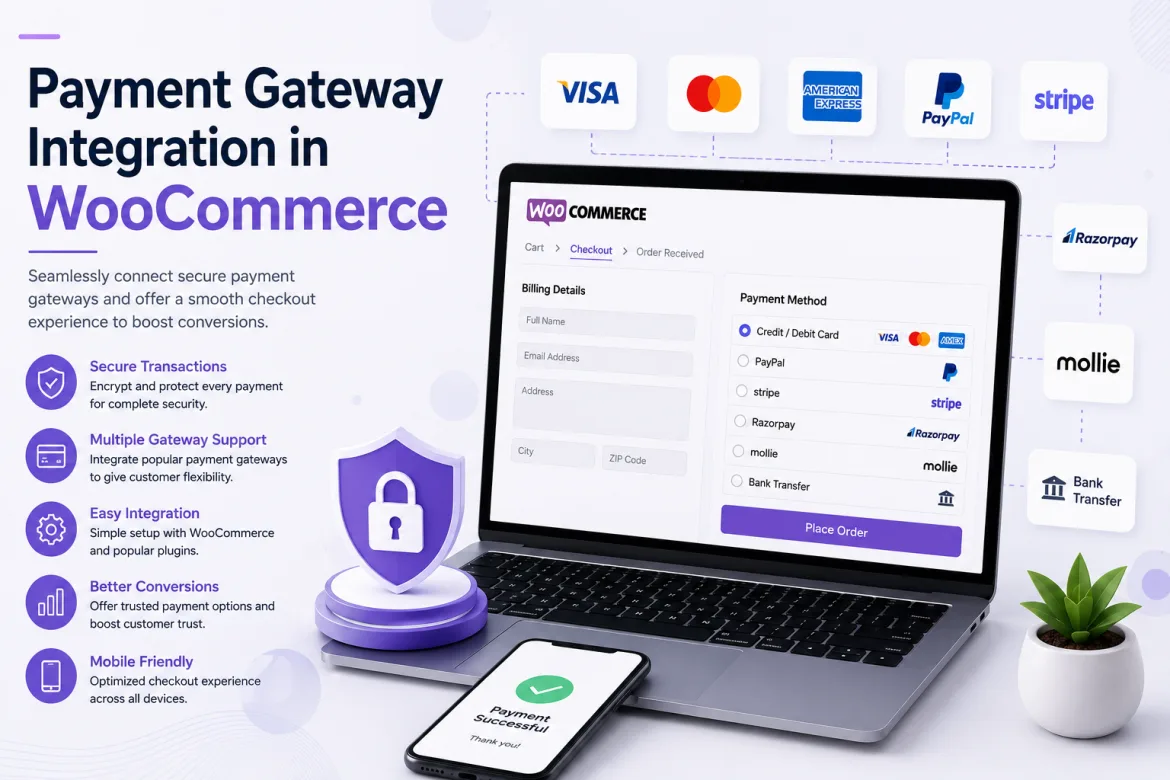
Customers increasingly expect online retailers to provide a seamless, safe, and convenient payment experience. Customers may abandon their purchases if the payment process is cumbersome or unreliable, regardless of how appealing a website or the products are. This is why payment gateway integration is critical to the success of any WooCommerce store.
WooCommerce has become one of the most popular eCommerce platforms due to its versatility, low cost, and wide customization options. To turn a WooCommerce website into a fully functional online store, merchants want a dependable payment gateway that allows customers to conduct transactions securely and effectively. The correct payment gateway not only builds client trust, but it also helps businesses increase sales and prevent cart abandonment.
Whether you run a tiny online store, a developing retail business, or a huge eCommerce operation, understanding payment gateway integration in WooCommerce is critical. This handbook covers everything business owners need to know about payment gateways, integration methods, benefits, essential considerations, typical mistakes, and future developments in online payments.
Understanding Payment Gateway Integration in WooCommerce
A payment gateway is a system that allows online businesses to receive payments from clients via credit cards, debit cards, digital wallets, bank transfers, and other online payment methods. It serves as a liaison between the customer, the merchant, and the financial institution that processes the payment.
When a customer orders from a WooCommerce store, the payment gateway securely communicates payment information for permission and verification. When the transaction is accepted, the payment is executed and the customer receives a confirmation of purchase. The entire process normally takes a few seconds.
WooCommerce supports a variety of payment gateways via built-in options and third-party plugins. Store owners can select gateways based on their business location, consumer preferences, transaction fees, and security needs. This flexibility enables businesses to design a payment experience that is appropriate for their target market.
Typically, the integration procedure includes installing a payment gateway plugin, configuring API credentials, testing transactions, and confirming security compliance. While the technical configuration is usually simple, choosing the correct gateway necessitates careful consideration of corporate objectives and consumer expectations.
Why Payment Gateway Integration Matters for WooCommerce Stores
Payment gateway integration has a direct impact on the overall customer experience. A smooth payment procedure decreases friction at checkout and increases the likelihood of successful purchases. Customers are more inclined to trust and shop at a store that accepts familiar and secure payment options.
Integrated payment systems let business owners automate transaction processing and reduce human labor. Instead of manually processing payment confirmations, the gateway automatically processes payments and updates order statuses in WooCommerce. This increases operational efficiency while saving valuable time.
Security is another significant advantage. Modern payment gateways incorporate enhanced encryption, fraud detection systems, and adherence to industry standards. These features help retailers and customers avoid payment-related risks and cyber dangers.
Additionally, payment gateway integration allows firms to enter new markets. WooCommerce stores that handle several currencies and foreign payment methods can attract clients from all around the world and expand global sales potential.
How Payment Gateway Integration Works in WooCommerce
The payment process begins when a consumer adds items to their cart and continues to the checkout. At this point, payment gateway options are available based on the store settings.
The customer selects a chosen payment option and inputs the necessary information. Depending on the gateway, the customer may stay on the merchant’s website or be routed to a secure payment page to finish the transaction.
The payment gateway encrypts the information before sending it to the payment processor for authorization. The processor connects with the customer’s bank or card issuer to confirm the transaction information and assess whether adequate funds exist.
When the payment is approved, the gateway sends a confirmation message to WooCommerce. The order status is automatically updated, and both the customer and the merchant receive transaction alerts. This streamlined approach guaranties a smooth shopping experience.
Popular Payment Gateways for WooCommerce
WooCommerce offers a wide range of payment gateways to meet the needs of various businesses and geographical regions.
Some of the most widely used options include:
- PayPal
- Stripe
- Razorpay
- Authorize.Net
- Square
- Amazon Pay
- PayU
PayPal is still a popular choice because to its global popularity and client confidence. Many shoppers already have PayPal accounts, which makes checkout faster and easier.
Stripe has grown in popularity due to its versatile features, support for different payment methods, and seamless checkout experience. It allows clients to make payments without leaving the site.
Razorpay and PayU provide robust local payment support to businesses in India, including UPI, net banking, wallets, and cards. These gateways enable merchants to efficiently cater to regional customer preferences.
Transaction costs, supported countries, payment methods, ease of integration, and client expectations are all important considerations when choosing a payment gateway.
Benefits of Payment Gateway Integration in WooCommerce
One of the primary benefits of payment gateway integration is increased consumer convenience. Customers can select from a variety of payment methods, making it easier to complete transactions based on their preferences.
Another big advantage is higher conversion rates. Customers are more likely to complete their orders if the payment process is smooth and trustworthy. This directly leads to increased revenue and business growth.
Integrated payment systems also enable speedier transaction processing. Orders are automatically confirmed, which reduces delays and increases customer satisfaction. Businesses may complete requests more swiftly and efficiently.
Additionally, payment gateways provide useful reporting and analytics services. Real payment data enables store owners to evaluate transaction success, discover patterns, and make informed business decisions.
Key Factors to Consider When Choosing a Payment Gateway
Choosing the best payment gateway necessitates considering a number of crucial business and technical considerations. Pricing-based decisions may result in future constraints or customer discontent.
The first consideration is the customer’s preferences. Businesses should identify which payment options are most typically used by their target demographic. Offering preferred payment choices generally results in increased conversion rates.
The second factor is transaction fees. Different gateways charge different fees for processing payments. These charges can have a considerable impact on profitability, particularly for organizations that handle a high volume of transactions.
Other important considerations include:
- Security and fraud protection features
- Multi-currency support
- Mobile payment compatibility
- Ease of WooCommerce integration
- Customer support quality
- Settlement and payout speed
A careful examination of these aspects enables firms to choose a payment solution that meets both operational requirements and long-term growth goals.
Security Considerations in Payment Gateway Integration
Security is one of the most important features of online payment processing. Customers entrust businesses with sensitive financial information, therefore protecting it should be a primary priority.
Most reputable payment gateways utilize encryption technology to protect transaction data during transmission. This lowers the danger of illegal access and data breaches. It ensures that sensitive client information is protected throughout the payment process.
Compliance with PCI DSS standards is another critical necessity. Payment gateways that satisfy these criteria adhere to tight security guidelines aimed at protecting cardholder data and reducing fraud risks.
Tokenization, two-factor authentication, and fraud monitoring systems add further layers of security. These techniques enable firms to preserve client trust while lowering financial risks.
Common Challenges During Payment Gateway Integration
Although WooCommerce payment integration is generally simple, organizations may face a number of obstacles during setup and deployment. Understanding these difficulties in advance helps to avoid checkout delays, errors, and disruptions. Proper planning leads to smoother payment functionality.
Compatibility issues might develop when payment gateway plugins clash with themes or other extensions. Configuration errors, such as misconfigured API keys or webhook settings, might potentially impede successful transactions. To avoid these issues, thorough testing and configuration are required.
- Plugin and theme compatibility issues
- Incorrect API or configuration settings
- International payment and currency challenges
- Regulatory and compliance requirements
- Complicated checkout experience for users
Businesses should also address the complexity of foreign payments, such as currency conversion and regional restrictions. A simple and user-friendly checkout process boosts conversions and reduces cart abandonment rates.
Common Mistakes Businesses Make
Many WooCommerce business owners prioritize product pages and marketing over the payment process. This typically results in missing revenue possibilities. A seamless and secure payment procedure is critical for increasing conversions and lowering cart abandonment.
One common problem is to provide too few payment options. Customers may abandon their purchases if their preferred payment option is not available. Providing several options improves accessibility and convenience.
Another mistake is to ignore mobile consumers. Because smartphones account for the majority of online purchases, payment gateways must work flawlessly across mobile devices and screen sizes.
Businesses also make the mistake of ignoring security upgrades. Outdated plugins can create vulnerabilities, exposing consumer data and harming a company’s reputation.
Some store owners do not test payment workflows on a regular basis. Even minor configuration errors can disrupt transactions and harm consumer trust if left undiscovered.
Best Practices for Successful Payment Gateway Integration
Understanding client behavior and selecting payment methods that fit market preferences are the first steps toward effective integration. Customer-centric decisions frequently yield superior company outcomes.
Businesses should thoroughly evaluate payment capabilities prior to establishing the gateway. Testing aids in the identification of technical difficulties, user experience problems, and transaction failures that may have an impact on sales.
It is equally crucial to keep the checkout procedure easy. Reducing the number of checkout stages increases convenience and encourages customers to complete their transactions. A simplified checkout process also reduces cart abandonment and boosts overall conversion rates.
Businesses can find chances for optimization by conducting regular monitoring and performance analysis. Reviewing transaction data, payment success rates, and customer comments can provide significant insights into continual improvement.
Store owners should also update payment gateway plugins to ensure compatibility, security, and access to the most recent features and improvements. Regular updates also help to prevent transaction issues and provide a smooth checkout experience for customers.
The Future of Payment Gateway Integration in WooCommerce
The future of payment gateway integration is inextricably linked to evolving consumer expectations and technical improvements. Businesses that stay ahead of these trends will be better positioned for long-term growth.
Digital wallets are gaining popularity worldwide. Customers value the speed and simplicity provided by payment options like Apple Pay, Google Pay, and other wallet-based systems. WooCommerce stores are anticipated to embrace these features more widely.
Artificial intelligence is also improving payment security. Advanced fraud detection systems can examine transaction patterns in real time to spot questionable activity before it becomes a serious problem.
Benefits of Buy Now, Pay Later (BNPL)
- Boosts customer purchasing power.
- Allows for flexible installment payments.
- Increases average order value.
- Improves store conversion rates.
As global commerce grows, businesses will want payment gateways that accept numerous currencies, local payment methods, and smooth cross-border transactions. WooCommerce’s adaptability makes it well-suited to these changing needs.
Conclusion
Payment gateway integration in WooCommerce is much more than just a technical need. It is an important company function that affects consumer trust, conversion rates, operational efficiency, and long-term success. A well-integrated payment system provides a seamless checkout experience, encouraging customers to complete their purchases and return for future transactions.
Businesses can create stronger WooCommerce stores that meet modern customer expectations by choosing the correct payment gateway, prioritizing security, avoiding common mistakes, and staying up to date on developing payment trends. In an increasingly competitive eCommerce landscape, investing in the correct payment infrastructure can provide a significant edge for long-term success.