

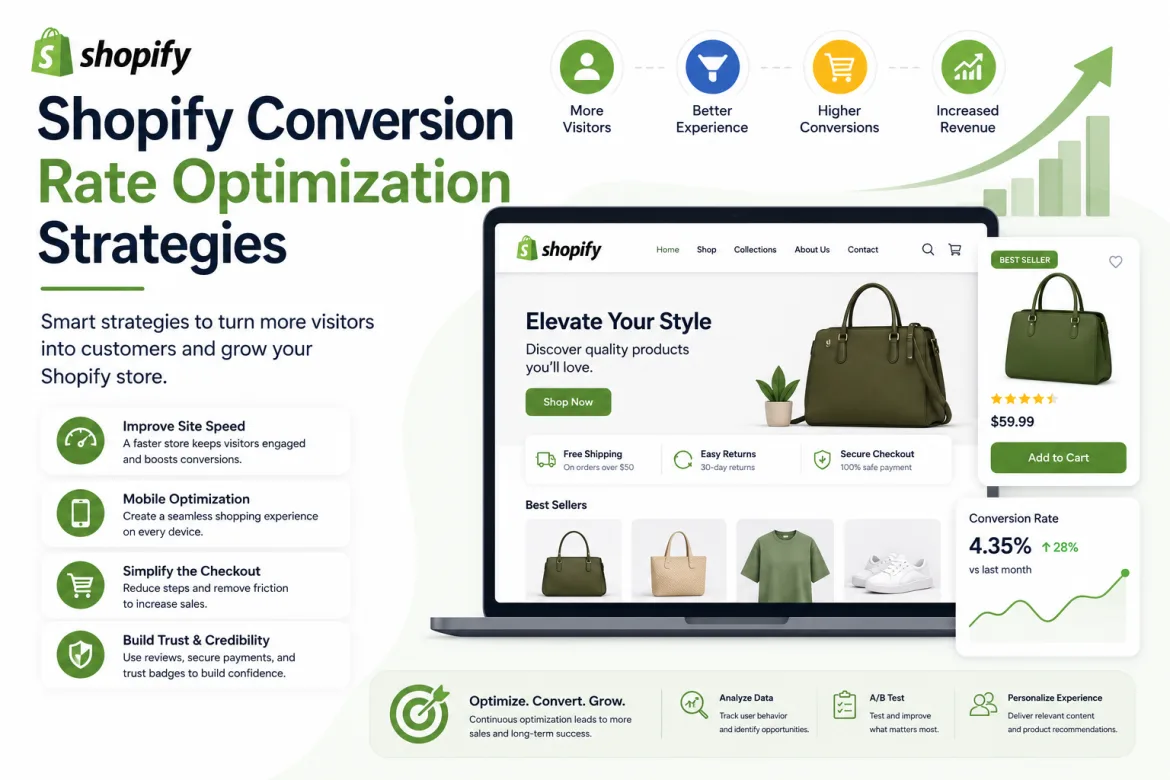
Running a Shopify store is no longer just about attracting visitors. Many businesses invest heavily in advertising, search engine optimization, and social media marketing to bring traffic to their online stores. However, if visitors leave without making a purchase, the business loses valuable opportunities. This is where Shopify Conversion Rate Optimization (CRO) becomes important. CRO focuses on improving the shopping experience so that more visitors become paying customers.
For Shopify store owners, increasing conversions is often more profitable than simply increasing traffic. A store that converts 4% of visitors instead of 2% can potentially double its revenue without spending additional money on advertising. This makes conversion rate optimization one of the most cost-effective growth strategies for eCommerce businesses.
As competition in online retail continues to grow, customers have more choices than ever before. Businesses that provide a seamless, trustworthy, and user-friendly shopping experience are more likely to succeed. This article explores effective Shopify conversion rate optimization strategies, key factors influencing conversions, common mistakes to avoid, and future trends that can help online stores maximize their sales potential.
Understanding Shopify Conversion Rate Optimization
Conversion Rate Optimization is the process of improving various elements of an online store to encourage visitors to complete desired actions. These actions may include making a purchase, subscribing to a newsletter, adding products to a cart, or filling out a contact form. The primary goal is to increase the percentage of visitors who convert into customers.
Shopify provides a strong foundation for eCommerce businesses, but simply launching a store does not guarantee sales. Customer behavior is influenced by many factors, including website design, product presentation, trust signals, loading speed, checkout simplicity, and overall user experience. Even small improvements in these areas can significantly impact conversion rates.
Businesses that focus on CRO gain valuable insights into customer preferences and shopping habits. Instead of relying on assumptions, they use data to understand what motivates customers to purchase and what causes them to leave. This data-driven approach helps create a more effective online store.
A successful CRO strategy is not a one-time task. It requires ongoing testing, monitoring, and optimization. Consumer expectations change over time, and businesses must continuously adapt their Shopify stores to remain competitive and improve performance.
Optimize Store Speed for Better Conversions
Website speed plays a critical role in conversion rates. Modern shoppers expect pages to load quickly, especially on mobile devices. Even a few seconds of delay can increase bounce rates and reduce sales opportunities.
When a Shopify store loads slowly, visitors may become frustrated and leave before viewing products. Fast-loading stores create a positive first impression and encourage customers to continue browsing. Search engines also favor faster websites, which can contribute to improved organic visibility.
Store owners should regularly evaluate page performance and identify elements that may slow down loading times. Large image files, unnecessary applications, excessive scripts, and unoptimized themes often contribute to slower performance.
Improving website speed benefits both user experience and business results. Faster stores typically experience longer session durations, lower abandonment rates, and higher conversion rates, making speed optimization a fundamental CRO strategy.
Create a Clear and User-Friendly Navigation Structure
Navigation serves as a roadmap for visitors exploring an online store. If customers struggle to find products, they are unlikely to complete a purchase. Clear navigation improves the shopping experience and reduces frustration.
A well-organized Shopify store categorizes products logically and presents information in an intuitive way. Visitors should be able to locate products quickly without excessive searching or clicking through multiple pages.
Simple menu structures help customers understand the store’s offerings immediately. Categories, collections, and filters should reflect how shoppers naturally search for products. This makes browsing more efficient and enjoyable.
User-friendly navigation not only improves conversions but also increases customer satisfaction. When shoppers can easily find what they need, they are more likely to complete purchases and return for future transactions.
Improve Product Pages for Higher Conversion Rates
Product pages often determine whether a visitor becomes a customer. These pages should provide all the information necessary to support purchasing decisions while creating confidence in the product.
High-quality product images are essential because online shoppers cannot physically examine items. Multiple images from different angles help customers understand product features and reduce uncertainty. Videos can further enhance product presentation by demonstrating usage and benefits.
Detailed product descriptions should focus on both features and customer benefits. Instead of listing specifications alone, businesses should explain how the product solves problems or improves the customer’s life. This creates stronger emotional connections and purchase motivation.
Product pages should also include clear pricing, availability information, shipping details, and return policies. Providing complete information reduces hesitation and minimizes objections that might prevent a sale.
Build Trust Through Social Proof
Trust plays a major role in online purchasing decisions because customers cannot physically inspect products before buying. As a result, they depend heavily on trust signals to evaluate reliability and quality. Strong social proof helps reduce hesitation and builds confidence in the buying process.
Customer reviews are one of the most effective forms of social proof. Positive feedback from real buyers helps validate product quality and answer common concerns. This makes it easier for potential customers to make informed decisions.
- Display authentic customer reviews prominently
- Use testimonials to highlight positive experiences
- Encourage user-generated photos and content
- Show ratings to build purchase confidence
Testimonials and user-generated content further strengthen brand credibility. When customers see others successfully using a product, they feel more confident in their purchase decision. Consistently showcasing social proof helps increase conversions and build long-term customer trust.
Simplify the Checkout Process
Many online sales are lost during checkout due to unnecessary complexity. A complicated checkout experience can cause customers to abandon their carts even after showing strong purchase intent.
A streamlined checkout process minimizes distractions and removes barriers. Customers should be able to complete their purchases with as few steps as possible. Every additional form field or page increases the risk of abandonment.
Guest checkout options are particularly valuable because some shoppers prefer not to create accounts before purchasing. Allowing quick transactions can significantly improve conversion rates, especially for first-time customers.
Transparency during checkout is equally important. Unexpected shipping costs, taxes, or additional fees can surprise customers and cause them to leave. Providing clear pricing information from the beginning helps maintain trust and encourages order completion.
Leverage Mobile Optimization
Mobile commerce is growing rapidly, making mobile optimization essential for Shopify stores. Many customers now browse, compare products, and complete purchases directly from their smartphones. This shift makes mobile experience a critical part of eCommerce success.
A mobile-friendly store must offer smooth navigation, fast loading speed, and responsive design. Users should be able to view products, read details, and complete checkout easily on smaller screens without friction.
- Ensure responsive mobile design
- Improve page loading speed
- Simplify navigation structure
- Use touch-friendly buttons
Touch-friendly elements and simple layouts improve usability and reduce frustration. When customers can easily interact with the store, they are more likely to complete their purchases. Mobile optimization directly boosts conversions and supports long-term growth.
Use Effective Calls-to-Action
Calls-to-action guide visitors toward desired actions. Whether encouraging users to add products to a cart, complete a purchase, or subscribe to updates, effective CTAs play a crucial role in conversion optimization.
Strong CTAs use clear and direct language. Visitors should immediately understand what action is expected and what benefits they will receive. Confusing or vague messaging can reduce engagement.
CTA placement also matters. Buttons should appear in prominent locations where customers naturally look during the shopping journey. Strategic positioning improves visibility and encourages interaction.
Testing different CTA designs, wording, and placements can reveal valuable insights into customer preferences. Continuous refinement helps businesses maximize the effectiveness of their conversion pathways.
Personalize the Shopping Experience
Personalization has become an important element of modern eCommerce success. Customers appreciate experiences that feel relevant to their interests and preferences.
Shopify stores can use browsing history, purchase behavior, and customer data to recommend products that match individual interests. Relevant recommendations often increase average order value and conversion rates.
Personalized email campaigns can also encourage customers to return and complete purchases. Abandoned cart reminders, product suggestions, and targeted promotions help maintain engagement throughout the customer journey.
As consumers increasingly expect personalized experiences, businesses that deliver relevant content and recommendations gain a competitive advantage while improving customer satisfaction.
Key Factors That Influence Shopify Conversion Rates
Several important factors directly impact how effectively a Shopify store converts visitors into customers. These elements shape the overall shopping experience and influence buyer decisions at different stages of the journey. Optimizing them is essential for improving performance.
Website speed, product quality, mobile usability, and trust signals all play a major role in conversion success. A smooth and reliable shopping experience encourages customers to complete purchases without hesitation.
- Website speed and performance
- Product page quality and content
- Mobile responsiveness
- Trust signals and customer reviews
- Checkout simplicity
- Competitive pricing
- Shipping transparency
Each factor contributes to the overall customer experience and directly impacts conversion rates. Businesses that continuously improve these areas often achieve stronger sales and higher customer retention.
Customer expectations are always evolving, so regular monitoring and optimization are necessary. Successful Shopify stores understand that conversions depend on multiple elements working together, not just a single improvement.
The Importance of A/B Testing
A/B testing allows businesses to compare different versions of store elements to determine which performs better. This approach removes guesswork and replaces assumptions with measurable results.
Store owners can test headlines, product images, CTA buttons, page layouts, pricing displays, and promotional messages. Even small adjustments can produce meaningful improvements in conversion rates.
Testing provides valuable customer insights that may not be obvious initially. What businesses believe will work best may differ from actual customer preferences and behavior patterns. This helps identify real user behavior and improve decision-making accuracy.
By implementing regular A/B testing, Shopify stores can make informed decisions that gradually improve performance and maximize return on investment from optimization efforts. It also supports continuous improvement by refining what truly works for conversions.
Common Shopify CRO Mistakes to Avoid
Many businesses unintentionally reduce their conversion rates by making avoidable optimization mistakes. These issues often go unnoticed but can significantly impact sales performance. Identifying them early helps prevent lost revenue opportunities.
Common mistakes include:
- Slow-loading pages
- Complicated navigation structures
- Poor-quality product images
- Lengthy checkout processes
- Hidden shipping costs
- Lack of customer reviews
- Ignoring mobile users
These issues create friction in the customer journey and often lead to abandoned carts. Businesses that focus only on traffic but ignore conversion optimization miss important revenue opportunities. Regular audits and improvements help ensure better performance and smoother customer experiences.
The Future of Shopify Conversion Rate Optimization
The future of Shopify CRO will be increasingly shaped by artificial intelligence and advanced customer insights. Businesses will have access to more sophisticated tools that analyze behavior and deliver personalized experiences automatically.
AI-powered product recommendations will become more accurate and relevant. These systems will help stores present products that align closely with individual customer preferences, increasing purchase likelihood.
Voice commerce and conversational shopping experiences are also expected to grow. Customers may interact with stores through voice assistants, chatbots, and intelligent support systems that simplify decision-making.
Data-driven personalization, predictive analytics, and automation will continue transforming how Shopify stores optimize conversions. Businesses that embrace these innovations early will likely gain a competitive advantage in the evolving eCommerce landscape.
Measuring CRO Success
Measuring results is essential for understanding whether optimization efforts are effective. Businesses should monitor key performance indicators regularly to evaluate progress and identify opportunities for further improvement.
Important metrics include conversion rate, average order value, cart abandonment rate, bounce rate, customer lifetime value, and revenue per visitor. These metrics provide a comprehensive view of store performance.
Analytics tools help identify patterns and reveal areas where customers encounter friction. Understanding these insights allows businesses to make targeted improvements that drive measurable results.
Successful CRO programs combine data analysis with continuous experimentation. Monitoring performance ensures that optimization efforts remain aligned with customer needs and business objectives.
Conclusion
Shopify Conversion Rate Optimization is one of the most effective ways for eCommerce businesses to increase revenue without significantly increasing marketing expenses. By focusing on store speed, navigation, product pages, trust signals, mobile experiences, personalization, and checkout optimization, businesses can create a smoother customer journey that encourages more purchases.
As customer expectations continue to evolve, CRO should be viewed as an ongoing process rather than a one-time project. Businesses that continuously test, measure, and improve their Shopify stores will be better positioned to achieve sustainable growth, stronger customer relationships, and long-term competitive success in the rapidly changing eCommerce marketplace.