

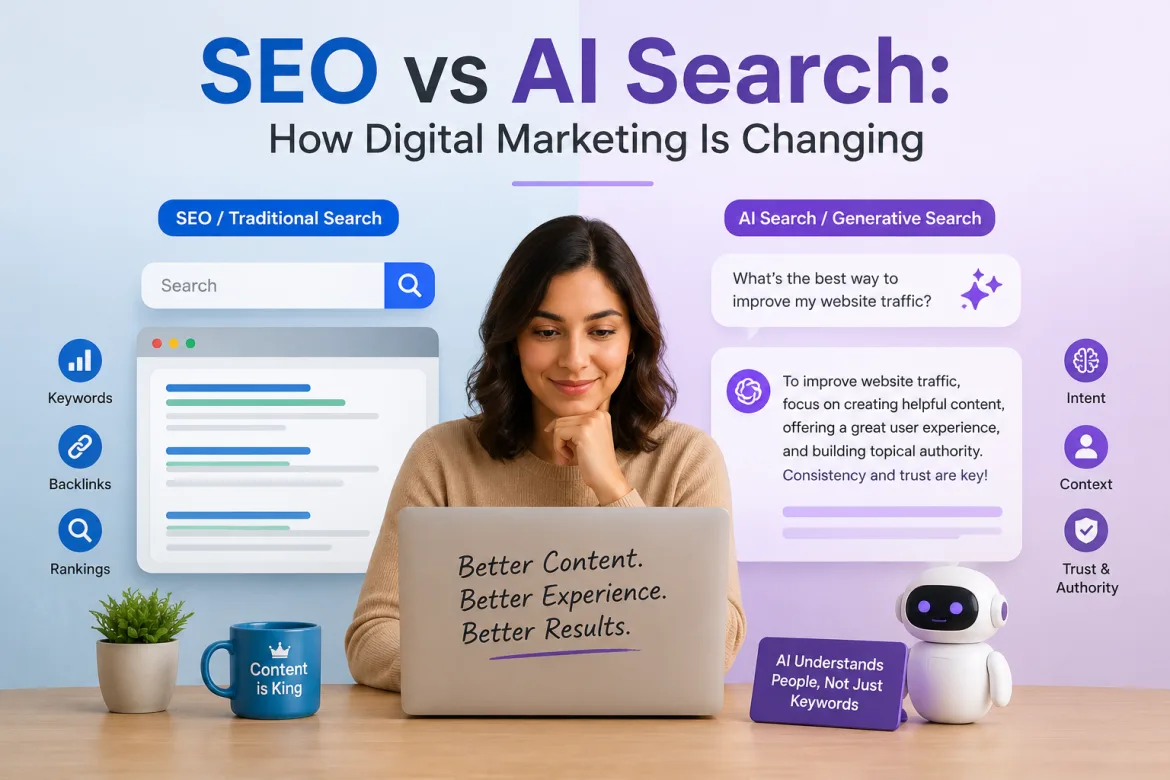
Digital marketing has always developed alongside technology, but the rise of artificial intelligence is causing one of the industry’s most significant upheavals in years. For decades, businesses used traditional Search Engine Optimization (SEO) to boost online presence, attract website visitors, and create leads via search engines. Today, AI-powered search engines are transforming how people find and consume information online.
Instead of browsing many websites for answers, consumers can now receive summarized responses provided by AI systems in seconds. This shift is affecting customer behavior, content strategies, and marketing priorities across industries. Businesses that recognize this shift early on will be better positioned to preserve visibility and remain competitive in an increasingly AI-driven digital market.
While some marketers perceive AI search as a threat to traditional SEO, the reality is far more balanced. SEO is not fading; rather, it is developing. Understanding how SEO and AI search operate together is now critical for business owners, marketers, and decision-makers seeking to establish a strong online presence.
Understanding Traditional SEO
SEO is the process of optimizing websites and content to show prominently in search engine results pages. When ranking websites, search engines take into account hundreds of characteristics such as content quality, keyword relevancy, page speed, mobile usability, backlinks, and user experience.
Google’s SEO Starter Guide provides additional guidance on search engine optimization and improving a website’s performance in Google Search.
The fundamental purpose of SEO is to provide visitors with useful information while assisting businesses in attracting qualified organic traffic. When done correctly, SEO creates long-term presence that can generate leads and consumers without the need for continued advertising.
Over time, SEO has become one of the most cost-effective digital marketing techniques. Businesses that routinely post quality content and maintain technically optimized websites benefit from improved search rankings, brand awareness, and customer trust.
What Is AI Search?
AI search makes use of artificial intelligence, machine learning, and natural language processing to comprehend user intent and offer direct, conversational responses. Instead of simply providing a list of URLs, AI systems can analyze data from numerous sources and provide short responses suited to the user’s inquiry.
Natural language processing (NLP) helps computers understand and communicate using human language and is an important technology behind conversational and AI-powered experiences.
This method leads to a more engaging search experience. Users can ask difficult questions, request comparisons, provide recommendations, and continue conversations without having to conduct additional searches. The end result is a faster and more convenient approach to find information.
For example, a user looking for marketing software would inquire, “Which CRM platform is best for a growing small business?” Rather than simply providing links, AI search can deliver a summarized answer outlining multiple viable solutions and their benefits.
Why User Search Behavior Is Changing
Consumer expectations are continually changing, as customers desire faster responses, personalized recommendations, and a more seamless search experience. AI-powered search engines match these expectations by making it easier to find relevant information and providing more immediate, context-aware responses.
The rise of voice assistants, chatbots, and conversational AI has altered how people interact with technology. Instead of typing short keyword-based queries, users now ask comprehensive, natural language questions, which improves the search experience and makes it more intuitive.
As search becomes more conversational, firms must rethink their content strategies. Understanding user intent, typical questions, and actual customer issues is now as vital as traditional keyword targeting.
- AI tools provide users with faster and more direct answers.
- Voice search promotes natural and question-based queries.
- Conversational AI is transforming how users interact with search systems.
- Content must prioritize user purpose over keywords.
In this changing market, businesses who align their content with actual user behavior will have a better chance of being visible and relevant.
SEO and AI Search: Key Differences
Although both SEO and AI searches assist consumers in finding information, their methodologies differ greatly. Traditional SEO aims to help webpages rank better in search engine results, thereby encouraging consumers to visit and study a website’s content.
AI search, on the other hand, aims to provide answers immediately within the search experience. Rather than merely recommending websites, AI systems assess data and provide simplified solutions that meet user intent rapidly.
Key differences include:
- SEO focuses on improving webpage ranks and organic traffic.
- AI search prioritizes direct responses and conversational engagement.
- SEO is mainly based on search visibility and clicks.
- AI search focuses on relevance, context, and user intent.
- SEO attracts traffic to websites, but AI search can provide answers without requiring a click.
Despite their differences, both strategies rely on high-quality material and authoritative information.
The Rise of AI-Driven Content Discovery
Content discovery is undergoing a significant transition as AI reshapes how people access and consume content. Instead of scrolling through several search results, customers now receive condensed answers that incorporate insights from a variety of reliable sources, making the experience faster and more straightforward.
This trend means that firms cannot rely solely on keyword rankings to acquire attention. They must produce high-quality, dependable, and well-structured content that AI systems deem useful enough to include in generated responses. In this new environment, consistency and precision have emerged as essential ranking indications.
- AI search offers summary answers rather than many results.
- Businesses should prioritize content quality before keyword optimization.
- Reliable, well-structured content is more likely to be referred.
- Expert-level material enhances visibility on AI-powered platforms.
Organizations that consistently provide authoritative, intelligent information are more likely to be identified by search engines and artificial intelligence systems, emphasizing the importance of quality over quantity.
Why Authority Matters More Than Ever
In an AI-driven search ecosystem, authority has become one of the most powerful factors influencing visibility and trust. AI systems prioritize content from credible and established sources when generating answers, making authority a critical ranking advantage.
Businesses can build authority by publishing original research, case studies, expert insights, and data-driven reports. Content that offers unique perspectives or verified information stands out far more than generic or repetitive articles found across the web.
- Authority aids AI systems in identifying trustworthy information sources.
- Original research and case studies improve brand credibility.
- Data-backed and expert content improves search visibility.
- Unique insights set firms apart from competition.
Finally, organizations that continually demonstrate authority acquire greater trust from both users and AI systems, resulting in long-term visibility, reputation, and growth.
Content Strategy in the AI Search Era
Content strategy is shifting from keyword-driven publishing to user-centered problem solutions. While keywords are still crucial, organizations must now generate content that actually answers issues and provides tangible value.
The most effective content frequently tackles specific consumer issues, offers extensive explanations, and exhibits genuine experience. Content that helps consumers make decisions does well in both traditional and AI-generated search settings.
Businesses should focus on:
- Creating comprehensive guides and educational resources.
- Answering frequently asked customer questions.
- Publishing original research and industry insights.
- Updating existing content regularly.
- Using clear, natural language that is easy to understand.
The goal is to develop material that users and AI systems perceive as genuinely useful and trustworthy.
The Growing Importance of Conversational Search
As AI use grows, conversational search is becoming a common component of the customer experience. Users increasingly want search results that recognize context, follow-up queries, and sophisticated requests.
This trend encourages marketers to focus on long-tail keywords and question-based search queries. Content that mimics how people naturally speak frequently performs better because it is more aligned with user intent.
For example, a user may type in “How can a small business improve local SEO without increasing its marketing budget?” Businesses who respond directly to questions like this are more likely to appear in AI-powered search results.
How Businesses Can Adapt
Companies that wish to stay competitive should mix classic SEO best practices with cutting-edge AI-driven techniques. Businesses that can successfully balance both methods will thrive in the future.
Several practical actions can help businesses prepare:
- Increase investment in technical SEO and website performance.
- Establish topical authority in your industry.
- Create helpful and experience-driven material.
- Improve content structure through clear titles and arrangement.
- Build brand credibility through thought leadership.
- Track search behavior and consumer expectations.
Adaptability will emerge as one of the most crucial competitive advantages in digital marketing over the next several years.
The Future of Digital Marketing
Search engines, AI assistants, speech technologies, and tailored recommendation systems will all play a role in shaping digital marketing’s future.
Brand trust, content quality, and subject expertise will all become more relevant as AI systems prioritize trustworthy and authoritative sources. Companies that prioritize true credibility will have a greater advantage in maintaining constant visibility and audience engagement.
At the same time, AI is not replacing search engines, but rather changing the way information is discovered. This transformation is resulting in a larger digital ecosystem in which users can get material via various intelligent channels, generating new opportunities for firms who adapt early.
- Digital marketing will move beyond traditional search engines.
- Brand authority and trust will be key ranking factors.
- AI and voice search will expand content finding options.
- Businesses should optimize for numerous platforms, not just Google.
Businesses who adapt early, establish strong authority, and develop high-quality content that performs well across both search engines and AI-powered platforms will have a competitive advantage in the digital marketing space.
SEO and AI Search Can Work Together
A widespread misperception is that organizations have to pick between traditional SEO and AI-powered optimization. In practice, both tactics complement one another, as AI systems continue to rely significantly on web-published and optimized material.
Strong SEO fundamentals including quality content, technical optimization, and user experience lay the groundwork for visibility in search engines and AI-powered platforms. Websites that adhere to SEO best practices are more likely to be mentioned and highlighted in AI-generated responses.
Google Search Central also provides guidance on how websites can appear in Google’s AI-powered search features and emphasizes that established SEO practices remain relevant.
Businesses can increase reach, reinforce authority, and build a more future-ready digital presence by viewing SEO and AI search as complementing initiatives rather than competitors.
- SEO lays the groundwork for AI visibility.
- High-quality content enhances performance on all platforms.
- Optimized websites for search engines and AI systems.
- Combining these tactics improves long-term digital reach.
This comprehensive approach ensures that organizations remain competitive in an ever-changing digital market where search and artificial intelligence intersect.
Conclusion
The discussion over SEO versus AI search is not about replacing one with the other. Instead, it demonstrates how digital marketing is adapting to changing customer expectations and technical improvements. Traditional SEO remains important for increasing organic visibility, while AI search is changing the way information is provided and consumed.
Businesses that use both tactics will be better positioned for long-term success. Organizations may remain visible regardless of how search technology advances by prioritizing high-quality content, authority, trust, user intent, and continual adaptability.
As AI continues to transform the digital world, firms that prioritize value, knowledge, and customer-focused content will have the best chance of growing. Businesses that understand not only how people search today, but also how they will search tomorrow, will have a competitive advantage in the digital marketing landscape.