

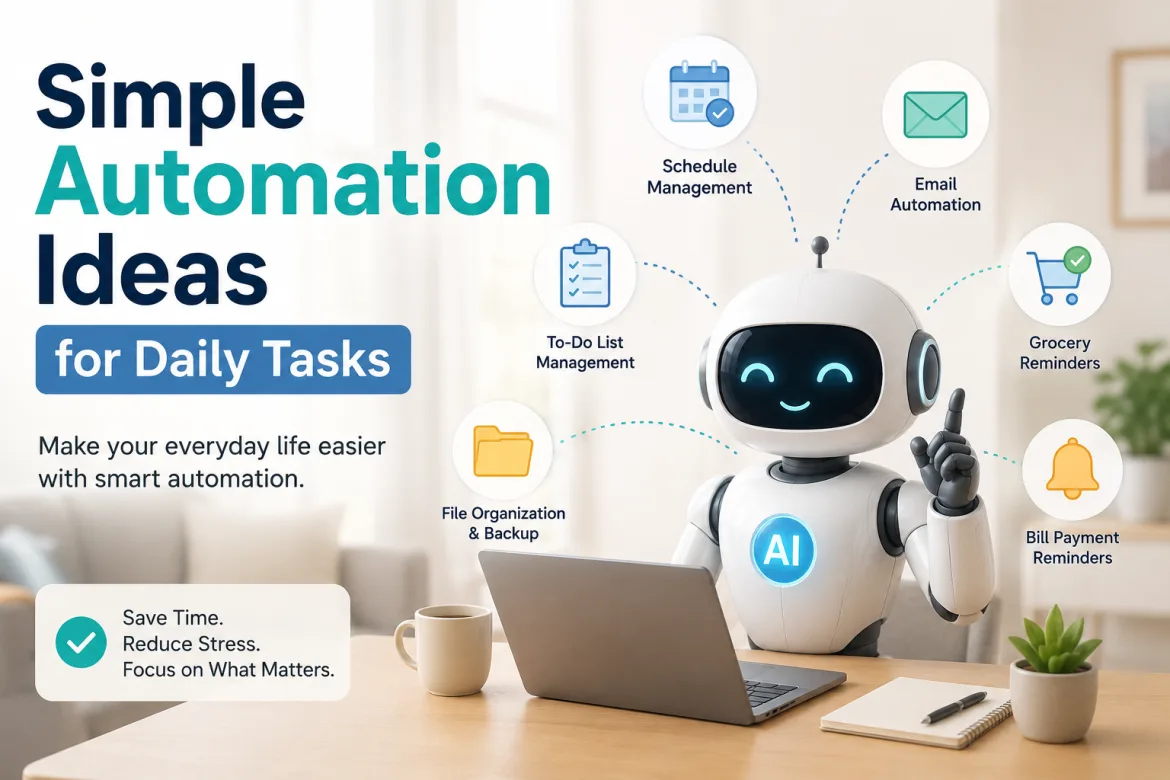
In 2026, corporations are moving quicker than ever. Teams are managing greater workloads, customers expect immediate replies, and competition is becoming more digital. In this context, manually performing repeated operations is no longer efficient. Emails, reporting, and file maintenance all take up time that may be better spent on growth-oriented tasks.
The good news is that automation is no longer just for major businesses. Startups, SMEs, freelancers, and expanding enterprises can now employ low-cost cloud tools, AI systems, and no-code platforms to automate daily activities. Even simple modifications can drastically minimize errors, save time, and increase productivity. This enables teams to focus more on strategy and innovation.
AI, cloud computing, and interconnected digital systems are all contributing to modern automation’s intelligence. Businesses that use automation early find faster growth, increased productivity, and better customer experiences. This guide delves into easy automation solutions that firms may put into action right away to improve their productivity in a digital-first era.
Why Automation Matters More in 2026
Automation has evolved beyond simply saving time. It is about creating a scalable business model that can respond to changing market demands. Businesses now handle massive amounts of data, distant staff, digital clients, and multi-channel communication. Manual methods create bottlenecks, slowing growth and raising operational costs.
Automation technologies have become more clever and accessible than ever before because to advances in AI and cloud services. Businesses may automate workflows without requiring substantial coding experience, making automation accessible to businesses of all sizes.
Some major benefits of automation include:
- Reduced manual errors
- Faster task completion
- Better data organization
- Enhanced customer experience
- Higher employee productivity
Companies that automate regular processes provide more flexibility for innovation. Employees can devote more time to problem resolution, service improvement, and business growth rather than repetitive tasks.
Simple Automation Ideas for Daily Tasks
Automating Email Management
Email is one of the most significant productivity challenges for businesses. Employees spend hours going through communications, responding to common questions, and organizing inboxes. Automation may greatly simplify email management.
AI-powered email tools can automatically:
- Automatically back up files
- Sync documents across devices
- Control file permissions
- Monitor unauthorized access
- Improve disaster recovery
A customer care business, for example, can automatically route technical inquiries to the IT team and billing inquiries to the finance department. This minimizes response time and increases customer satisfaction.
Cloud-based marketing tools enable businesses to automate newsletter campaigns, appointment reminders, and onboarding emails. These solutions offer regular communication without the need for manual effort every day.
Automating Daily Team Communication
Modern firms rely significantly on collaboration technologies, particularly as remote and hybrid work settings become commonplace in 2026. Daily updates, reminders, and meeting notifications can be automated.
Businesses can create workflows that:
- Identifying repetitive tasks
- Prioritizing high-impact workflows
- Testing automation gradually
- Monitoring performance regularly
- Maintaining strong cybersecurity practices
For example, a software development company can automate sprint updates within project management platforms. Team members receive real-time updates when tasks are finished or delayed.
AI meeting helpers are also gaining popularity. These systems automatically record discussions, provide summaries, identify action items, and send notes to team members following meetings.
AI-Powered Automation for Business Productivity
Smart AI Assistants for Daily Operations
Artificial intelligence has become fundamental to business automation plans. AI assistants can manage monotonous administrative tasks and improve decision-making processes.
Businesses are increasingly embracing AI for:
AI chatbots, for example, can provide 24-hour customer service without the need for human operators to handle every inquiry. Startups and SMEs gain especially since AI decreases manpower requirements while maintaining great service quality.
In 2026, conversational AI systems will integrate with CRMs, cloud storage, accounting platforms, and cybersecurity solutions. This results in highly integrated workflows that increase operational efficiency across departments.
Automating Customer Support
Customers’ expectations are changing rapidly. Businesses must respond quickly across websites, mobile apps, and social channels. Automation enables firms to better manage customer interactions.
Simple customer support automation ideas include:
AI Chatbots
AI chatbots can immediately answer basic queries, allowing businesses to cut support requests and increase customer happiness.
Automated Ticketing Systems
Support requests can be automatically sorted and assigned to the appropriate teams.
Self-Service Knowledge Bases
Businesses can automate frequently asked questions and support documents, allowing customers to resolve difficulties on their own.
Feedback Collection
Automated surveys can collect consumer feedback following interactions, allowing firms to continuously improve services.
These solutions are especially useful for e-commerce businesses, SaaS providers, healthcare platforms, and financial institutions.
Cloud-Based Automation Solutions
Automating File Management and Storage
Cloud computing will continue to dominate digital transformation tactics in 2026. Businesses are increasingly turning to cloud-based automation to improve accessibility, security, and collaboration. This move enables enterprises to scale operations more efficiently while lowering infrastructure costs and increasing system flexibility.
Cloud automation can help businesses:
For example, accounting firms can automate secure cloud backups for financial records, ensuring data protection and regulatory compliance.
Cloud-based automation also improves disaster recovery planning. If systems fail, businesses can quickly restore operations without major downtime.
Workflow Automation Across Departments
One of the biggest advantages of modern cloud platforms is workflow integration. Businesses can connect multiple applications into unified automation systems. This helps eliminate manual data transfer and ensures smoother, more efficient cross-platform operations.
Examples include:
Zapier workflows can connect applications and automate repetitive business tasks.
This level of connection boosts efficiency and reduces repetitious manual effort across divisions.
Cybersecurity Automation for Safer Operations
Why Security Automation Is Essential
As firms automate activities, cybersecurity becomes more critical. Phishing attacks, ransomware, and illegal access are examples of new hazards introduced by digital transformation. Cybersecurity automation enables firms to respond to threats faster and reduce vulnerabilities.
The key security automation strategies are as follows:
For example, AI-powered monitoring solutions can detect suspicious login attempts and prevent unwanted access before it does harm.
In 2026, organizations will use automation to ensure compliance with data privacy requirements. Automated compliance reporting lowers legal risks and simplifies audits.
Automation Ideas for Startups and SMEs
Affordable Automation Without Heavy IT Investment
Many small firms believe automation is costly or technically challenging. However, current no-code and low-code platforms have made automation widely available. These technologies enable users to create workflows fast without requiring sophisticated programming knowledge.
Start-ups and SMEs can automate:
A local service business, for example, can send booking confirmations, payment reminders, and follow-up messages automatically without the need for human intervention.
These minor enhancements result in significant productivity advantages over time, allowing firms to scale more efficiently.
Automation for Ecommerce Businesses
Ecommerce businesses are among the largest benefits of automation technologies. They use automated technologies to process orders, manage inventories, and provide customer service. This reduces the manual workload and improves operational precision.
Automation also allows for tailored marketing and speedier delivery updates to customers. It enhances the overall purchasing experience while boosting corporate efficiency and scalability.
Simple ecommerce automation ideas include:
Inventory Management
Stock levels can be automatically updated following a purchase.
Order Processing
Orders can promptly initiate shipping operations and customer alerts.
Personalized Marketing
Artificial intelligence systems can recommend products based on customer behavior.
Abandoned Cart Recovery
Automated emails can urge clients to make purchases.
Fraud Detection
AI-powered systems can detect suspicious transactions in real-time.
These automations enhance the client experience while lowering operational overhead.
Key Factors to Consider When Choosing Automation Tools
Scalability and Flexibility
Businesses should select automation solutions that can scale with the organization. A startup may require simple operations now, but more complicated integrations in the future.
Scalable automation solutions enable firms to expand without having to reinvent their systems from scratch.
Cybersecurity Standards
Automation systems frequently process sensitive corporate and customer information. Security should always be the first priority.
Businesses should evaluate:
A secure automation system mitigates operational risks while maintaining consumer trust.
AI Integration Capabilities
Modern automation is increasingly based on AI-powered decision-making. Businesses should select systems that provide AI capabilities such as predictive analytics, natural language processing, and intelligent workflow optimization.
AI integration boosts long-term efficiency and secures digital operations.
Ease of Integration
Automation tools should connect smoothly with existing business systems such as:
Microsoft Power Automate provides low-code and AI-powered workflow automation across applications and services.
Poor integration frequently causes workflow disruptions rather than productivity increases.
Vendor Reliability and Support
Choosing the proper technology partner is important to a successful automation installation.
Businesses should evaluate vendors based on:
A dependable IT service provider enables firms to quickly execute automation methods while minimizing downtime and technical hazards.
Common Automation Mistakes Businesses Should Avoid
Automating Broken Processes
One of the most prevalent mistakes is automating inefficient workflows before improving them. Automation should improve procedures rather than create more complication.
Ignoring Employee Training
Automation technologies are only useful if employees know how to use them correctly. Lack of training frequently results in low adoption rates and operational inefficiencies.
Over-Automating Customer Interactions
While automation increases efficiency, too much automation can make client interactions feel impersonal.
Neglecting Cybersecurity
Many firms prioritize productivity while ignoring security issues. Poorly configured automation systems can disclose critical business information.
Choosing Tools Without Long-Term Planning
Some firms use multiple separate tools that do not interact well. This causes operational silos and data fragmentation.
Emerging Automation Trends in 2026
Hyperautomation
Businesses are rapidly merging artificial intelligence, machine learning, robotic process automation, and cloud technology to create unified automation ecosystems.
Hyperautomation enables enterprises to automate whole operational chains rather than individual activities.
AI-Driven Decision Intelligence
Modern automation tools are increasingly predictive. AI systems can now evaluate historical data, identify trends, and make recommendations for operational changes automatically.
This enables firms to make faster, more informed decisions.
Low-Code and No-Code Development
Non-technical teams are increasingly creating automation workflows with drag-and-drop platforms.
The democratization of automation lowers development costs and speeds digital transformation initiatives.
Autonomous Cybersecurity Systems
AI-enabled cybersecurity automation is quickly evolving. Businesses are implementing systems that can identify, analyze, and respond to hazards without human interaction.
These solutions accelerate security reaction times while lowering operational risks.
Industry-Specific Automation
Automation systems are becoming more tailored to certain industries such as healthcare, banking, logistics, education, and manufacturing.
Industry-specific solutions improve compliance, workflow customization, and operational efficiency.
Building a Sustainable Automation Strategy
Successful automation does not include replacing people. It is about providing teams with better tools and more efficient workflows.
Businesses should approach automation strategically by:
A sustainable automation plan boosts productivity while also promoting long-term business success.
Conclusion
Simple automation concepts, when applied thoughtfully, can have a significant commercial impact. From AI-powered customer assistance to cloud-based workflow management and cybersecurity automation, modern organizations have more ways than ever to optimize their daily operations.
Automation will be required for firms to remain competitive by 2026. Automation is being used by startups, SMEs, and enterprises to decrease manual work, improve customer experiences, strengthen security, and grow more efficiently.
The key is choosing the right tools, integrating systems properly, and partnering with experienced technology providers who understand business goals and digital transformation strategies. Businesses that automate intelligently today will be better positioned for innovation, growth, and long-term success tomorrow.