

Website performance has emerged as one of the most critical aspects influencing search engine results and user experiences. Visitors want websites to load quickly, reply promptly, and offer a seamless surfing experience. When a website fails to match these expectations, consumers frequently depart without engaging with the content or completing a transaction. This has a direct impact on traffic, conversion rates, and overall business growth.
Google launched Core Web Vitals to assess real-world user experience and urge website owners to build quicker, more reliable websites. These performance measures assist search engines in determining how users interact with a page and whether the browsing experience fulfills modern expectations. Websites with strong Core Web Vitals frequently have more engagement and search exposure.
For business owners, strengthening Core Web Vitals is more than just a technical SEO task. It is a strategic investment that affects customer satisfaction, lead generation, sales, and brand reputation. Understanding these parameters and making practical modifications can help websites compete more successfully in search results while also providing a better user experience.
Understanding Core Web Vitals
Core Web Vitals are a set of user-focused performance measures established by Google to assess how users interact with a webpage. Rather than focusing solely on technological speed, these measurements consider how rapidly users can view content, interact with the page, and navigate without sudden layout shifts. This user-centric strategy makes them extremely beneficial to both SEO and business success.
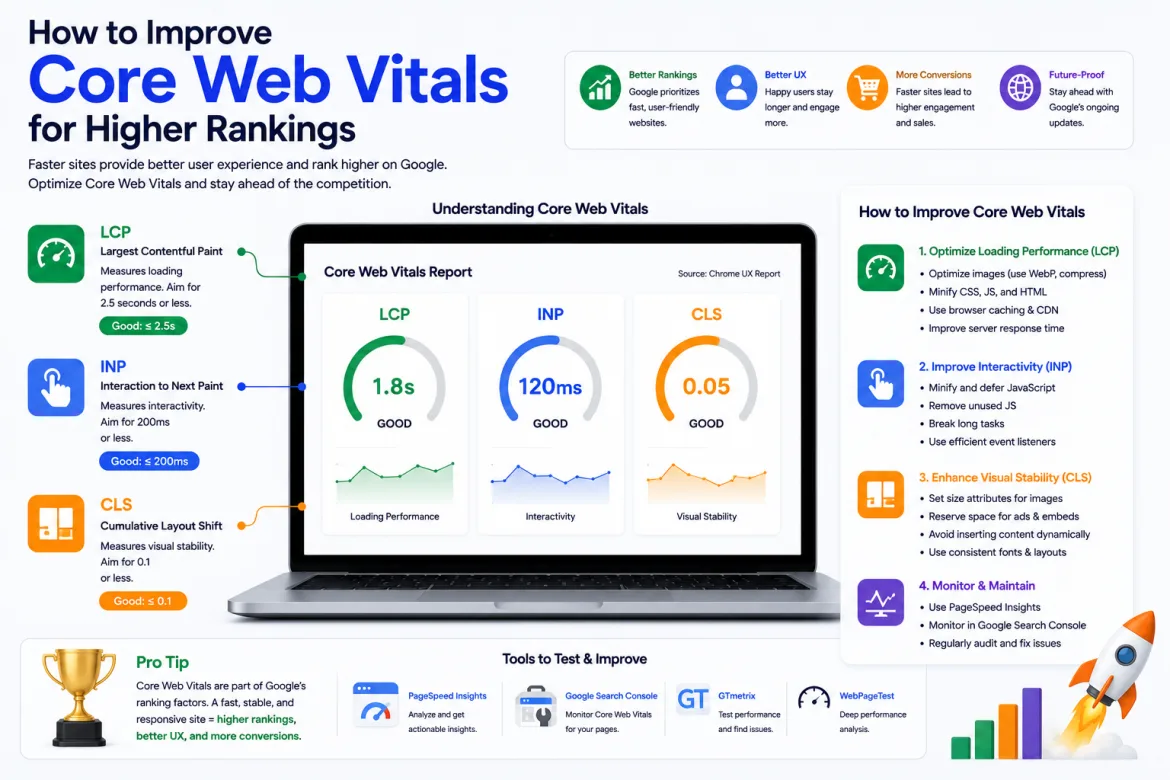
The three main Core Web Vitals metrics are Largest Contentful Paint (LCP), Interaction to Next Paint (INP), and Cumulative Layout Shift. Each indicator captures a different aspect of website performance. They give a full assessment of page performance, responsiveness, and visual stability.
A website with strong Core Web Vitals provides a smooth and engaging experience for visitors. Users can obtain information fast, communicate without delay, and browse without being frustrated by graphic changes. These enhancements frequently result in longer session durations, decreased bounce rates, and improved conversion rates.
Businesses who prioritize Core Web Vitals show a dedication to the consumer experience. Because user satisfaction is inextricably linked to revenue generation and brand reputation, increasing these measures can yield benefits that go beyond search rankings.
Why Core Web Vitals Matter for SEO
Google considers page experience signals for ranking websites. While content relevance remains the most essential ranking criteria, website performance might influence how pages compete when the same material appears on several domains. Improved performance can offer a significant competitive advantage.
A sluggish website generally leads to higher abandonment rates. Users are less inclined to wait for material to load, particularly on mobile devices with extremely high performance expectations. Poor performance can lower engagement and limit visitor conversions.
Core Web Vitals influence how users perceive a brand. Websites that are fast and responsive convey a professional image and foster trust. Visitors are more inclined to interact with a company that provides a seamless digital experience rather than one that is outdated or difficult to browse.
As search engines continue to prioritize user experience, Core Web Vitals are expected to play an essential role in technical SEO. Businesses that continuously analyze and improve these KPIs set themselves up for better long-term search performance.
Largest Contentful Paint (LCP): Improving Loading Performance
Largest Contentful Paint measures how long it takes for the largest visible element on a page to load. This element is often a hero image, banner, featured product image, or major content block. Google recommends achieving an LCP score of 2.5 seconds or less for a good user experience.
Slow server response times are one of the most common causes of poor LCP performance. When hosting infrastructure cannot deliver content efficiently, visitors experience noticeable delays before seeing meaningful page content. Upgrading hosting resources or using optimized server configurations can significantly improve loading speed.
- Large images reduce LCP performance
- High-resolution images slow page speed
- Use compression and WebP format
- Enable responsive image delivery
Content delivery networks (CDNs) enhance LCP by distributing website assets over several worldwide servers. Visitors receive material from the nearest server location, which reduces latency and speeds up page rendering. This technique is especially advantageous for businesses that serve audiences from multiple regions.
For more information about measuring and improving Core Web Vitals, visit Google PageSpeed Insights.
Interaction to Next Paint (INP): Enhancing Responsiveness
Interaction with Next Paint determines how quickly a webpage replies when people interact with it. Examples include clicking buttons, opening menus, submitting forms, and moving through sections. A responsive website improves user experience and increases engagement.
Excessive JavaScript execution is frequently responsible for slow responsiveness. Large scripts can use browser resources and cause delays in interactions. Reducing superfluous JavaScript and improving code execution can improve page responsiveness dramatically.
Third-party scripts, including advertising platforms, analytics tools, and social media widgets, can all have an impact on INP performance. While these tools have useful features, excessive use can slow interactions and cause delays. Regular audits assist in identifying scripts that have a detrimental impact on performance.
Efficient coding approaches help to improve responsiveness. Developers can boost efficiency by dividing down complex activities into smaller procedures, reducing render-blocking resources, and prioritizing key user interactions. These enhancements contribute to a more responsive browsing experience.
Cumulative Layout Shift (CLS): Maintaining Visual Stability
Cumulative Layout Shift tracks unexpected visual movements that occur while a page loads. When buttons, graphics, or information move unexpectedly, causing unintended clicks, users may become frustrated. Maintaining visual steadiness increases usability and consumer happiness.
Missing picture dimensions are a common cause of layout alterations. When browsers do not know the size of a picture before it loads, the surrounding content may change unexpectedly. Defining picture proportions helps to reserve required space and prevent movement.
Advertisements and embedded content can also cause layout adjustments. Dynamic items that load after the primary content frequently knock other page elements out of place. Allocating reserved space for these pieces contributes to a uniform layout.
Web typefaces might cause CLS difficulties when text changes appearance after loading. Using optimal font-loading procedures and fallback fonts decreases visual instability and improves the reading experience for visitors.
Key Factors That Influence Core Web Vitals
Several website components have a direct impact on Core Web Vitals’ performance. Understanding these characteristics enables firms to prioritize their optimization efforts and achieve demonstrable results.
Key factors include:
- Server performance and hosting quality
- Image optimization and file compression
- JavaScript and CSS efficiency
- Content delivery network implementation
- Mobile responsiveness
- Third-party script management
- Browser caching and resource optimization
Regular performance audits can assist discover which aspects have the biggest influence on a website’s Core Web Vitals scores and overall user experience.
Practical Strategies to Improve Core Web Vitals
The first step in website optimization should be to measure performance. Google PageSpeed Insights, Lighthouse, and Search Console are useful tools for identifying performance issues. These tools assist discover areas for improvement and track progress over time.
Image optimization is one of the quickest ways to see noticeable results. Image compression, lazy loading, and the use of appropriate file formats can all help to reduce page weight significantly. This generally results in faster loading times and more user satisfaction.
Minifying CSS, JavaScript, and HTML files helps to remove extraneous code and minimize resource sizes. Smaller files load faster and need less processing power, resulting in better overall website performance across devices.
Caching methods also help to increase performance. Browser caching allows frequently used resources to be saved locally, minimizing repeat downloads and speeding up page loading for returning visitors.
Website owners can also use Google Search Console to monitor website performance and Core Web Vitals reports.
The Role of Mobile Optimization
Mobile traffic continues to dominate online browsing activity. Because Google evaluates websites primarily through mobile-first indexing, mobile performance has become crucial for both SEO and user experience.
Mobile users frequently browse at different network speeds and device capabilities. A website that performs well on desktop may struggle on mobile devices if optimization efforts are not carefully executed. Testing on multiple devices helps to discover potential problems.
Responsive design ensures that content adapts seamlessly to various screen sizes. Properly optimized layouts, graphics, and navigation features help Core Web Vitals run better on mobile devices.
Businesses that focus mobile optimization provide a better experience for the vast majority of their visitors. This often leads to increased engagement, longer sessions, and higher conversion rates.
Common Mistakes That Hurt Core Web Vitals
Many organizations unintentionally degrade website performance by making avoidable blunders. Identifying these issues early can help to avoid ranking and usability concerns.
Common mistakes include:
- Uploading oversized images without compression
- Using excessive third-party scripts
- Ignoring mobile performance testing
- Choosing low-quality hosting services
- Failing to reserve space for images and advertisements
- Adding unnecessary animations and effects
Avoiding these blunders can boost performance while decreasing the need for large technical improvements in the future.
Real-World Business Benefits of Better Core Web Vitals
Improved Core Web Vitals frequently translate into measurable commercial results. Faster websites encourage users to stay longer and engage with more content. This increased engagement opens up more potential for conversions and revenue growth.
E-commerce websites commonly see increased conversion rates following performance enhancements. Even little decreases in page load time can have a significant impact on product views, cart completions, and transactions.
Lead generating websites benefit from improved performance analytics. Faster forms, responsive interactions, and solid layouts all contribute to a more seamless experience, encouraging visitors to finish inquiries and contact requests.
Beyond conversions, improved Core Web Vitals boost brand reputation. Customers equate speed and dependability with professionalism, which helps organizations establish trust and credibility in competitive industries.
The Future of Core Web Vitals and SEO
Google is constantly updating its method to assessing user experience. As technology advances, performance measures may become more sophisticated and relevant to real-world encounters. Businesses can expect user experience to be an important ranking factor.
Artificial intelligence, enhanced browser technology, and improved web standards are anticipated to have an impact on future optimization tactics. Websites that implement modern performance techniques will be better prepared for future developments.
Users’ expectations are also rising. Visitors demand fast loading, smooth interactions, and consistent experiences across devices. Businesses that fail to satisfy these standards risk losing clients to competitors that have better-performing websites.
Investing in Core Web Vitals now provides a solid basis for future SEO success. Continuous monitoring and optimization ensure that websites remain competitive as search engines and user behavior change.
For additional technical guidance and documentation, visit Google Web Vitals.
Conclusion
Core Web Vitals have become an indispensable component of modern SEO and website performance improvement. Businesses may improve loading speed, responsiveness, and visual stability to provide better user experiences while increasing search exposure. These enhancements frequently result in greater engagement, trust, and conversion rates.
A effective Core Web Vitals plan necessitates continual attention, regular performance monitoring, and a focus on user experience. Businesses that emphasize these KPIs set themselves up for long-term growth, higher rankings, and digital success in an increasingly competitive online world.