

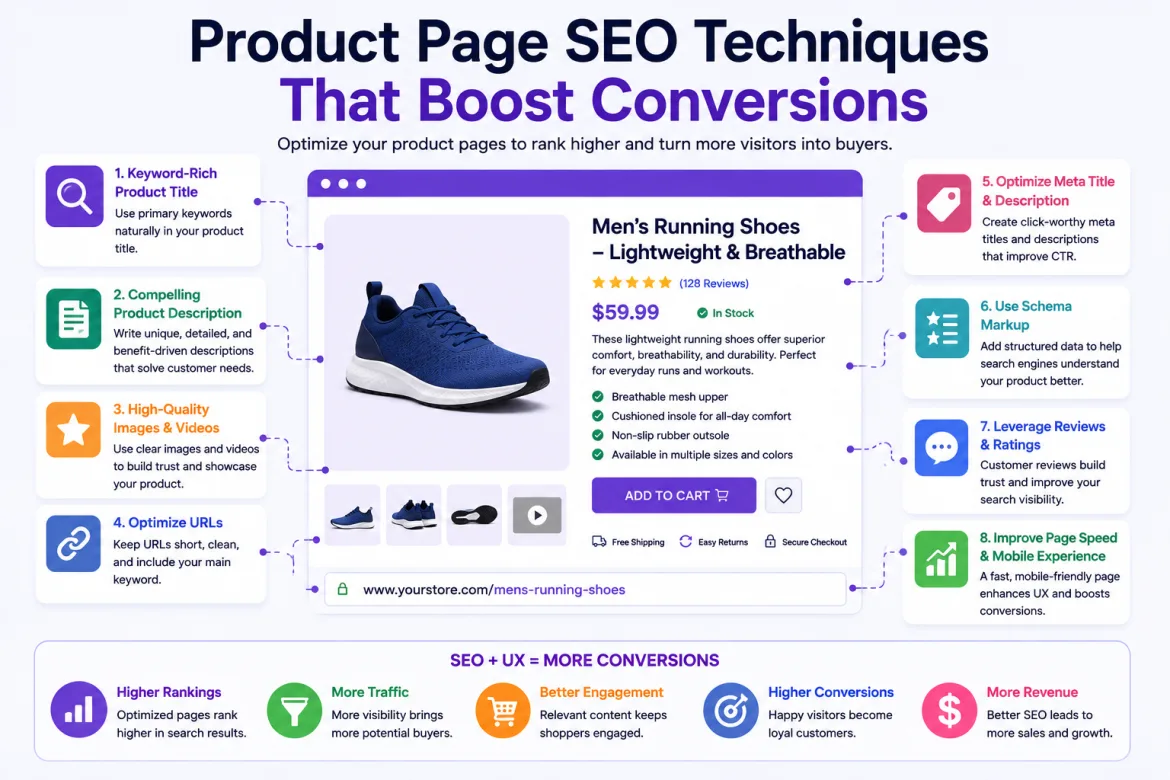
Product Page SEO: How to Increase Conversions
In today’s competitive eCommerce landscape, simply having an online store is not enough to generate consistent sales. Businesses invest significant resources in attracting visitors through search engines, social media, and paid advertising, but many struggle to convert that traffic into actual customers. This is where product page SEO plays a critical role in bridging the gap between visibility and revenue.
A product page is often the final destination before a customer decides whether to make a purchase. If the page lacks relevant information, loads slowly, or fails to address customer concerns, visitors may leave without completing the transaction. On the other hand, a well-optimized product page can improve search rankings while creating a seamless buying experience that encourages conversions.
Product page SEO is not just about adding keywords to descriptions. It involves optimizing content, images, user experience, technical elements, and trust signals to meet both search engine requirements and customer expectations. By implementing the right strategies, businesses can increase organic traffic, improve engagement, and ultimately boost sales.
Understand Search Intent Before Optimizing
Successful product page SEO begins with understanding the intent behind customer searches. People searching for products online are often at different stages of the buying journey. Some may be researching options, while others are ready to make an immediate purchase. Identifying these intentions helps businesses create content that matches customer expectations.
Search intent directly influences keyword selection. Instead of targeting broad terms with high competition, businesses should focus on specific keywords that indicate purchasing intent. For example, someone searching for “best waterproof hiking boots for men” is likely closer to buying than someone searching for “hiking boots.”
Understanding intent also helps improve product descriptions, titles, and calls-to-action. When content aligns with what customers are looking for, they are more likely to stay on the page and engage with the product. This improves user experience while sending positive signals to search engines.
Businesses should regularly analyze search queries, customer behavior, and competitor strategies to identify valuable keywords. By aligning product pages with customer intent, companies can attract highly qualified traffic that has a greater chance of converting into sales.
Create Unique and Detailed Product Descriptions
Many online stores rely on manufacturer-provided descriptions, which often appear on multiple websites. This creates duplicate content issues that can limit search visibility and reduce opportunities to stand out from competitors.
Unique product descriptions allow businesses to communicate directly with their target audience. Instead of simply listing technical specifications, descriptions should explain how the product solves a problem or improves the customer’s life. This approach makes the content more engaging and persuasive.
Detailed descriptions also provide search engines with additional context about the product. Including relevant keywords naturally throughout the content helps improve rankings while ensuring the page remains informative and easy to read.
For example, rather than stating that a laptop has a long-lasting battery, explain how the battery supports remote work, travel, or extended productivity. This practical information helps customers visualize the benefits and increases the likelihood of a purchase.
Optimize Product Titles for Search and Clicks
Product titles are one of the most important SEO elements on a product page because they help search engines understand the content and influence user click-through rates. A well-optimized title clearly describes the product and includes key details such as brand, model, size, color, or major features.
- Clearly describe the product with relevant keywords
- Include brand name, model, size, color, or key features
- Improve search visibility for relevant queries
- Increase click-through rates from search results
- Well-structured titles improve visibility, reduce user confusion, and enhance the overall shopping experience.
For example, a title like “Samsung Galaxy Watch 6 Bluetooth Smartwatch – 44mm Black” is far more effective than a generic title like “Smartwatch” because it provides clarity and encourages more clicks.
Write Compelling Meta Titles and Meta Descriptions
Meta titles and meta descriptions serve as the first impression of your product page in search engine results. Although users may never have visited your website before, these elements can influence whether they choose your listing over a competitor’s.
A strong meta title should include the primary keyword and product name while remaining concise and readable. It should accurately represent the content of the page and encourage users to click.
Meta descriptions provide an opportunity to highlight product benefits, promotions, pricing advantages, or unique selling points. A compelling description can significantly improve click-through rates from organic search results.
Businesses should regularly review and update metadata to ensure it remains relevant and competitive. Well-crafted metadata not only improves visibility but also attracts visitors who are more likely to convert.
Use High-Quality Product Images with SEO Optimization
Visual content plays a major role in online purchasing decisions because customers rely on images to evaluate product quality, design, and functionality before buying. High-quality visuals create a professional impression and build trust with potential buyers. Multiple images showing different angles and real-life usage help customers make more informed decisions while improving overall engagement.
Key Image Optimization Practices
- Use high-resolution images while maintaining fast loading speeds.
- Add descriptive file names that include relevant keywords.
- Write accurate and meaningful alt text for every image.
- Compress image files to improve page performance.
Optimizing product images not only enhances user experience and trust but also improves SEO performance, leading to better visibility and higher conversion rates.
Improve Product Page Loading Speed
Website speed has become a critical ranking factor and a major contributor to user satisfaction. Customers expect pages to load quickly, and delays can lead to frustration and abandoned purchases.
A slow-loading product page can negatively impact bounce rates, engagement metrics, and conversion rates. Even a small delay can result in lost revenue, particularly for mobile users who expect instant access to information.
Businesses should regularly monitor page performance using speed testing tools. Identifying and resolving technical issues helps maintain a smooth shopping experience. Consistent monitoring ensures your website stays fast, reliable, and optimized for both users and search engines.
Common improvements include image compression, browser caching, code optimization, and reliable hosting services. Faster pages improve both SEO performance and customer satisfaction, creating a stronger foundation for conversions.
Implement Structured Data for Better Visibility
Structured data helps search engines understand product information more effectively. By providing additional context, businesses can improve how their products appear in search results.
Schema markup can display valuable information such as pricing, availability, ratings, and reviews directly within search listings. These enhanced results often attract more attention than standard listings.
Rich snippets help users quickly evaluate products before clicking. When customers can see ratings and pricing information immediately, they are more likely to visit the page if it matches their needs.
Implementing structured data also improves communication between websites and search engines. This can lead to better indexing, increased visibility, and higher-quality traffic over time.
Optimize Calls-to-Action and User Experience
Driving traffic to a product page is only part of the conversion process. Businesses must also guide visitors toward taking action once they arrive on the page.
Calls-to-action such as “Buy Now,” “Add to Cart,” or “Get Yours Today” should be clearly visible and strategically placed. Customers should never have to search for the next step in the purchasing process.
User experience extends beyond button placement. Product pages should provide clear pricing, shipping information, return policies, and product availability. Transparency helps reduce hesitation and builds trust.
A smooth and intuitive shopping experience encourages customers to complete purchases. When users can easily navigate the page and find the information they need, conversion rates often improve significantly.
Internal Linking for Better Navigation and SEO
Internal linking helps search engines understand your website structure while improving navigation for users by connecting related products and content. It encourages visitors to explore more pages, increasing engagement and reducing bounce rates, which can lead to higher conversions and better customer retention. Additionally, internal links distribute SEO value across your site, helping important pages perform better in search results.
Effective Internal Linking Strategies
- Link related products within product pages.
- Connect products to relevant category pages.
- Include links to buying guides and educational resources.
- Create clear navigation paths across the website.
- Highlight popular or best-selling products where relevant.
Effective internal linking not only improves website navigation but also strengthens your overall SEO performance by distributing authority across important pages. When implemented strategically, it enhances user experience, increases engagement, and supports higher rankings in search results.
Key Factors That Influence Product Page SEO Success
Several factors work together to determine the effectiveness of product page SEO. Businesses that focus on these areas are more likely to achieve sustainable growth and stronger conversion rates.
Key Factors to Focus On
- Search intent and keyword relevance.
- Unique and valuable product content.
- Fast page loading speed.
- Mobile-friendly design.
- Customer reviews and trust signals.
Consistently improving these factors helps businesses create product pages that satisfy both search engines and customers. Over time, these improvements contribute to stronger rankings and increased sales.
Optimize for Mobile Shopping
Mobile shopping continues to dominate the eCommerce industry, making mobile optimization essential for success. A growing percentage of online purchases now occur through smartphones and tablets.
Search engines prioritize mobile-friendly websites because they provide a better experience for users. Businesses that neglect mobile optimization risk losing both rankings and potential customers.
Product pages should display correctly across all screen sizes and maintain fast loading speeds. Navigation, images, and checkout processes should be designed with mobile users in mind.
A seamless mobile experience improves customer satisfaction and increases the likelihood of conversions. As mobile commerce continues to expand, businesses must prioritize mobile optimization as part of their SEO strategy.
The Future of Product Page SEO
The future of product page SEO will be shaped by advancements in artificial intelligence, voice search, and personalized shopping experiences. Search engines are becoming increasingly sophisticated in understanding user behavior and intent.
AI-powered search algorithms will continue rewarding websites that provide valuable, relevant, and user-focused content. Businesses will need to focus more on customer experience rather than relying solely on traditional keyword optimization.
Voice search is also influencing how consumers search for products online. Product pages optimized for conversational queries may gain a competitive advantage as voice-assisted shopping becomes more common.
Additionally, personalization will play a larger role in eCommerce success. Businesses that use customer data to deliver tailored product recommendations and experiences will likely see stronger engagement and conversion rates in the years ahead.
Common Product Page SEO Mistakes to Avoid
Many businesses unknowingly limit their SEO performance by making avoidable mistakes. Identifying and correcting these issues can significantly improve rankings and conversions. Avoiding these errors helps ensure better visibility, stronger user experience, and more consistent organic traffic growth.
Common Mistakes
- Using duplicate manufacturer descriptions.
- Ignoring image optimization and alt text.
- Creating unclear or incomplete product titles.
- Neglecting mobile user experience.
- Failing to collect customer reviews.
Avoiding these mistakes helps create a stronger foundation for both search visibility and customer engagement. Regular audits can help businesses identify opportunities for improvement before they impact performance.
Conclusion
Product page SEO is more than just improving search rankings; it is a complete approach that combines content optimization, technical performance, user experience, and trust-building elements to deliver real business results. Businesses that focus on understanding customer intent, creating unique content, improving page speed, using reviews, and enhancing mobile experience can gain a strong competitive advantage while attracting more organic traffic.
As eCommerce continues to grow, product pages will remain one of the most valuable assets for online success. Implementing effective SEO strategies and adapting to changing trends helps businesses increase conversions, build stronger customer relationships, and achieve long-term sustainable growth.