

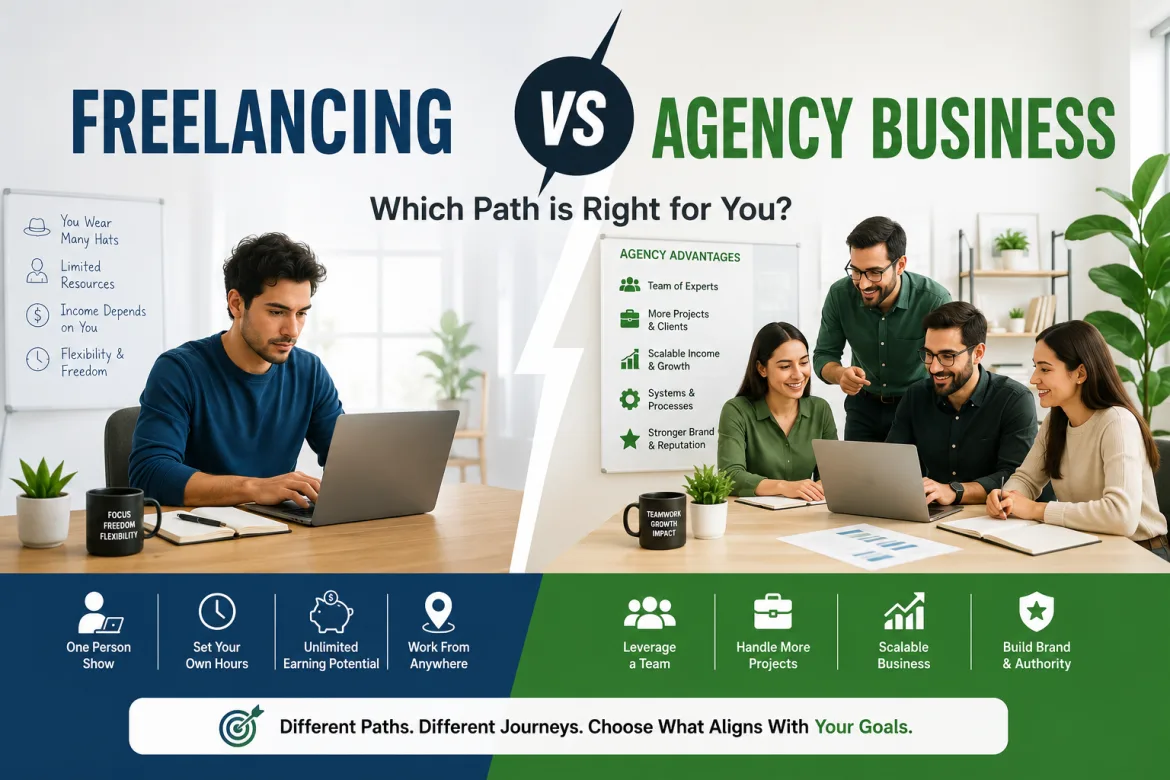
In today’s digital economy, earning money online is no longer limited to traditional jobs. Two of the most popular paths for professionals and entrepreneurs are freelancing and running an agency business. Both models offer flexibility, income potential, and independence, but they operate in very different ways.
Freelancing is often seen as the starting point for many individuals entering the online business world. It allows one person to offer skills directly to clients and get paid per project or hour. On the other hand, an agency business is a more structured model where a team delivers services to multiple clients at scale.
Choosing between freelancing and building an agency is not just about income. It also involves lifestyle preferences, long-term goals, risk tolerance, and leadership ability. This blog will break down both models in detail so you can clearly understand which direction aligns better with your future goals.
Understanding Freelancing: A Solo Skill-Based Business
Freelancing is a self-employed model where an individual provides services like writing, design, development, marketing, or consulting directly to clients. The freelancer manages everything alone, from finding clients to delivering work and handling payments.
It is one of the simplest ways to start an online career because it requires low investment and no team setup. Many professionals begin freelancing as a side income before turning it into a full-time career.
Key Points About Freelancing
- Low startup cost and easy entry into the market
- Complete control over working hours and clients
- Income depends directly on time and effort
- Best for individuals with strong technical or creative skills
Freelancing offers independence and flexibility, but it also limits scalability since income is tied to personal working capacity.
Understanding Agency Business: A Scalable Service Model
An agency business is a structured organization where a team works together to deliver services to multiple clients. Instead of one person handling everything, tasks are divided among specialists like designers, marketers, developers, and managers.
This model focuses heavily on systems, delegation, and scalability. Agencies can handle larger workloads because multiple people work on different parts of the same project simultaneously.
Key Points About Agency Business
- Built for scalability and team collaboration
- Multiple clients handled simultaneously through delegation
- Requires leadership, management, and operational systems
- Higher income potential but also higher responsibilities
Agencies are not just service providers; they operate like full business systems designed for growth and long-term sustainability.
Key Differences Between Freelancing and Agency Business
| Factor | Freelancing | Agency Business |
|---|---|---|
| Structure | Freelancing is individual-driven, where one person handles all client work independently. | Agency business is system-driven, relying on teams, processes, and delegation. |
| Work Approach | Focuses on personal skills and direct execution of tasks. | Focuses on managing projects, teams, and scalable systems. |
| Income Model | Earnings are based on hours worked or individual project fees. | Revenue comes from multiple clients, retainers, and scalable service packages. |
| Scalability | Limited growth as income depends on personal time and availability. | High scalability through hiring, outsourcing, and automation. |
| Risk Level | Lower financial risk but limited long-term growth potential. | Higher operational complexity but greater long-term earning potential. |
| Client Management | Handles clients directly with minimal support structure. | Uses account managers, systems, and structured communication processes. |
Income Potential: Freelancing vs Agency
Income is one of the biggest factors when choosing between freelancing and agencies. Freelancers can earn well depending on skill level and demand, especially in high-value niches like design, development, or marketing.
However, freelancing income has a natural limit because one person can only handle a certain number of projects at a time. Even high-paying freelancers eventually hit a capacity ceiling.
Agencies, on the other hand, can scale income by adding more clients and expanding the team. This allows revenue to grow without being limited by one individual’s time.
Key Points on Income
- Freelancers have limited earning capacity due to time constraints
- Agencies can generate multiple income streams simultaneously
- Freelancers rely on skill-based pricing, agencies rely on scaling systems
- Agencies have higher revenue potential but also higher operational costs
Skills Required for Freelancing vs Agency Building
Freelancing primarily requires strong technical or creative skills. Whether it’s writing, coding, designing, or marketing, your ability to consistently deliver high-quality work determines your success. These skills directly impact client satisfaction and long-term reputation.
Soft skills like communication, time management, and negotiation are also important, especially when dealing with clients directly. Strong interpersonal skills help freelancers build trust and secure repeat projects.
Agency building requires a broader and more strategic skill set. In addition to service expertise, you need leadership, team management, sales, marketing strategy, and operational planning skills. These capabilities help you manage growth and coordinate multiple clients effectively.
An agency owner must think like a business leader rather than just a service provider, focusing on systems and scalability instead of only execution. This shift in mindset is often the biggest challenge for freelancers transitioning into agencies.
Workload and Lifestyle Differences
One of the biggest advantages of freelancing is control over workload. You decide how many clients to take and when to work. This makes it suitable for people who prefer flexibility and independence. It also allows better work-life balance for those managing personal priorities.
However, freelancers often face inconsistent workloads. Some months may be highly profitable, while others may be slow. This unpredictability can make financial planning more challenging over time.
Agency owners typically have a more structured workload. While the responsibility is higher, tasks are distributed across a team, reducing personal execution pressure. This allows for handling multiple clients more efficiently at scale.
However, agency owners often work longer hours initially, especially during the growth phase. Managing clients, employees, and operations can be demanding until systems are properly established. Over time, these systems help create more stability and predictable operations.
Scalability: The Biggest Divider Between the Two Models
Scalability is where freelancing and agencies differ the most. Freelancing is limited by individual capacity, meaning growth is restricted by time and energy.
Even highly successful freelancers eventually face limitations because they cannot expand beyond a certain number of clients without sacrificing quality or burnout.
Agencies solve this problem by building systems and hiring teams. This allows them to take on more clients without increasing the founder’s workload directly.
Key Scalability Insights
- Freelancers grow linearly, agencies grow exponentially
- Agencies use delegation to expand capacity
- Freelancers depend on personal availability
- Agencies are built for long-term scaling
Client Acquisition and Business Growth
Freelancers usually rely on personal branding, referrals, freelance platforms, and social media to find clients. Growth depends heavily on individual effort and reputation. Building strong relationships and delivering consistent quality work plays a key role in long-term success.
Agencies use more structured marketing strategies such as paid ads, SEO, outbound sales, partnerships, and lead generation systems. This allows them to attract clients more consistently and scale their operations beyond personal networks.
However, agencies also face higher competition and need stronger branding to build trust. Clients often expect agencies to deliver more reliability, faster turnaround, and higher professionalism compared to individual freelancers. Over time, strong systems and marketing processes help agencies achieve more predictable and scalable growth.
Over time, agencies that successfully implement structured marketing systems and client acquisition processes are able to reduce dependency on individual effort and create more predictable revenue streams. This shift allows them to scale operations, serve more clients efficiently, and build a stronger long-term business foundation.
Common Challenges in Freelancing
Freelancing comes with several challenges despite its simplicity. The biggest issue is income instability, as work is not always consistent throughout the year. Another challenge is working alone, which can lead to isolation and reduced motivation over time. Freelancers also often struggle with managing multiple clients and handling revisions.
Key Challenges
- Unstable and inconsistent income flow
- Limited scalability due to time constraints
- Difficulty in managing multiple clients alone
- Risk of burnout from continuous workload
Freelancing requires strong discipline and self-management to succeed long-term.
Common Challenges in Agency Business
Running an agency introduces more complex challenges compared to freelancing. Hiring the right team members and maintaining quality across projects is often difficult. Agencies also face cash flow issues since expenses like salaries, tools, and marketing must be managed even when client payments are delayed.
Key Challenges
- Hiring and retaining skilled team members
- Managing operational costs and cash flow
- Maintaining consistent service quality
- Avoiding dependency on the founder
Despite these challenges, agencies offer higher long-term growth potential when managed properly.
Future of Freelancing and Agency Models
The future of both freelancing and agency businesses looks promising, especially with the growth of remote work and digital transformation. These trends are creating more global opportunities, allowing professionals and businesses to collaborate beyond geographical boundaries.
Freelancing is expected to continue growing as more companies prefer flexible, on-demand talent instead of full-time hiring. Platforms and digital marketplaces will further expand opportunities for skilled individuals.
At the same time, agency models are evolving into more specialized and niche-focused businesses. Instead of offering broad services, modern agencies are focusing on specific industries or solutions, such as performance marketing, AI automation, or SaaS growth.
Interestingly, many freelancers eventually transition into agencies once they reach capacity. This hybrid evolution is becoming a common path in the digital business world.
Automation tools and AI are also reshaping both models. Tasks that once required manual effort are now being streamlined, allowing freelancers and agencies to focus more on strategy and creativity.
Which One Should You Choose?
The choice between freelancing and an agency business depends on your personal goals, skills, and risk tolerance. Both paths can be successful, but they serve different stages of an entrepreneur’s journey.
If you prefer flexibility, low risk, and independence, freelancing is a great starting point. It allows you to build skills, earn income quickly, and gain real-world client experience without major overhead.
If your goal is long-term growth, higher income potential, and building a scalable system, then an agency model is more suitable. It requires more responsibility but offers greater opportunities for expansion and team building.
Many successful entrepreneurs start as freelancers, gain experience, and eventually transition into agencies once they understand client needs and market dynamics. This progression helps reduce risk while building strong business foundations.
There is no “perfect” choice—only the right choice for your current stage, resources, and long-term vision.
Conclusion
Freelancing and agency businesses are two powerful models in the modern digital economy. While freelancing focuses on individual skill and flexibility, agency businesses focus on scalability, systems, and team growth.
Both paths can lead to financial independence, but they require different mindsets and strategies. Freelancing is ideal for starting small and gaining experience, while agencies are designed for building long-term, scalable businesses.
Ultimately, the best approach is to align your choice with your goals, skills, and long-term vision. Whether you start as a freelancer or aim directly for an agency, consistency and continuous learning are what truly determine success.