

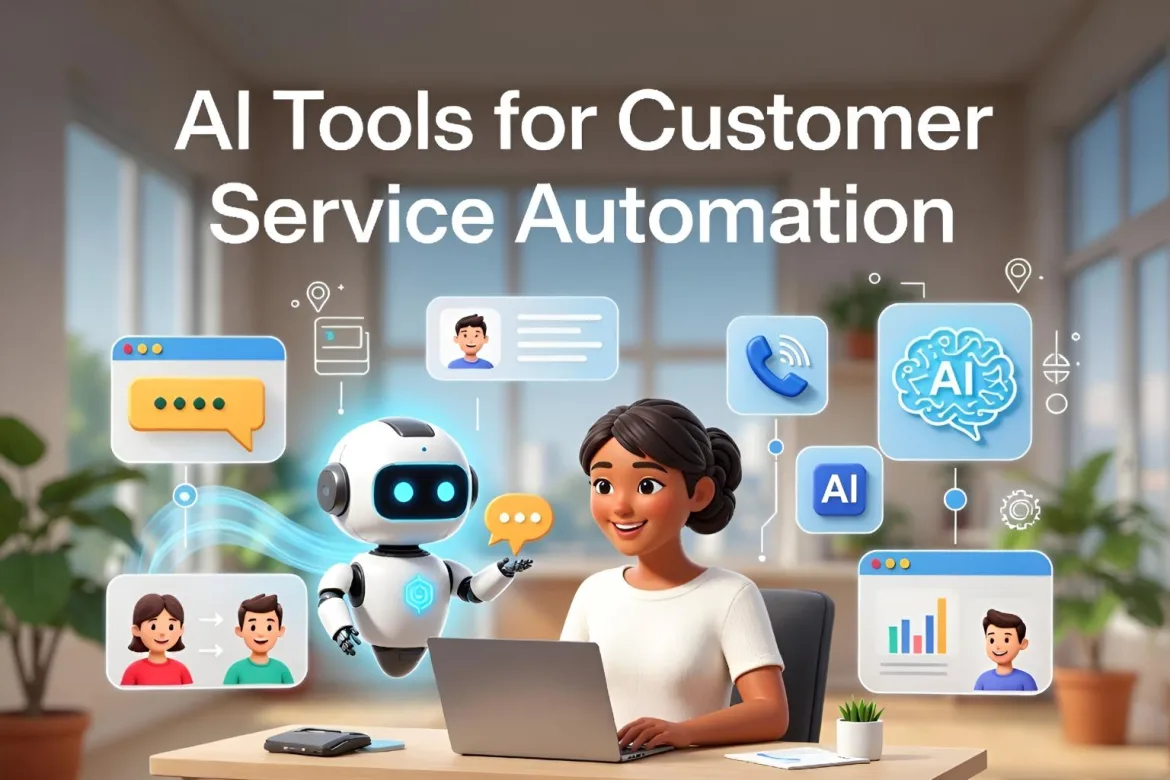
Customer expectations in 2026 extend beyond product quality and price. Customers are increasingly expecting rapid responses, tailored experiences, 24-hour support, and consistent communication across websites, applications, email, social media, and phone calls. Businesses that fail to match these expectations may have slower response times, increased support burdens, and difficulty retaining customers.
AI-powered customer care is transforming how businesses handle these demands. Intelligent chatbots, virtual assistants, predictive analytics, AI help desks, and cloud-based support systems can automate repetitive tasks, allowing teams to respond more quickly and consistently. As the amount of interactions increases, these technologies can benefit startups, SMEs, and businesses.
Modern artificial intelligence platforms can grasp intent, summarize conversations, evaluate behavior, route requests, recommend responses, and detect sentiment. The idea is not to eliminate people from customer service, but rather to let AI do routine tasks while human agents focus on difficult, sensitive, or high-value encounters.
Why Customer Service Automation Matters in 2026
Businesses increasingly handle client conversations across multiple digital channels. A customer may start with an online chatbot, then go on to email before contacting a call center. Without integrated technologies, support workers may have to repeat tasks or hunt for information across several platforms. Automation promotes consistency in workflows and reduces unnecessary manual labor.
Customer service automation is about more than just lowering expenses. It can reduce response times, make assistance more scalable, and offer clients simple self-service choices. AI can also analyze enormous amounts of conversation and ticket data to detect reoccurring issues, allowing businesses to enhance their products, documentation, onboarding, and support processes.
- Instant and continuous support across digital channels
- Personalized assistance based on customer context
- Omnichannel workflows connecting chat, email, social, and voice
- Scalable support for growing interaction volumes
- Analytics for service trends and recurring customer problems
Key AI Tools for Customer Service Automation
AI Chatbots and Virtual Assistants
AI chatbots are one of the most popular customer service automation solutions. Rather than depending solely on predefined commands, modern systems incorporate natural language processing to grasp queries and conversational context. They can work with websites, mobile apps, messaging platforms, and social media.
Businesses employ chatbots to answer frequently asked inquiries, track orders, schedule appointments, handle refunds, perform basic troubleshooting, qualify leads, and onboard customers. For smaller firms, this might relieve stress on support workers during peak periods. Larger businesses can utilize chatbots to handle everyday discussions while referring odd or sensitive issues to human agents. AI customer service agents are one example of how modern platforms support automated and personalized customer interactions.
AI-Powered Help Desk Systems
AI-powered help desks automate administrative activities like ticket classification, urgency recognition, routing, chat summaries, and answer recommendations. This decreases the amount of time agents spend arranging lines and searching for information, allowing them to focus on solving customer issues.
AI can also detect reoccurring issues and odd ticket surges. If a certain problem creates a large number of requests, management might explore the root reason and enhance documentation or the product itself. This transforms the help desk into a source of operational intelligence rather than just a location to file complaints.
Conversational AI Platforms
Conversational AI goes beyond ordinary chatbots by preserving context and producing more natural interactions. These systems can handle text and audio chats, leverage client history as needed, and provide more relevant recommendations. They are rapidly being used in retail, banking, SaaS, telecoms, and other high-volume service industries.
A conversational system can walk a consumer through a multi-step troubleshooting process and determine when the conversation should be forwarded to a human representative. This combination of automation, context, and escalation can result in a more seamless support experience.
AI Voice Support and Call Center Automation
Artificial intelligence speech technology can transcribe calls, identify themes, assess sentiment, summarize discussions, and provide real-time assistance to operators. Some businesses also utilize voice assistants to handle mundane tasks like account verification, appointment scheduling, billing inquiries, and basic troubleshooting.
Automated transcription can eliminate note-taking in contact centers, while quality monitoring allows supervisors to compare interactions to service standards. Because voice miscommunication may quickly frustrate customers, organizations should establish clear escalation pathways and provide human assistance when automation fails.
Predictive Analytics for Customer Support
Predictive analytics examines past contacts, consumer behavior, and operational data to uncover patterns that may suggest future assistance need. Businesses can utilize these information to identify potential churn concerns, forecast ticket quantities, anticipate demand surges, and prepare for personnel needs.
For example, a software company may notice that customers who have a specific onboarding issue are more likely to call assistance later. The organization can respond by improving onboarding or offering proactive coaching. Predictive systems should be closely monitored because their findings are dependent on the accuracy and relevance of the underlying data.
The Role of Cloud Services in AI Customer Support
Why Cloud-Based AI Platforms Are Growing
Cloud computing powers most of the infrastructure for modern AI customer support. Cloud platforms enable enterprises to get enhanced capabilities without having to purchase and maintain massive amounts of on-premise hardware. They also make it easy to add users, expand capacity, link apps, and roll out upgrades.
This flexibility is especially valuable for startups and SMEs who require professional support technologies while keeping infrastructure expenses under control. Enterprises can employ centralized cloud systems to link teams, geographies, and communication channels. Businesses should still assess data location, availability, integration architecture, backup procedures, access controls, and service dependability before to adoption.
- Remote access for distributed support teams
- Flexible capacity as customer volumes change
- Faster deployment without extensive hardware investment
- Integration with CRM, ERP, marketing, and communication tools
- Centralized updates, monitoring, backup, and recovery
Cybersecurity and Data Protection in AI Customer Service
AI customer care systems may handle sensitive information such names, account numbers, payment information, support history, and other personal information. Security is therefore a fundamental necessity. Businesses should understand how vendors gather, store, process, and destroy information, as well as if customer data can be used to train models.
Prior to deployment, organizations should implement suitable safeguards. Encryption, multi-factor authentication, role-based access, secure cloud configuration, monitoring, testing on a regular basis, and incident response protocols all contribute to risk reduction. Vendor security policies and regulatory standards should also be evaluated during the selection process.
- Encryption for customer data in transit and at rest
- Multi-factor authentication and role-based access
- Clear privacy, retention, and compliance policies
- Regular security assessments and monitoring
- Defined incident-response and vendor-risk procedures
How AI Improves Scalability for Growing Businesses
Scalability is one of the most practical aspects of AI customer service automation. As client volumes increase, traditional support models frequently require extra staffing. AI can handle many routine contacts, allowing human teams to concentrate on exceptions and complicated circumstances.
This is excellent for digital firms that face high demand during launches, promotions, or seasonal periods. AI can function continuously across time zones, provide multilingual communication, and handle massive volumes of recurring requests. However, scalability should not come at the expense of accuracy, human intervention, or customer happiness.
The most effective strategy combines automation with solid data, well-designed workflows, and human monitoring. Businesses can thus increase support capacity while keeping consistent service standards as customer and market demands shift.
Real-World Business Use Cases
E-Commerce
Online merchants utilize artificial intelligence (AI) to answer product questions, recommend products, track deliveries, handle typical return requests, and guide customers through the checkout. During peak promotional periods, automated help may handle frequent questions while human personnel address payment problems and unexpected orders.
SaaS Companies
Onboarding, technical issues, account questions, and self-service assistance are all areas where software firms apply AI. AI-powered knowledge systems can direct customers to relevant documentation, whereas ticket summaries help agents comprehend a problem before replying.
Healthcare
Virtual assistants can help healthcare organizations with administrative chores like appointment scheduling, reminders, and general information. Because healthcare information is so sensitive, these systems require strict privacy, security, and human-review controls.
Financial Services
Automation is used by banks and fintech companies for account management, transaction inquiries, fraud detection, and customer communication. Strong authentication and security procedures are especially critical since automated systems may handle sensitive financial data.
2026 Trends in AI Customer Service Automation
Hyper-Personalized Experiences
AI systems can use consumer history, preferences, recent behavior, and conversation context to make interactions more relevant. Personalization can reduce duplication and assist support workers grasp the basis for a request faster.
AI and Human Collaboration
AI is increasingly cooperating with human agents. It can generate summaries, recommend replies, obtain information, and handle repetitive chores while people make complex or sensitive judgments. This technique can boost productivity without eliminating the human element of customer service.
Generative AI, Multilingual Support, and Sentiment Analysis
Generative AI can compose responses, summarize conversations, and generate knowledge-base content. Multilingual systems can assist firms in serving clients across geographies, while sentiment analysis can detect signs of discontent or urgency. These aspects should be evaluated and monitored, as automated outputs and sentiment scores are not ideal.
Key Factors to Consider When Choosing AI Customer Service Tools
Business Requirements and Goals
Begin by outlining the challenges that the organization want to solve. A business that handles repetitive requests may require chatbot and knowledge-base automation, but a contact center may prioritize voice analytics and agent support. Clear goals make results easier to quantify.
Scalability and Integration
The platform should be able to accommodate future expansion in customers, agents, channels, and geographic coverage. It should also link with CRM platforms, order systems, ticketing tools, communication applications, and analytics platforms to eliminate the need for staff to enter data several times.
Security, Ease of Use, and Vendor Reliability
Businesses should examine data processing policies, access controls, compliance requirements, training needs, technical support, service availability, product updates, and the vendor’s long-term roadmap. A feature-rich platform is less valuable if it is difficult to use or unreliable in everyday tasks.
Common Mistakes Businesses Should Avoid
Adopting AI Without a Clear Strategy
Businesses should not use AI solely because it is popular. They should identify particular service concerns, establish quantifiable targets, and select instruments to remedy those issues. This strengthens the platform for implementation and evaluation.
Over-Automating Customer Interactions
Customers may get dissatisfied when automated methods make it impossible to reach a person. Human agents continue to be vital for complaints, odd requests, delicate situations, and judgment-based choices. Clear escalation channels help to maintain a balanced experience.
Neglecting Security and Integration
Security should be considered before architecture and vendor selection, not after implementation. At the same time, an AI tool operating in isolation may generate additional work. Data flows, authentication, reporting, and the customer journey should all be considered while developing integration plans.
Building a Future-Ready Customer Service Strategy
Successful customer service techniques in 2026 incorporate automation, dependable processes, cloud infrastructure, security, and human expertise. AI can enhance response time and operational capacity, but the overall experience is determined by the information the system gets and the workflows that surround it.
Businesses should implement automation in stages. Before moving on to advanced conversational and predictive applications, a good place to start could be frequently asked questions, ticket classification, knowledge-base recommendations, or agent assistance. This enables teams to evaluate outcomes, fine-tune operations, and mitigate implementation risk.
Measuring is equally crucial. Organizations can track response times, resolution rates, escalation volumes, customer satisfaction, ticket deflection, agent productivity, and recurrent issue types. These metrics assist teams in determining whether automation is effectively improving the customer journey.
The most sustainable strategy views AI as a component of a larger customer service ecosystem. When cloud infrastructure, security controls, business data, staff workflows, and customer feedback are integrated, firms can continuously improve support while anticipating shifting demands.
Conclusion
In 2026, AI-powered customer care automation solutions will reshape how businesses connect with customers. Chatbots, AI help desks, conversational platforms, voice automation, predictive analytics, and cloud-based technologies can all assist businesses handle increasing interaction volumes while improving speed and consistency.
The value of these technologies is dependent on careful execution. Businesses should choose solutions based on their actual service requirements, integration needs, scalability, security, and ease of use. They should also have explicit human escalation channels for complex or sensitive circumstances.
For startups, SMEs, and corporations, the goal is not to automate every interaction. The goal is to develop a support paradigm in which AI handles appropriate repetitive labor while human professionals contribute judgment, empathy, and problem-solving where they are most valuable.