

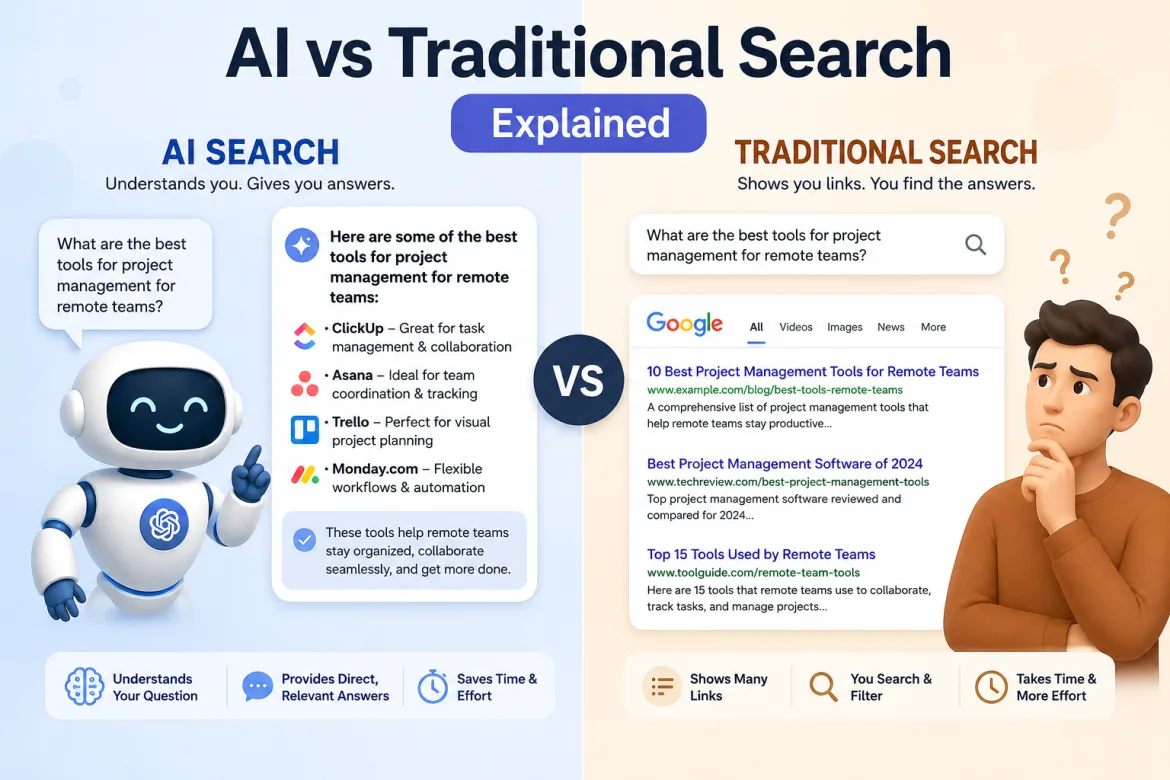
The way individuals seek for information online is continuously changing. Traditional search engines have long been the primary means of discovering websites, researching issues, and finding solutions, and they serve as the foundation for the majority of digital marketing initiatives. This concept has influenced how firms optimize their web presence for many years.
Today, AI is altering the experience by providing direct, conversational responses rather than lists of links. Users may now gain fast insights without having to navigate several pages, which is redefining expectations for speed and simplicity. This trend is also influencing how organizations create content to increase engagement and accessibility.
Understanding the differences between AI and traditional search is becoming increasingly important for startups, SMEs, and companies seeking to remain competitive. Businesses that adapt early can improve user experience, increase exposure, and prepare for the transition to AI-powered search ecosystems.
Understanding Traditional Search
For more than 20 years, traditional search engines have served as the internet’s foundation. Their primary goal is to assist users in finding relevant information by indexing billions of web pages and displaying the most relevant results based on the user’s search query. This method has proven to be quite successful for discovering websites, conducting research, and comparing data from various sources.
For businesses, traditional search remains one of the most effective ways for recruiting potential clients. Ranking high in search results can result in increased traffic, brand awareness, and lead generation opportunities. As a result, SEO remains an important component of global digital marketing efforts.
How Traditional Search Works
Traditional search typically involves three important steps:
- Search bots crawl online sites.
- Indexing stores and organizes content.
- Algorithms determine which pages are ranked first.
When a user types a query, search engines assess dozens of ranking signals to decide which pages are most relevant to the search intent. The final results displayed to visitors are influenced by factors such as content quality, website authority, relevancy, page speed, user experience, and backlinks.
Example
Imagine a business owner looking for:
“How can I cut customer support costs?”
A standard search engine will provide a list of papers, case studies, software solutions, and industry reports about customer service optimization. While this provides access to useful information, the user frequently needs to consult many sources before determining the best answer.
This method is useful for in-depth research, but it can be time-consuming and labor-intensive, especially when dealing with complex business concerns.
Advantages of Traditional Search
- Large database of indexed content.
- Effective website discovery skills.
- Skilled at accessing certain websites.
- Encourages thorough research from different sources.
- Established an SEO ecosystem.
Limitations of Traditional Search
- Users frequently need to review various sources.
- Information collecting can be time-consuming.
- Results may include outdated content.
- Limited context understanding.
- Complex inquiries may take many searches.
As organizations seek faster and more effective ways to acquire information, these restrictions have opened the door to more intelligent search experiences powered by artificial intelligence.
What Is AI Search?
AI search is the next step in the evolution of information discovery. Rather than just showing a list of links, AI-powered systems assess user intent, comprehend context, and generate direct responses, allowing users to discover what they need faster.
AI search enhances the interactive and conversational experience by merging machine learning, natural language processing, and massive language models. Users can ask specific inquiries in plain language, and the responses feel more like expert advice than standard search results.
This trend is especially useful in corporate settings where decision-makers require instant access to pertinent information without spending hours investigating different sources.
How AI Search Works
- Natural language processing (NLP).
- Large language models (LLMs).
- Machine learning algorithms.
- Semantic search.
- Context awareness.
- Knowledge graphs.
Together, these technologies enable AI to grasp not only the terms in a query, but also the intent behind the request. This allows for more accurate responses, particularly when users ask sophisticated or conversational inquiries.
Example
A startup founder asks:
“What are the best cost-effective approaches to automating customer service for a SaaS company with fewer than 20 employees?”
Instead of presenting a list of links, an AI-powered search system can provide a summary of the response, identify automation solutions, applicable tools, and explain implementation considerations. This enables the founder to obtain actionable information far faster than traditional search methods.
The end result is a more efficient research process and faster decision-making.
AI Search vs Traditional Search: Key Differences
AI and traditional search both assist users in finding information, but they operate in fundamentally different ways. Traditional search engines provide a list of online links, forcing users to carefully investigate and assess different sources. In contrast, AI search algorithms strive to provide direct, contextual replies by better understanding user intent and summarizing relevant material.
These differences have a big impact on how people interact with information online. Traditional search is more keyword-driven and frequently involves numerous steps to arrive at a conclusion, but AI search provides a more conversational and efficient experience. As a result, AI-based solutions are gaining popularity for speedier decision-making and more efficient research operations.
| Feature | Traditional Search | AI Search |
|---|---|---|
| Results | List of links | Direct answers |
| User Effort | Higher | Lower |
| Context Understanding | Limited | Advanced |
| Research Speed | Slower | Faster |
| Personalization | Basic | Highly contextual |
Overall, AI search enhances speed and usability, while traditional search still remains valuable for exploring multiple sources and in-depth research. The future of search is likely to combine both approaches for a more balanced information experience.
Why Businesses Are Paying Attention to AI Search
The growing use of AI search mirrors a broader trend toward efficiency, automation, and intelligent decision-making. Business executives are constantly under pressure to increase efficiency and provide better consumer experiences. AI-powered search directly helps both objectives.
According to industry surveys, firms are increasingly investing in AI technologies as a means of lowering operational costs and improving staff productivity. Search is becoming a critical component of that shift. Businesses can also refer to NIST’s AI resources for information about artificial intelligence and related practices.
Faster Access to Information
Employees in modern firms frequently spend a significant amount of time searching for documents, reports, policies, and consumer information. AI search minimizes friction by giving quick, context-aware replies, allowing teams to get the correct information without manually traversing different systems or files. This increases overall workflow efficiency and cuts down on decision-making delays.
- Quick access to important documents and data.
- Reduced time spent searching several systems.
- Increased productivity for knowledge-intensive jobs.
- Enables faster team decision-making.
This shift in information availability results in huge productivity gains and allows firms to operate more efficiently at scale.
Improved Productivity
Organizations that deploy AI-powered knowledge systems generally see increases in efficiency because employees spend less time searching for information and more time acting on it.
Examples include:
- Internal knowledge bases.
- Employee support portals.
- Search for technical documentation.
- Self-service system for customers.
These tools enable teams to get accurate information more quickly and reduce repetitive support requests.
Better Customer Experiences
Customers’ expectations are increasing as they want rapid, precise, and flawless digital interactions. AI-powered search enables businesses to match these expectations by providing instant responses, enhancing navigation, and easing product or information discovery across websites and support platforms. This results in a smoother overall consumer journey with less friction at each level.
- Improved access to answers and support information.
- Enhanced website navigation and product discovery.
- Improved tailored and relevant search results.
- Reduced need for manual customer support.
As a result, organizations can increase customer happiness while cutting support expenses and boosting overall service efficiency.
Real-World Business Applications
AI search is already providing significant benefits across a variety of businesses. Companies are employing intelligent search capabilities to boost operational efficiency, speed up decision-making, and increase consumer engagement.
E-Commerce
Online shops utilize AI search to better comprehend client intent and propose products that meet their individual requirements. This generates a more personalized shopping experience, which frequently results in improved conversion rates and consumer satisfaction.
Healthcare
Healthcare businesses use AI search to improve the efficiency with which professionals obtain clinical guidelines, research papers, and patient-related information. Faster access to relevant knowledge leads to better operational and clinical outcomes.
Enterprise Knowledge Management
Large businesses frequently deal with fragmented data dispersed across various systems. AI search helps to consolidate data sources and make key corporate information more accessible, thereby decreasing inefficiencies and enhancing cooperation.
Financial Services
Financial institutions employ AI-powered search to navigate rules, market reporting, and internal policies more effectively. This enhances research speed, compliance procedures, and overall operational efficiency.
The Impact on SEO and Digital Marketing
The emergence of AI search is changing how organizations approach SEO and digital marketing. While search behavior evolves, SEO remains vital to retaining online visibility. However, the focus is rapidly changing away from keyword-based optimization and toward intent-driven, high-value content that really benefits consumers.
Even in an AI-driven world, classic SEO principles remain critical for organic development. At the same time, organizations must change their content strategies to match shifting consumer expectations and search trends. This includes creating more meaningful, structured, and conversational material that corresponds to how consumers currently seek for information.
- Strong technical SEO and website performance are still important.
- Rankings are still driven by high-quality, authoritative content.
- Content should offer original thoughts, examples, and true value.
- Optimize for natural, conversational search queries.
To compete in this changing market, organizations must strike a balance between traditional SEO methods and AI-driven content initiatives. Those who prioritize user intent and content quality will have high visibility on both search engines and AI-powered platforms. For additional guidance, businesses can review Google’s SEO Starter Guide.
Challenges of AI Search
Despite its benefits, AI search does not come without obstacles. Before deploying AI-driven search techniques, businesses should understand the benefits as well as the constraints. Data accuracy, privacy problems, and system bias all have an impact on the credibility of AI-generated outcomes, necessitating appropriate oversight and control.
Accuracy Concerns
AI systems can occasionally produce incorrect or incomplete responses. Human verification remains necessary, especially in areas where accuracy is vital.
Data Privacy Issues
Organizations must guarantee that AI systems comply with data protection rules and security standards. When dealing with sensitive company information, robust governance practices are required.
Content Attribution
As AI-generated responses become increasingly frequent, concerns about content ownership, attribution, and intellectual property continue to arise. Businesses should constantly follow changes in this area.
Dependence on AI Models
AI systems are valuable tools, but they should not replace human skill totally. Important company decisions continue to require strategic oversight and critical thinking.
What the Future of Search Looks Like
Search technology is turning into a more sophisticated, connected, and personalized system rather than just a tool for discovering information. Instead of totally replacing traditional search, AI is improving it by making results more contextual, interactive, and relevant to real-world decision-making.
Future search experiences will be more focused on natural communication, personalization, and action-oriented outcomes. Users will interact with systems in a more intuitive manner, obtaining personalized responses and even completing tasks right within the search environment.
- Search will be more conversational and context-aware.
- Users will receive highly tailored results based on their requirements and behaviors.
- Search platforms will prioritize action-oriented skills.
- AI search will be vital for managing massive data systems.
As search evolves, firms who implement AI-powered search early will gain a significant advantage in efficiency, productivity, and information accessibility across their operations.
Conclusion
The search landscape is undergoing one of the most dramatic changes in digital history. Traditional search is still required for website discovery, in-depth study, and web navigation, whereas AI search provides a faster, more intelligent way to acquire information and insights.
The opportunity for startups, SMEs, companies, and technology leaders is to understand how these approaches can function together. Organizations that combine strong SEO foundations with AI-powered experiences can increase productivity, boost customer satisfaction, and make better business decisions.
As AI continues to alter the digital world, organizations who adapt early will be better positioned to compete, develop, and expand in the coming years.