

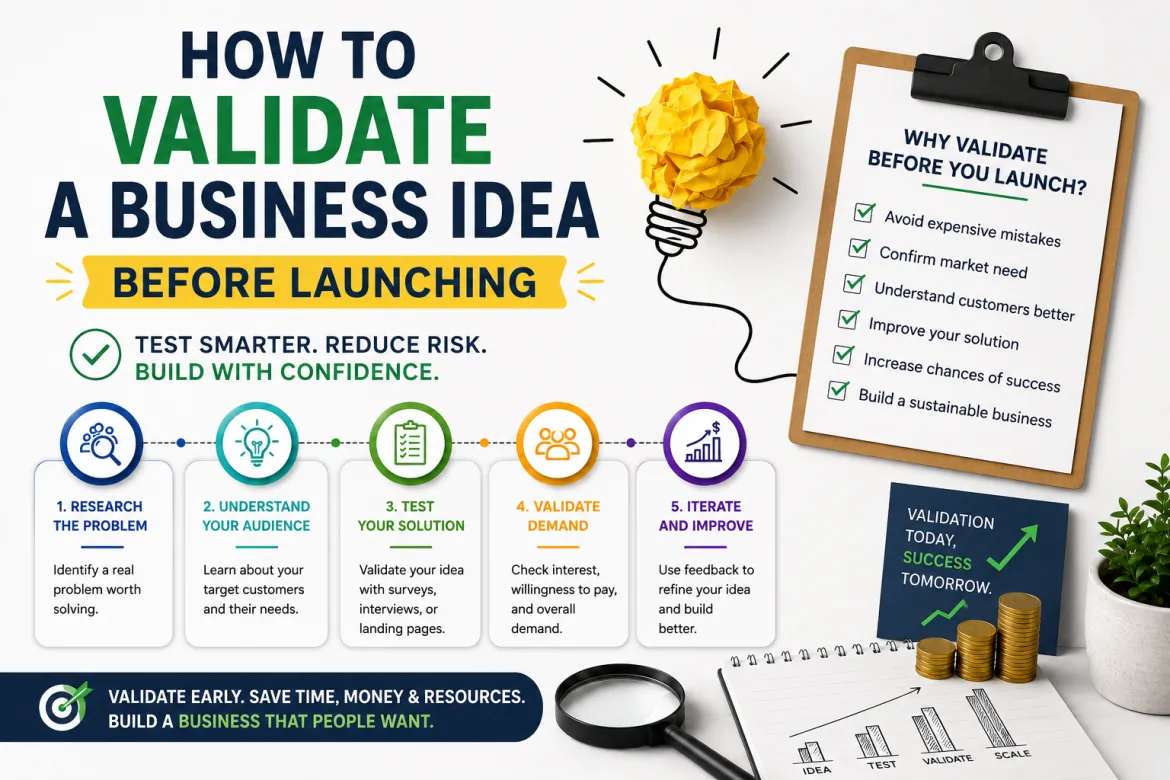
Many entrepreneurs become enthused about a new business idea and quickly begin developing items, designing websites, or investing in marketing. While passion is crucial, starting a business without first confirming the idea might result in lost time, money, and effort. Some of the most typical startup failures occur when organizations build solutions that customers do not require.
Business idea validation is the process of determining whether there is a genuine demand for your product or service before making large investments. It enables entrepreneurs to better understand their target audience, identify market possibilities, and anticipate future problems. Instead of making assumptions, validation enables you to base decisions on actual customer feedback and market facts.
In today’s competitive business world, proving an idea is no longer an option. Whether you’re creating an online business, subscription service, eCommerce store, SaaS platform, consulting agency, or local business, appropriate validation can significantly boost your chances of success. It instills clarity and confidence while reducing avoidable risks.
This article will explain how to validate a business idea before to launching, the essential aspects to consider, typical mistakes to avoid, and practical techniques to help you lay a solid foundation for long-term success.
Why Business Idea Validation Matters
Business idea validation is the process of ensuring that clients want the product or service you intend to give. Many entrepreneurs spend months creating an idea only to find that there is minimal demand in the market. Validation reduces ambiguity and demonstrates that your product can attract paying clients.
A verified business idea instills confidence in entrepreneurs prior to launch. It assists in determining consumer demands, pricing expectations, market demand, and competitive potential. Instead of creating assumptions, business managers may shape their strategy and reduce risk by leveraging real-world customer information.
Benefits of validating a business idea:
- Helps confirm real market demand before investing heavily
- Reduces financial and operational risks
- Improves product-market fit through customer feedback
- Increases the chances of long-term business success
Simply said, validation enables entrepreneurs to establish businesses based on facts rather than preconceptions.
Start by Identifying a Real Problem
Every successful business is built on the foundation of solving a relevant problem. Before you think about products, services, or features, consider the real difficulties your target customer encounters and how strongly they feel about them.
Consider what problem your company solves and why people care about the solution. The more painful, frequent, or costly the problem, the more likely customers are to actively seek and pay for a solution that improves their circumstances.
Spend time observing your target market on several platforms. Examine forums, social media debates, industry groups, consumer evaluations, and online communities for reoccurring grievances and unmet requirements that indicate potential opportunities.
Businesses that focus on solving genuine problems grow quicker because they provide immediate value, making it simpler to attract and retain clients without resorting to aggressive marketing.
Define Your Target Audience Clearly
One of the most common mistakes businesses make is attempting to service everyone. Successful firms know who their ideal clients are and personalize their solutions accordingly.
Make a detailed profile of your target audience. Consider age, occupation, income level, location, interests, objectives, and difficulties. The more precise you are, the easier it will be to successfully validate your idea.
For example, instead of “small business owners,” you may target “freelance graphic designers who struggle with client management.” A smaller audience typically delivers better feedback and greater validation results.
Research the Market Thoroughly
Market research is one of the most critical stages of company validation since it determines whether there is sufficient demand for your concept. Understanding your sector enables you to spot opportunities, customer behavior patterns, and upcoming trends before going live.
Thorough research also tells whether your target market is expanding, stable, or contracting. This information allows you to make more informed decisions about product development, marketing strategies, and long-term planning.
Important areas to research include:
- Industry growth trends and future opportunities
- Customer purchasing habits and preferences
- Market size and demand potential
- Existing solutions available in the market
Business market research and competitive analysis resources can help entrepreneurs understand customer demand, market size, pricing, and existing competition.
Google Trends can also be used to explore search interest and identify changes in consumer search behavior and market trends.
Business idea validation is the process of ensuring that clients want the product or service you intend to give. Many entrepreneurs spend months creating an idea only to find that there is minimal demand in the market. Validation reduces ambiguity and demonstrates that your product can attract paying clients.
A verified business idea instills confidence in entrepreneurs prior to launch. It assists in determining consumer demands, pricing expectations, market demand, and competitive potential. Instead of creating assumptions, business managers may shape their strategy and reduce risk by leveraging real-world customer information.
Benefits of validating a business idea:
- Helps confirm real market demand before investing heavily
- Reduces financial and operational risks
- Improves product-market fit through customer feedback
- Increases the chances of long-term business success
Simply said, validation enables entrepreneurs to establish businesses based on facts rather than preconceptions.
Analyze Existing Competitors
Competition should not be regarded as a danger during the validation process. In many cases, competitors demonstrate that customers are already willing to pay for identical solutions. Their success demonstrates that there is demand in the market.
Competitor analysis can also help you identify areas where your company might improve. Understanding client complaints, service gaps, and unmet expectations allows you to better position your offer and develop a stronger value proposition.
When analyzing competitors, focus on:
- Product and service offerings
- Pricing strategies
- Customer reviews and feedback
- Marketing and branding approaches
A thorough competition research allows you to identify possibilities to stand apart rather than merely mimicking others.
Conduct Customer Interviews
Speaking directly with potential clients delivers insights that are not always available through online research. Customer interviews help entrepreneurs grasp the true issues, concerns, and expectations of the individuals they want to serve.
The purpose is not to pitch the idea during the chat. Instead, learn about client challenges and existing solutions. Honest talks frequently offer useful information that can help shape product development and positioning.
Questions worth asking include:
- What is your biggest challenge related to this problem?
- How do you currently solve it?
- What frustrations do you have with existing solutions?
- Would you pay for a better alternative?
Customer interviews frequently provide the most unambiguous validation because they are conducted directly with your target audience.
Multi-Channel Validation Strategy for Testing Business Ideas
When numerous approaches are utilized together to validate a business idea rather than relying on a single source of feedback, the reliability of the validation increases. Combining surveys, MVP testing, and landing page trials allows businesses to gain both qualitative and quantitative insights before releasing fully.
Surveys help to discover client wants and preferences on a large scale, whereas MVPs provide real-world feedback by testing a simpler version of the product. Landing pages, on the other hand, track user behavior and sign-ups to determine true interest and demand.
Key Validation Methods
- Customer surveys for needs and preferences
- Minimum Viable Product (MVP) testing
- Landing page sign-ups and conversions
- Social media engagement tracking
- Pre-launch waitlist creation
Each strategy adds a distinct layer of information, reducing assumptions and improving decision-making. Together, they provide a more complete picture of whether a business idea has true market need.
Using a multi-channel validation method allows entrepreneurs to decrease risk, fine-tune their offering, and create solutions that are matched with actual client expectations from the start.
Validating Real Market Demand Through Customer Commitment
A solid company idea is only confirmed when actual clients express interest and willingness to commit. While feedback and engagement are useful signs, true validation occurs when people are willing to take action through financial or behavioral commitments.
Testing willingness to pay helps distinguish between interest and genuine demand. When people commit money, even in tiny amounts, it indicates that your concept has real market value rather than just theoretical attraction. Similarly, tracking engagement demonstrates how strongly potential users interact with your concept prior to making a purchase choice.
Key validation signals enable firms to assess actual client interest and market demand. Pre-orders, early access sign-ups, beta program conversions, and paid consultations all indicate a readiness to participate and contribute. Email response rates, click-through rates, webinar attendance, and engagement all provide useful information on audience interest and product viability.
Engagement data from channels like as social media, landing pages, and email marketing provides further information about client interest levels. High interaction typically implies high demand, but poor engagement may indicate the need to improve messaging or target a new demographic.
Finally, integrating financial commitment with engagement tracking provides a clear and accurate picture of market readiness. Businesses that focus on both are better able to provide things that customers actually desire and are willing to pay for.
Key Factors That Determine Business Idea Success
A successful company idea typically addresses a significant problem, serves a specified audience, and has a clear value proposition. While many concepts appear great on paper, only a few have the appropriate mix of demand, differentiation, and profitability.
Before taking any action, entrepreneurs should consider a variety of things. Understanding these characteristics helps evaluate whether the company can achieve long-term growth and revenue.
Critical success factors include:
- Strong and consistent customer demand
- Clear value proposition and market positioning
- Sustainable pricing and profit potential
- Ability to scale and grow over time
When these factors come together, the basis for a successful business is significantly stronger.
Common Mistakes to Avoid During Validation
Many entrepreneurs unwittingly undermine their validation efforts by committing preventable blunders. One common mistake is to seek validation solely from friends and family. These folks frequently provide positive feedback, which may not reflect actual market demand. Another mistake is focusing on product features rather than customer issues. Customers are more concerned with outcomes than technical specifics. Some entrepreneurs overlook negative criticism. While criticism can be unpleasant, it frequently provides useful insights for progress.
Other frequent mistakes include:
- Launching too quickly without testing
- Relying solely on assumptions
- Ignoring competitors
- Avoiding customer interviews
- Overbuilding before validation
- Misinterpreting positive feedback as purchase intent
Avoiding these blunders can save a significant amount of time and money.
The Future of Business Idea Validation
The future of business validation is becoming more data-driven. Entrepreneurs today have access to powerful analytics, artificial intelligence tools, online communities, and digital testing platforms, making validation faster and less expensive.
AI-powered research tools can assist in analyzing client behavior, identifying market trends, and discovering new prospects. Businesses may quickly test concepts via social media advertising, landing sites, and digital campaigns.
As competition grows, validation will become increasingly vital. Companies that efficiently employ customer feedback and market data will outperform those that rely entirely on intuition.
Future entrepreneurs will most likely spend more time verifying concepts before launching and less time fixing costly mistakes after. This transition will result in better firms based on proven demand rather than assumptions.
Turning Validation into a Launch Strategy
Turning validation into a launch strategy guarantees that your company remains aligned with real client needs throughout its life cycle. Instead of approaching validation as a one-time event, it should be a continuous process that informs decision-making and product enhancements.
Customer preferences, industry trends, and rival products are constantly changing, making ongoing validation critical for being relevant and competitive. Businesses can find fresh opportunities and avoid old assumptions by collecting feedback and evaluating user behavior on a frequent basis.
Using these insights effectively enables businesses to tweak messaging, improve products, modify price, and improve the overall consumer experience. Businesses that constantly adjust based on real-world input are more likely to achieve better market fit and long-term growth.
Companies that retain a customer-centric approach frequently experience stronger growth because their offers are continually aligned with market demand.
Conclusion
Validating a business idea before launching is one of the best decisions an entrepreneur can make since it eliminates risk, saves money, and raises the likelihood of long-term success. Instead of making assumptions, successful business owners collect real-world data through market research, customer interviews, surveys, MVP testing, and competitive analysis. This method ensures that judgments are based on evidence rather than speculation.
Strong businesses are built on true client demand, not assumptions. By spending time validating your idea, understanding your market, and testing important assumptions, you can launch with greater confidence, attract customers more effectively, and lay the groundwork for long-term growth. This technique also allows you to adapt early and avoid costly mistakes later in your business journey.