

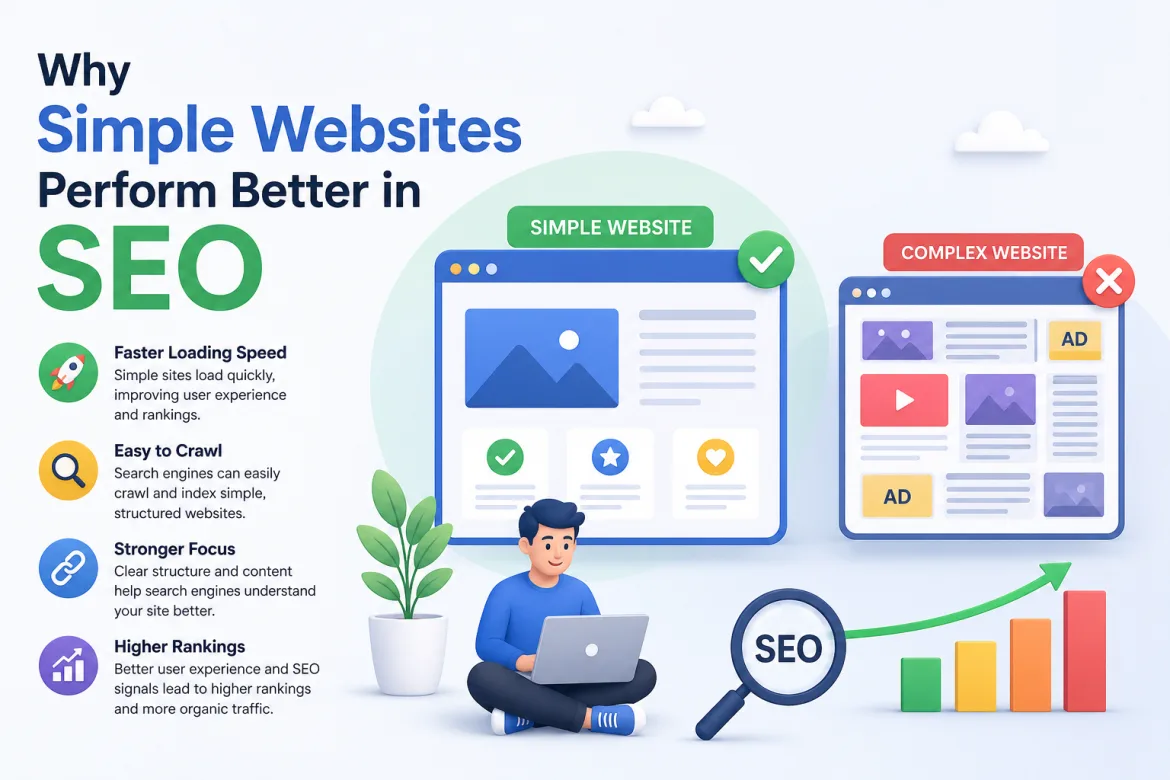
Over the last decade, websites have developed from simple digital brochures to complex interactive ecosystems complete with AI chatbots, animations, and dynamic features. While these improvements improve functionality, they also add complexity and may have a negative influence on performance.
In 2026, search engines will focus on speed, usability, accessibility, and user experience. Many feature-rich websites experience slow loading times, poor navigation, and technical SEO difficulties, which lower rankings and user engagement.
Simple websites frequently perform better because they prioritize clarity, rapid loading, and solid structure. They improve the mobile experience, lower bounce rates, and are easier for search engines to index. This post looks at why simplicity is critical to SEO performance in 2026.
The Relationship Between Simplicity and SEO
Search engine optimization has evolved beyond keywords and backlinks. The goal of modern SEO is to provide the best possible user experience. Search engines such as Google increasingly employ AI-powered ranking systems that monitor user behavior, page performance, content accessibility, and engagement signals in real time.
Simple websites are naturally aligned with these ranking goals because they reduce friction throughout the browsing experience. When users can discover content quickly and without distractions, they stay longer, interact more, and convert more frequently.
A clear website layout also makes it easier for search engine crawlers to understand the page hierarchy. Clear navigation menus, improved internal linking, and lightweight code help to reduce crawl errors and indexing concerns.
In contrast, websites that are crowded with scripts, animations, pop-ups, and superfluous plugins frequently have slower loading times and lower usability scores. Even visually appealing websites can suffer in rankings if they frustrate users.
Why Website Speed Matters More Than Ever
Speed Is a Core Ranking Factor
In 2026, website speed has emerged as one of the most important SEO indications. Users want pages to load quickly, particularly on mobile devices. Research regularly reveals that even a one-second delay can diminish conversions and increase bounce rates.
Simple websites perform better because they have cleaner code structures, less unneeded plugins, optimized media assets, lightweight frameworks, and fewer server calls. These characteristics shorten page load times and enhance overall performance metrics.
For example, a SaaS business with a minimalist landing page may outperform a competitor with a visually complex website simply because visitors can get content faster and navigate more quickly.
- Cleaner code structures
- Fewer unnecessary plugins
- Optimized media files
- Lightweight frameworks
- Minimal server requests
Core Web Vitals and User Experience
Search engines now place a high value on Core Web Vitals, which measure loading performance, interaction, and visual stability. Google Search Central’s page experience guidance explains that Core Web Vitals are part of Google’s ranking systems and recommends focusing on overall page experience.
Complex websites frequently fail these tests owing to heavy JavaScript, big video backdrops, or poorly designed cloud integrations. Simpler websites often receive higher rankings because they stress important functionality over attractive aspects.
Businesses engaging in digital transformation should recognize that performance optimization is more than a technical need; it is a revenue driver.
Mobile-First Indexing Rewards Simplicity
Most Users Browse on Mobile Devices
In 2026, mobile traffic will dominate practically every industry. Search engines typically analyze websites using mobile-first indexing, which means that the mobile experience heavily influences rankings.
Simple websites perform particularly well on mobile due to their ease of scaling across devices. Clean design, readable typography, and focused navigation enhance usability on tiny displays.
Complex websites frequently struggle with responsive design, slow-loading animations, cluttered interfaces, complicated navigation menus, and poor touch optimization.
A streamlined mobile experience enables consumers to execute tasks fast, such as booking a service, reading material, or making a transaction.
Minimal Design Improves Engagement
Modern consumers prefer intuitive experiences. They do not want to go through layers of useless content in order to obtain contact information or product details. Clear navigation and minimal design allow consumers to find what they need fast and without aggravation, increasing overall satisfaction and engagement.
A simple design increases session time, page interactivity, user pleasure, conversion rates, and client trust. These behavioral cues can help SEO performance if they reflect helpful, relevant experiences.
How AI Is Changing SEO and Website Design
AI Search Engines Prefer Structured Simplicity
AI-powered search algorithms are changing the way webpages are ranked and discovered. Search engines are increasingly reliant on machine learning to recognize context, user intent, and content structure.
Simple websites are easier for AI systems to understand because they have clear semantic frameworks, ordered headings, logical content flow, user-friendly navigation, and less technological clutter.
Businesses that utilize AI-powered personalization and automation tools should ensure that these technologies improve usability rather than complicating the user experience.
AI Chatbots Should Support, Not Distract
Many organizations have integrated AI customer service solutions into their websites. While AI can boost engagement, badly integrated chat systems can hurt SEO and user experience.
Common issues include aggressive chatbot pop-ups, slow-loading AI widgets, unwanted automated messaging, and excessive tracking scripts.
Simple websites use AI intelligently without overwhelming viewers. The goal is to improve customer service while retaining fast performance and a clean interface.
Clean Website Architecture Improves Crawlability
Search Engines Need Clear Structures
Search engine bots crawl websites to better comprehend content relationships and page relevance. A basic website structure improves crawling speed and efficiency. This enhances indexing accuracy, increasing the likelihood of increased search visibility in competitive rankings.
Logical URL structures, tidy navigation menus, consistent internal linking, well-organized category systems, and minimal redirect chains are all examples of strong SEO architecture.
Complex architectures can cause crawl confusion, particularly for large enterprise websites with thousands of pages.
- Logical URL structures
- Clean navigation menus
- Consistent internal linking
- Organized category systems
- Minimal redirect chains
Scalability Without Complexity
Businesses frequently feel that scalability necessitates more intricate websites. In truth, scalable digital systems prosper when they retain organizational simplicity as they expand. Clean architecture and modular design make it easy to add features while maintaining performance and usability.
A startup launching a SaaS product may start with a home page, product page, pricing page, blog post, and contact page. This targeted structure generally outperforms websites with many landing pages and duplicate content.
Large organizations that use cloud services and automation tools can preserve SEO-friendly simplicity by organizing material into clear silos and streamlining user journeys.
Cybersecurity and SEO Are More Connected Than Ever
Secure Websites Build Trust
Cybersecurity has emerged as a key trust element in current SEO. Users want websites to be safe, secure, and trustworthy. Simple websites can reduce security concerns by using fewer third-party plugins and needless integrations.
Businesses should prioritize safe connections, dependable hosting, cloud security monitoring, frequent software updates, and minimum plugin usage.
Every new plugin or script might add maintenance requirements and potential risks.
Complex Websites Increase Risk
Highly sophisticated websites are more difficult to manage and safeguard. Multiple integrations, outdated frameworks, and unnecessary dependencies increase hackers’ attack surfaces. Regular updates and streamlined architecture contribute to reduced vulnerabilities and improved overall system security.
When websites encounter security breaches, SEO performance suffers due to blacklisting, downtime, virus warnings, and decreased user confidence.
Simple architecture makes continuous cybersecurity management much easier.
The SEO Benefits of Better User Experience
Simplicity Increases Conversions
SEO’s ultimate goal is to generate actual business results, not just visitors. Simple websites increase conversion rates because they allow visitors to focus on vital tasks without interruption.
Examples include scheduling a consultation, purchasing a product, filling out a contact form, requesting a demo, or downloading a resource.
When navigation is intuitive, users are more likely to take the intended actions.
Reduced Bounce Rates Improve Rankings
Visitors rapidly abandon websites that appear complicated or slow. High bounce rates should not be interpreted as a direct ranking signal; nonetheless, low engagement can indicate that a page is failing to satisfy user expectations.
Improving page speed and navigation increases user retention and engagement.
Simple websites reduce friction by delivering information fast, improving readability, removing clutter, streamlining navigation, and lowering decision fatigue.
- Delivering information quickly
- Improving readability
- Eliminating clutter
- Streamlining navigation
- Reducing decision fatigue
Cloud Services and Website Performance
Cloud Infrastructure Supports Fast Websites
Cloud services have revolutionized web hosting and scalability. Businesses now rely on cloud platforms to offer global content, automate scaling, backup data, ensure high availability, and optimize performance.
However, cloud technology alone does not ensure SEO success. Poorly optimized websites can still function poorly on modern cloud infrastructure.
Simple websites leverage the benefits of cloud hosting by putting less demand on resources and requiring fewer server queries.
Common Mistakes Businesses Should Avoid
Prioritizing Design Over Performance
One of the most common mistakes organizations make is focusing solely on esthetics while ignoring usability and SEO.
Heavy animations, video backgrounds, and huge images may appear great at first, but they can slow down websites, degrade mobile performance, distract users, and increase abandonment.
Modern design should strike a balance between visual appeal, speed, and practicality.
Using Too Many Plugins
Content management systems make plugin installation simple, but too many plugins generate technical debt.
Too many plugins can raise security concerns, slow down page load times, cause compatibility issues, and affect SEO architecture.
Businesses should only implement tools that add measurable value.
Ignoring Technical SEO
Even well-designed websites might fail if technical SEO is overlooked.
Broken links, duplicate content, bad indexing, missing information, unoptimized pictures, and slow mobile response are all common technical concerns.
Regular SEO audits are essential for ensuring long-term performance.
Overcomplicating Navigation
Visitors should never struggle to access important information. Complex menus and complex layouts degrade both UX and SEO. Clear structure and easy design allow consumers to access content more quickly and increase overall happiness.
Simple menu structures, clear calls to action, well-organized categories, and predictable navigation patterns are all best practices.
The more user-friendly a website is, the higher its overall SEO potential.
Choosing the Right IT and Web Development Partner
Businesses Need Strategic Technology Partners
Visual design alone is insufficient for a successful website. Companies want technology partners who understand SEO strategy, cloud infrastructure, cybersecurity, AI integration, performance optimization, scalability planning, and automation workflows.
The right development business creates websites that strike a balance between innovation and simplicity.
Key Questions to Ask Before Hiring
Businesses should consider whether an IT service provider or web development company prioritizes performance, understands current SEO, can grow the platform, adheres to strong cybersecurity standards, and responsibly supports AI and automation.
Businesses can also review Google’s SEO Starter Guide to understand fundamental SEO practices before evaluating a development partner.
2026 Website Trends Supporting Simplicity
Minimalist UX Design
Modern organizations are increasingly adopting minimalist design ideas centered on clarity, accessibility, and speed.
This trend includes cleaner layouts, more whitespace, easier navigation, speedier interfaces, and content-focused experiences.
Minimalism is more than simply a fashion fad; it’s a performance strategy.
AI-Assisted Content Organization
AI solutions now assist organizations in organizing content more intelligently, improving discoverability while minimizing complexity.
Smart search systems, dynamic FAQs, predictive navigation, and tailored content recommendations are some examples.
The greatest implementations are subtle and intuitive, rather than overwhelming.
Performance-First Development
Lightweight frameworks, server-side rendering, edge computing, cloud optimization, and sustainable coding approaches are all becoming more popular among development teams.
Performance-first development complements basic website architecture.
Real-World Business Use Cases
E-Commerce Brands
Many e-commerce companies have improved their user experience and performance by streamlining product pages and removing redundant scripts.
Benefits include speedier checkout times, improved mobile usability, increased conversion rates, and lower cart abandonment.
SaaS Companies
Concise message, focused landing pages, and lightweight UI design are common features of SaaS platforms that improve SEO performance.
Instead of overloading users with features, great SaaS experiences lead them on clear user journeys.
Professional Service Firms
Simple website structures are beneficial to law firms, IT consultants, healthcare providers, and financial service corporations since trust and clarity are critical.
Users who visit these websites often need clear information, quick access to services, simple contact options, and mobile accessibility.
Simplicity can increase perceived credibility and simplicity of usage.
Conclusion
In 2026, basic websites can score well in SEO because they fit with what people and search engines value: speed, clarity, usability, accessibility, and trust.
While current technology such as artificial intelligence, cloud services, automation, and improved cybersecurity tools continue to influence digital interactions, the most successful firms recognize that innovation should complement rather than replace simplicity.
A clean, well-structured website boosts search performance, increases user engagement, lowers security threats, and establishes scalable digital foundations for long-term success. Whether you’re a company founder starting a new platform or an enterprise updating its digital infrastructure, minimalism is still a crucial SEO approach.
Businesses that prioritize performance-first web design can create more efficient digital experiences than those that rely on overly complex websites.