

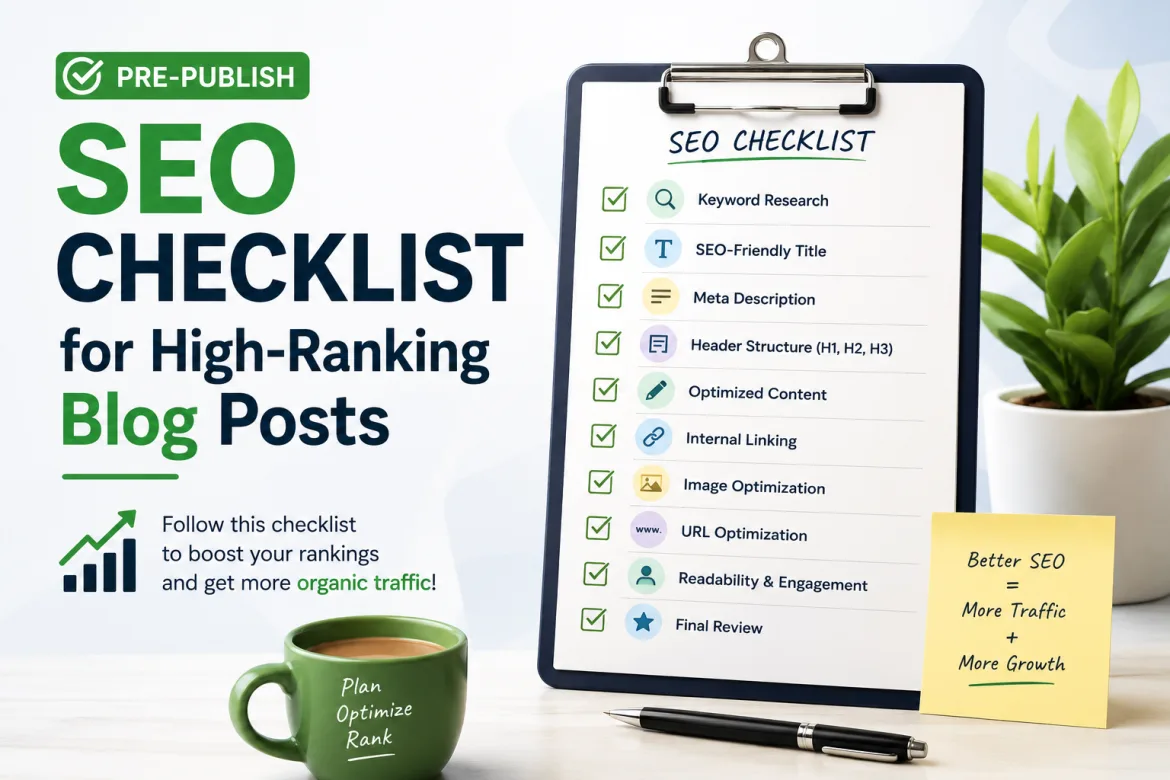
Creating a blog post is only half of the job. The true challenge begins before you click the publish button. In 2026, search engines are more sophisticated, consumer expectations are higher, and the fight for online presence is fierce. Businesses that wish to get continuous organic traffic cannot rely just on quality writing. Every blog article should be optimized for search exposure, user experience, readability, and conversion rates.
Whether you’re a startup raising brand recognition, a SME producing leads, or an enterprise scaling content marketing, a systematic SEO checklist may assist ensure that each post maintains a consistent quality level. Minor flaws with intent, structure, performance, or technical SEO can lower exposure and engagement.
Successful businesses approach blog posting as a strategic process rather than a basic content chore. A repeatable checklist enables teams to enhance consistency, attract qualified audiences, and maximize the return on their content investment.
Why an SEO Checklist Matters in 2026
Search engines are increasingly evaluating material based on relevancy, user purpose, site quality, experience, and overall utility, rather than keyword repetition alone. A checklist establishes a repeatable publication process, reducing unnecessary errors and assisting content teams in maintaining consistent standards.
Before publication, evaluate the article from both a search engine and a reader’s perspective. The idea is not to prioritize algorithms over people, but to make useful content simpler to find, comprehend, and act on.
Start with Search Intent Verification
One of the most typical SEO mistakes is focusing on keywords without knowing why people look for them. Determine whether the audience want information, comparisons, product research, or a solution to a specific problem.
Someone searching for “best CRM software for startups” is generally seeking for comparisons, features, pricing information, and suggestions. A solely instructional definition of CRM may not meet that goal.
Examine the content to verify that it directly addresses the main queries that users are likely to have. Strong alignment between search intent and content expectations can boost the page’s relevance, engagement, and overall usefulness.
Review Primary and Secondary Keywords
Keyword optimization is still vital, but current SEO prioritizes natural relevance over repetition. The principal keyword should occur in appropriate places, while ancillary terms should be introduced naturally to ensure full topic coverage.
Consider the title, H1, introduction, subheadings, image alt text, meta description, and URL. Don’t force keywords into sentences. Well-optimized content should read naturally and provide true value, rather than appearing to be written exclusively for search engines.
Evaluate Content Quality and Depth
Before publication, make sure the content actually helps readers solve a problem or comprehend a topic. Thin or generic content may struggle to compete with resources that offer practical depth, examples, up-to-date information, and unique ideas.
Inquire whether important issues have been answered, examples are relevant, information is reliable and up to date, and the piece offers anything valuable in addition to basic definitions. Real-world experience and detailed recommendations can boost credibility and reader confidence.
Optimize Headlines and Subheadings
Your title is frequently the first thing users see in search results. It should be clear, relevant, detailed, and compelling without being misleading or excessively commercial.
Subheadings boost readability by dividing difficult topics into sensible divisions. They enable readers to scan the page more quickly and provide search engines with clearer information about the content’s structure and breadth.
Check URL Structure
A clear URL improves usability and makes the page’s topic easier to understand. Keep URLs short, descriptive, and related to the article. Avoid using excessive numbers, symbols, parameters, or random character strings.
For example, a URL explaining an SEO checklist for blog posts should be brief and useful, rather than a huge string of meaningless words and numbers.
Optimize Meta Titles and Descriptions
Search snippets impact users’ decision to click. A clear meta title should express the content while naturally including the primary keyword. The meta description should summarize the page’s value and provide users with a compelling incentive to investigate the content.
Examine these elements for clarity, relevancy, and alignment with the original article. Avoid making inflated promises or descriptions that promise information that the page does not have.
Review Internal Linking Opportunities
Internal links help visitors find related material and search engines understand the relationships between sites. Before publishing, find relevant current articles, service pages, instructions, or resources that will provide true value to the new post.
Use descriptive anchor text and links only when the destination is relevant in context. A carefully planned internal linking system can improve navigation, content discovery, and topical categorization. For additional guidance, refer to Google’s guidance on crawlable links when reviewing your site’s internal linking structure.
Verify Sources and Content Accuracy
Statistics, research findings, industry claims, and factual statements should be verified before to publishing. Strong source boosts credibility and instills reader trust in the information offered.
- Refer to trusted industry sources and official publications.
- Ensure accurate numbers, dates, and assertions before posting.
- Replace obsolete information with current evidence.
- Provide source links for readers to verify important statements.
- Eliminate unsubstantiated statements, duplicated information, and superfluous references.
Optimize Images Before Publishing
Images can boost comprehension and engagement, but huge or poorly prepared files might degrade performance. Compress photos, utilize descriptive filenames, provide meaningful alt text, and ensure that visuals work properly on mobile devices.
For instance, “seo-blog-checklist.jpg” is more detailed and valuable than a generic filename like “IMG001.jpg.” Image optimization should improve both accessibility and page performance. You can also review Google’s image SEO documentation for guidance on making images easier for search engines to understand.
Test the Mobile Experience
Many readers get business content on their smartphones and tablets. Check the page on smaller displays to confirm that the text, graphics, navigation, forms, and calls-to-action are still usable.
A good mobile experience should make the article easy to read without requiring excessive zooming, horizontal scrolling, or complex interaction. Mobile usability should be tested prior to release, rather than after traffic has arrived.
Check Page Speed and Performance
Page performance influences user experience and search visibility. Before publishing, check the loading behavior, Core Web Vitals, picture sizes, scripts, and server response times.
Performance enhancements should prioritize real user experience rather chasing a single number. Fast, stable pages make it easier for visitors to digest material and take the desired actions. The Core Web Vitals guidance from web.dev can also be used when reviewing page performance.
Final On-Page and Technical SEO Review
A last quality check can detect minor errors that could compromise indexing, usability, or content structure. Before publishing the article, carefully review it.
- Confirm the H1 and heading hierarchy are logically structured.
- Check canonical tags, indexing settings, and sitemap eligibility.
- Test internal and external links for errors.
- Review schema markup when relevant to the page type.
- Check redirects, mobile rendering, and page accessibility.
Review Readability and User Experience
SEO content should be simple to read and understand. Long blocks of text, poor transitions, and uneven layout can turn readers off, even if the material is valuable.
Use brief paragraphs, detailed headings, simple transitions, and consistent layout. Read the article as if you were a first-time visitor, and remove any unneeded friction.
Verify Calls-to-Action (CTAs)
Standardized workflows aid large-scale content publishers. A documented checklist enables writers, editors, SEO professionals, and marketing teams to adhere to the same standards before publishing an article.
CTAs should be suitable and beneficial, rather than unduly pushy. A software company discussing digital transformation may invite readers to schedule a consultation, while an educational piece may push them to purchase a relevant book.
Build a Repeatable SEO Publishing Process
Standardized workflows aid large-scale content publishers. A documented checklist enables writers, editors, SEO professionals, and marketing teams to adhere to the same standards before publishing an article.
A repeatable procedure lowers errors, increases consistency, and saves time. It also simplifies quality assurance as content development is spread across different writers, themes, and business units.
Pre-Publish Quality Assurance
Complete a final review from the reader’s and business’s perspectives. The following checks help to ensure that the article is ready for publishing.
- Confirm the article satisfies the target search intent.
- Proofread grammar, spelling, formatting, and factual accuracy.
- Verify links, images, CTAs, metadata, and mobile presentation.
- Check that the content offers clear and useful information.
- Confirm the page supports a measurable business or content goal.
Turning SEO Checks into Long-Term Growth
An successful SEO workflow goes beyond preparing a single article for publishing. It establishes a common standard that may be applied throughout a content library. Teams can also use performance data after publishing to identify pages that require stronger internal links, updated material, better snippets, or refreshed sections.
Combining pre-publication quality control with continuous content management enables organizations to maintain valued pieces accurate, relevant, and competitive as search behavior and industry expectations evolve.
Conclusion
Publishing a blog article without proper SEO optimization is similar to introducing a product without a marketing strategy. Even outstanding content can struggle to reach its intended audience if key optimization procedures are ignored.
A comprehensive SEO checklist may help firms boost exposure, improve user experience, increase engagement, and get better long-term outcomes from their content marketing initiatives. From search intent and keyword optimization to technical SEO, performance, and conversion features, each phase improves the page’s overall quality.
As competition for organic traffic grows in 2026, a structured publication process provides a realistic solution for organizations to retain consistency and increase content performance. The most effective method is to view SEO as a continuous process of study, optimization, measurement, and refining rather than a one-time activity.