

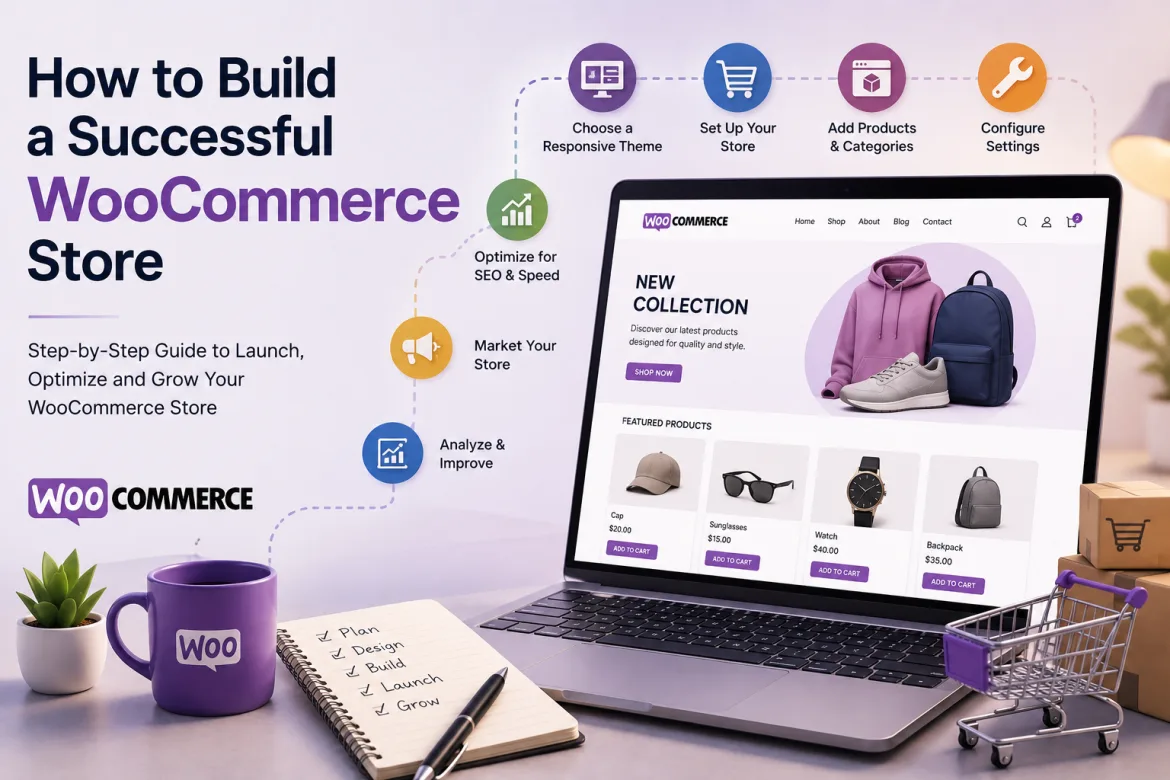
Creating an online store has become one of the most successful ways for businesses to contact clients in various regions and marketplaces. Among the numerous eCommerce platforms available today, WooCommerce has emerged as one of the most popular options for businesses of all kinds. Its versatility, low cost, and smooth interaction with WordPress make it an appealing alternative for entrepreneurs wishing to build a professional online store without excessive complexity.
A successful WooCommerce store is more than just a website that has product listings. It necessitates meticulous planning, a user-friendly design, successful marketing techniques, robust security measures, and a positive client experience. Businesses that specialize in these areas are more likely to attract visitors, convert them into customers, and encourage repeat purchases over time.
Whether you are starting your first online business or expanding an existing one, recognizing the main ingredients of WooCommerce success is crucial. This article discusses the key steps, best practices, common mistakes, and future trends that will assist you in creating a successful WooCommerce business that supports long-term growth.
Why Choose WooCommerce for Your Online Store?
WooCommerce is an open-source eCommerce platform that is designed exclusively for WordPress. It enables businesses to turn an ordinary website into a fully functional online store with several customization choices. Unlike many hosted platforms, WooCommerce allows store owners more flexibility over design, functionality, and customer experience.
One of WooCommerce’s main advantages is its versatility. Businesses can offer physical things, digital products, subscriptions, memberships, bookings, and even services through the same platform. This versatility makes it appropriate for startups, small businesses, and major corporations.
WooCommerce’s popularity can also be attributed to its low cost. The core plugin is free, allowing businesses to get started with minimal cost. Extensions and plugins can be used to add new functionality based on unique business needs, allowing businesses to better manage their spending.
WooCommerce also benefits from the vast WordPress ecosystem. Thousands of themes, plugins, developers, and support resources are accessible, allowing businesses to easily personalize their stores and overcome obstacles as they grow.
Planning Your WooCommerce Store Before Development
Many online companies fail because the owners rush into development without careful planning. Before starting a WooCommerce store, it’s critical to establish clear business objectives and determine your target audience. Understanding who your customers are influences product offers, website design, and marketing techniques.
Product research is just as vital during the planning stage. Businesses should discover client demands, evaluate competition, and develop price strategies. Understanding market demand might assist you avoid investing in products that may not create consistent revenue.
Developing a thorough store structure is another critical stage. Categories, navigation menus, product pages, and checkout flows should all be properly structured so that visitors can simply locate what they’re looking for. A logical structure enhances the user experience and boosts SEO performance.
Budgeting should also be considered. While WooCommerce is free, businesses must pay for hosting, premium themes, plugins, marketing, support, and security. A realistic budget helps to prevent unforeseen expenses throughout the expansion period.
Selecting the Right Hosting and Domain Name
A successful WooCommerce store starts with dependable hosting that delivers high performance and stability. Hosting has a direct impact on website speed, security, and uptime, all of which affect the client experience and sales. Choosing a WooCommerce-optimized supplier ensures that store operations run smoothly.
Good hosting should provide fast loading times, strong security measures, automatic backups, and easy scalability. As your store grows, the hosting environment must be able to manage more traffic without slowing down. This enables consistent performance throughout peak selling periods.
- Reliable uptime and fast loading speed.
- Effective security and protection features.
- Automatic backups ensure data security.
- Scalable infrastructure to support traffic growth.
A well-chosen domain name reinforces your brand’s identity and makes your store easier to recall. It should be brief, simple, and easy to spell so that customers can remember it. Avoid using elaborate or confusing names, which restrict visibility.
Choosing a domain that is consistent with your brand and long-term goals will help you prevent future rebranding complications. It strengthens recognition and promotes constant progress. A solid domain and hosting foundation assures the long-term success of your WooCommerce store.
Designing a Professional and User-Friendly Store
Website design has a significant impact on whether people stay in a store or depart. Customers frequently appraise a firm within seconds of visiting its website, making first impressions critical for eCommerce success.
A clean and professional design promotes trust. Product photos should be of excellent quality, typography should be easy to understand, and layouts should organically guide visitors through the purchasing process. Cluttered designs might overwhelm users and lower conversion rates.
Mobile responsiveness is another important feature. A sizable proportion of internet shoppers view and buy things using cellphones. To maximize sales prospects, a WooCommerce store must provide a consistent user experience across all screen sizes.
Navigation should be straightforward and intuitive. Customers should be able to navigate across categories, product pages, and checkout screens without difficulty. The easier it is to navigate the business, the more likely customers are to make purchases.
Creating High-Converting Product Pages
Product pages function as digital sales reps. They provide information, respond to client inquiries, and encourage purchasing decisions. Well-optimized product pages have the potential to drastically enhance conversion rates.
Product descriptions should highlight benefits rather than merely listing characteristics. Customers want to know how a product solves an issue or enhances their life. Clear and convincing descriptions have the potential to significantly impact purchasing decisions.
High-quality product photos are critical for increasing client confidence. Multiple photographs from various viewpoints, usage scenarios, and close-up information assist clients in more correctly evaluating things before purchasing.
Customer reviews and ratings lend legitimacy to product pages. Many customers rely on social evidence to make purchases. Encourage genuine consumer feedback to build trust and enhance conversion rates.
Strong call-to-actions like “Buy Now” or “Add to Cart” should be prominently displayed. Visitors are more likely to complete purchases when they see clear messaging and strategic placement.
Optimizing WooCommerce Store for SEO
SEO is one of the most effective long-term marketing techniques for WooCommerce stores. SEO enables organizations to acquire organic visitors without relying solely on paid advertising strategies.
Keyword research should be the foundation of all SEO strategies. Understanding the terms that customers use to search for products enables firms to optimize product pages, category pages, and blog content accordingly.
Search engine exposure is improved with optimized product titles, descriptions, URLs, and meta tags. These characteristics aid search engines in comprehending page content and improve the likelihood of ranking for relevant searches.
Content marketing can help to boost SEO efforts. Publishing instructional blog entries, buying guides, tutorials, and industry insights attracts readers and establishes market authority.
Technical SEO is equally crucial. Fast-loading pages, mobile-friendly design, secure HTTPS connections, and structured data all help to boost search ranks and improve user experiences. Google Search Central provides official guidance on search appearance, SEO, and structured data.
Essential Features Every WooCommerce Store Needs
A well-equipped WooCommerce store allows consumers to simply locate products, make purchases, and track their orders without difficulty. When these key elements operate together, they improve customer happiness, foster trust, and dramatically raise the possibility of repeat purchases and long-term business success.
While WooCommerce provides several customization choices, certain characteristics are especially vital for success:
- Enhanced product search functionality.
- Secure payment gateways.
- Ratings and reviews from customers.
- Streamlined checkout procedure.
- Provides order tracking capabilities.
These features boost usability and make buying more convenient for customers.
Building Customer Trust and Credibility
Trust is one of the most important criteria in online shopping decisions. Because customers cannot directly contact with things before purchasing, they rely significantly on signs of credibility.
Displaying clear contact information tells visitors that the company is authentic and reachable. When customers require phone numbers, email addresses, or support, they should be able to find them conveniently.
Transparent policies for shipping, returns, exchanges, and refunds decrease ambiguity. Customers are more inclined to buy when they know what to expect after placing an order.
Security badges and SSL certificates boost trust. Visible security indications ensure that visitors’ payment and personal information are secure throughout transactions.
Customer testimonials, case studies, and user-generated material all provide social proof, encouraging new visitors to trust the brand and make purchases.
Effective Marketing Strategies for WooCommerce Success
A well-designed WooCommerce store cannot survive without a solid marketing approach. Businesses require a clear strategy for attracting targeted visitors and converting them into paying clients. Marketing is essential for achieving constant traffic and revenue growth.
Email marketing is a highly productive and profitable tool for WooCommerce stores. Campaigns such as welcome emails, cart recovery reminders, and targeted offers all contribute to increased consumer engagement. It also stimulates repeat purchases and increases the overall client lifetime value.
- Conducted email marketing campaigns for welcome, cart recovery, and offers.
- Marketing on social media platforms such as Instagram, Facebook, LinkedIn, and Pinterest.
- Paid advertising for specific audience reach.
- Collaborating with influencers to increase brand exposure.
Influencer marketing is yet another effective approach for increasing reach and trust. Collaboration with reputable influencers exposes products to highly engaged audiences. This promotes trust, raises brand awareness, and attracts qualified customers to the store.
Improving Customer Experience and Retention
Customer acquisition is vital, but customer retention typically results in higher long-term profitability. Returning consumers tend to spend more and demand less marketing costs than new customers.
Personalization has the potential to dramatically improve customer experiences. Product recommendations, targeted incentives, and personalized email campaigns make clients feel appreciated and understood.
Another essential consideration is the speed with which customers are served. Quick responses to inquiries, issues, and complaints show professionalism and foster stronger client connections. It also boosts client satisfaction and the possibility of repeat purchases.
Customers are encouraged to make repeat purchases through loyalty programs, which reward them for their continuing participation. Points systems, unique discounts, and VIP bonuses have the potential to boost client lifetime value.
Post-purchase communication must not be ignored. Order updates, feedback surveys, and follow-up emails all help to keep customers engaged after the sale is complete.
Key Factors That Determine WooCommerce Store Success
Several essential aspects influence the success of a WooCommerce store. These characteristics have a direct impact on the user experience, customer trust, and overall business performance. A solid foundation in these areas promotes long-term stability.
User experience, performance, and marketing all work together to drive shop growth. When these characteristics are appropriately optimized, firms may attract more clients and increase conversion rates. Consistency across all areas is critical to success.
- Good product-market fit.
- User-friendly website design.
- Rapid loading speed.
- Effective SEO approach.
- Consistent marketing efforts.
Businesses that prioritize these basic characteristics have a solid basis for long-term growth. This results in increased profitability, higher client retention, and long-term success in competitive marketplaces.
Common Mistakes to Avoid
Many WooCommerce business owners unwittingly make blunders that stifle growth and lower profitability. These difficulties are commonly overlooked during the initial setup phase, but they can have a substantial impact on long-term performance. Identifying them early improves shop stability and income.
One common mistake is picking low-quality hosting, which results in slow website performance. A sluggish site irritates users and lowers search engine ranks. This ultimately leads to decreased traffic and lost sales opportunities.
Another common blunder is to overlook mobile optimization in store design. Given the fast growth of mobile commerce, a poor smartphone experience can impact conversions. Businesses must guarantee that mobile devices operate smoothly and responsively.
Some store owners prioritize boosting traffic over conversion optimization. However, without an effective user experience, traffic cannot guaranty purchases. Ignoring consumer feedback and ignoring routine maintenance further restricts growth and degrades overall store performance.
The Future of WooCommerce Stores
The future of WooCommerce is inextricably linked to larger eCommerce trends and technology breakthroughs. Businesses that adjust to changing client expectations are more likely to succeed.
Artificial intelligence is becoming more significant in eCommerce. AI-powered product suggestions, chatbots, and personalization tools can enhance the consumer experience while enhancing operational efficiency.
Voice commerce is projected to expand as more consumers utilize smart devices to conduct shopping-related searches. WooCommerce stores may need to optimize their content for conversational search patterns in the coming years.
Sustainability will continue to influence consumer behavior. Businesses that demonstrate environmental stewardship in their products, packaging, and operations may gain a competitive advantage in developing markets.
Conclusion
Building a successful WooCommerce store is much more than simply installing a plugin and putting things online. To achieve long-term success, businesses should prioritize planning, user experience, SEO, marketing, security, customer service, and constant optimization. Every aspect of the store should work together to provide a smooth and reliable purchasing experience.
As eCommerce evolves, WooCommerce remains one of the most powerful and adaptable systems available. Businesses may establish a WooCommerce store that generates regular sales, strengthens brand reputation, and promotes long-term success by following the tactics indicated in this article and responding to client expectations on a continuous basis.