

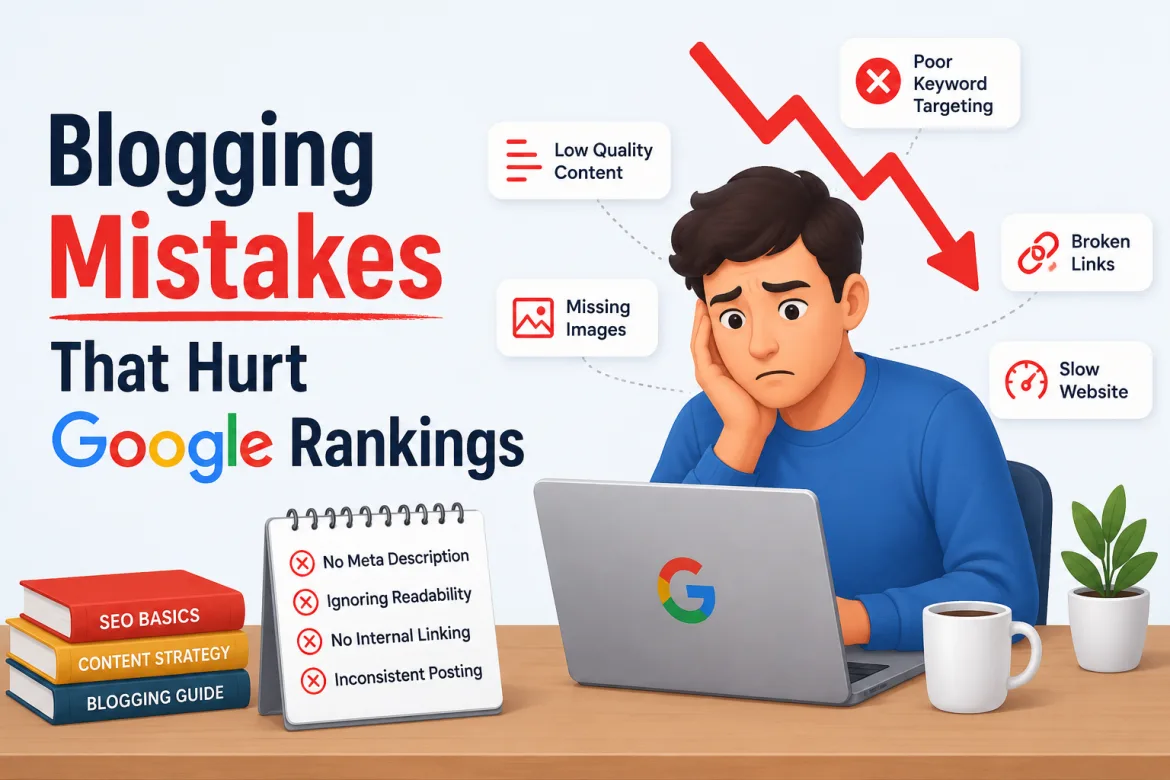
Blogging is one of the most effective digital marketing techniques for firms seeking to boost online visibility, create qualified leads, and develop authority. However, continuously publishing content does not guaranty high Google ranks. Search has evolved, and successful content today relies on relevant information, clear knowledge, a positive user experience, technical accessibility, and credible signals rather than keyword repetition alone.
In 2026, startups, SMEs, SaaS providers, software firms, and corporations will all battle for more scarce organic attention. Many firms invest in content but receive unsatisfactory results because minor strategic and technological errors undermine otherwise useful articles. The good news is that the majority of these issues can be discovered and resolved. A organized approach to content quality, search intent, technical SEO, and continual measurement can transform a blog into a more valuable long-term company asset.
Why Google Rankings Matter More Than Ever
15 Blogging Mistakes That Can Hurt Google Rankings
1. Publishing Low-Quality or Thin Content
One of the most prevalent issues is writing articles that are too thin for the topic matter. Publishing regularly may increase the number of URLs on a website, but quantity cannot compensate for poor research or low utility. Readers require sufficient context to understand the problem, evaluate alternatives, and adopt a practical next action.
2. Overusing AI-Generated Content Without Human Expertise
AI can speed up research, planning, drafting, and content creation, but releasing machine-generated content without meaningful human assessment can result in generic and repetitive articles. Content may appear professional but lacks firsthand experience, industry background, original examples, or precise details. Even if a site is technically sound, these flaws can reduce its utility.
3. Ignoring Search Intent
Keywords are useful, but they do not entirely explain why people conduct searches. A person looking for a definition has a different requirement than someone comparing suppliers or planning to acquire a service. When an article does not fit the underlying goal, it may attract visitors who then leave since the page does not give the information they expected.
Before writing, determine the user’s likely purpose and base the content on it. Informational searches typically require explanations and instructional advice, whereas commercial searches frequently demand comparisons and assessment standards, and transactional inquiries may necessitate explicit service information or conversion pathways. Matching content to intent improves the user experience and the capacity to support the buyer journey.
4. Keyword Stuffing and Over-Optimization
Repeating an exact term excessively is an outmoded strategy that can make content difficult to comprehend. Modern search systems can grasp related terms, concepts, things, and context, so writers don’t have to use the same phrase in every heading or sentence. Excessive optimization can also make material appear artificial, lowering reader confidence.
Use the primary topic naturally, and address related questions that will benefit the reader. Clear headings, detailed language, relevant internal links, and extensive coverage are often more effective than aiming for a precise keyword density. Write the content in such a way that anyone can comprehend it, and then go over the page for obvious ways to increase its relevancy and clarity.
5. Neglecting Technical SEO Fundamentals
High-quality material requires a technically accessible website. Search engines must be able to crawl sites, analyze relevant resources, grasp site structure, and index URLs in the correct format. Issues such as sluggish performance, broken links, duplicate pages, mobile accessibility, and indexing might limit the visibility of otherwise good material.
Technical SEO should therefore be regarded as the foundation for content marketing. Businesses should examine page performance, crawlability, indexing, redirection, internal links, mobile usability, structured data (where applicable), and other technical signals on a frequent basis. A stable technical infrastructure enables content investments to work more consistently as the website expands. Google’s SEO Starter Guide also provides useful guidance on helping search engines understand website content.
6. Poor User Experience and Website Design
A useful content may lose viewers if the accompanying website is difficult to navigate. Slow pages, obtrusive popups, complex navigation, small writing, distracting adverts, and bad mobile design can all make it difficult for readers to locate and consume content. Good content requires an environment that facilitates reading across desktop, tablet, and mobile platforms.
7. Failing to Build Topical Authority
Publishing unrelated posts on various issues can make a business blog appear unfocused. A more effective approach is to create related groups of material around topics in which the business has true expertise. Covering basic themes, supporting questions, practical instructions, comparisons, and implementation considerations provides visitors with a more in-depth resource and helps the site focus on a specific subject.
A technology consulting firm, for example, may create integrated resources focused on cloud migration, cybersecurity, digital transformation, automation, enterprise software, and scalability. These themes can be connected together where appropriate, allowing readers to transition from broad instructional content to detailed guides and service information. The end effect is a more cohesive content ecosystem, rather than a collection of disconnected posts.
8. Weak Internal Linking Strategy
Internal links help users find relevant material while also assisting search engines in understanding page relationships. However, many firms post new content without linking them to existing resources. This can isolate valuable pages, making it harder for both users and crawlers.
9. Ignoring Content Updates
A blog post is not necessarily complete when it is published. Statistics fluctuate, software products evolve, industry norms emerge, and advice may become out of date. This is especially critical in fast-moving fields like AI, cybersecurity, cloud computing, and automation, where information can become obsolete quickly.
Create a review mechanism for critical, evergreen material. Update old statistics, replace obsolete examples, refresh screenshots, correct technical information, add new advancements, and improve areas that are no longer relevant to the user’s needs. Maintaining good existing content can be more efficient than constantly creating new pages without first assessing the quality of the current collection.
10. Not Optimizing for Mobile Users
Mobile usability is critical since individuals are increasingly researching products and services via smartphones and tablets. A page that functions fine on desktop but requires too much zooming, horizontal scrolling, or tough tapping on mobile can cause unwanted friction. Responsive design, clear text, quick loading, and touch-friendly navigation should be basic features in blog publication.
11. Publishing Without Demonstrating E-E-A-T
Experience, experience, authoritativeness, and trustworthiness are all crucial concepts when developing credible material. Businesses can improve these signals by indicating who wrote an article, describing relevant experience, citing credible sources, and providing original ideas whenever possible. Readers are more likely to trust stuff that they understand.
Author information, professional credentials, case studies, firsthand examples, references, original research, and clear editorial methods can all serve as useful trust signals. These parts should be authentic, rather than provided solely for cosmetic SEO purposes. The primary purpose is to establish that the organization’s information is credible. Google’s guidance on creating helpful, reliable, people-first content provides additional context for developing useful content.
12. Overlooking Cybersecurity and Website Security
Website security has an impact on user confidence, company continuity, and the integrity of published content. Missing security updates, malware, insufficient authentication, and other vulnerabilities can cause website interruption and reputational harm. Secure websites also offer a safer environment for visitors who fill out forms, create accounts, or interact with corporate services.
13. Neglecting Website Scalability
Successful content can result in unanticipated traffic spikes, particularly when an item starts ranking for several keywords or gains attention through social and referral channels. A website that works well in regular traffic may struggle when demand increases. Slow replies and outages might degrade the user experience at precisely the time when the content is receiving increased attention.
14. Ignoring Analytics and Performance Data
Examine organic traffic, search visibility, click-through behavior, engagement, conversions, and other pertinent metrics based on the goal of each content. A brand awareness post may have different success metrics than a service comparison page. Regular analysis enables teams to identify material that requires improvement, extension, consolidation, or a clearer conversion path.
Businesses can also use Google Search Console to monitor search performance and identify opportunities for improving the visibility of their content.
15. Creating Content Without a Business Strategy
Traffic alone does not constitute a complete content strategy. Blogging should align with business goals such as consumer education, lead creation, brand exposure, product discovery, and revenue growth. When articles are written without a clear target or purpose, they may receive traffic but fail to assist the company achieve its goals.
Before publication, identify who the post is intended for, what problem it answers, how it helps the buyer journey, and what valuable next steps a reader may do. Content should complement the overall marketing and sales plan without transforming every instructional item into a sales pitch. A balanced approach fosters trust while offering readers logical opportunity to investigate relevant services.
Key Factors When Choosing an IT Service Provider
Technology infrastructure has a direct impact on website performance, security, scalability, and digital operations, making choosing an IT service provider a critical decision. Businesses should look at technical knowledge, implementation experience, security practices, scalability, support quality, and the provider’s ability to grasp corporate objectives rather than just the initial quote.
Common Mistakes When Selecting Technology Partners
Organizations may choose technology partners based only on price, only to learn that the solution does not scale or that support and security expectations are unclear. Other issues arise when firms neglect to check references, ignore the technological stack, or do not consider future requirements throughout the selection process.
A better evaluation takes into account entire value, technological capabilities, security, scalability, communication, support, and long-term alignment. The goal is not just to buy a service, but to form a technology partnership that will support operational reliability and future development. Clear requirements and measurable service expectations might help to prevent misunderstandings after implementation.
- Compare providers based on long-term value and strategy alignment, not just pricing.
- Consider references, service level commitments, communication processes, and maintenance duties.
- Ensure infrastructure can scale to meet increasing traffic and operational needs.
- Evaluate security practices, compliance requirements, support methods, and service reliability.
- Verify technology experience.
Conclusion
Blogging remains an effective approach for businesses to establish authority, attract suitable prospects, and support long-term growth, but constant writing is insufficient. Strong performance necessitates useful content, search-intent alignment, technical accessibility, mobile usability, reputable expertise, security, and ongoing improvement. Each piece adds to the overall experience that readers and search engines have.
Businesses that address these typical problems in a methodical manner can create a stronger and more resilient content program. When combined with human expertise, AI can boost production efficiency, while analytics can guide continuous optimization and technology infrastructure can enable growth. The most effective strategy is to view blogging as a long-term business system rather than a one-time publishing activity, tying useful content to genuine consumer demands and measurable organizational goals.