

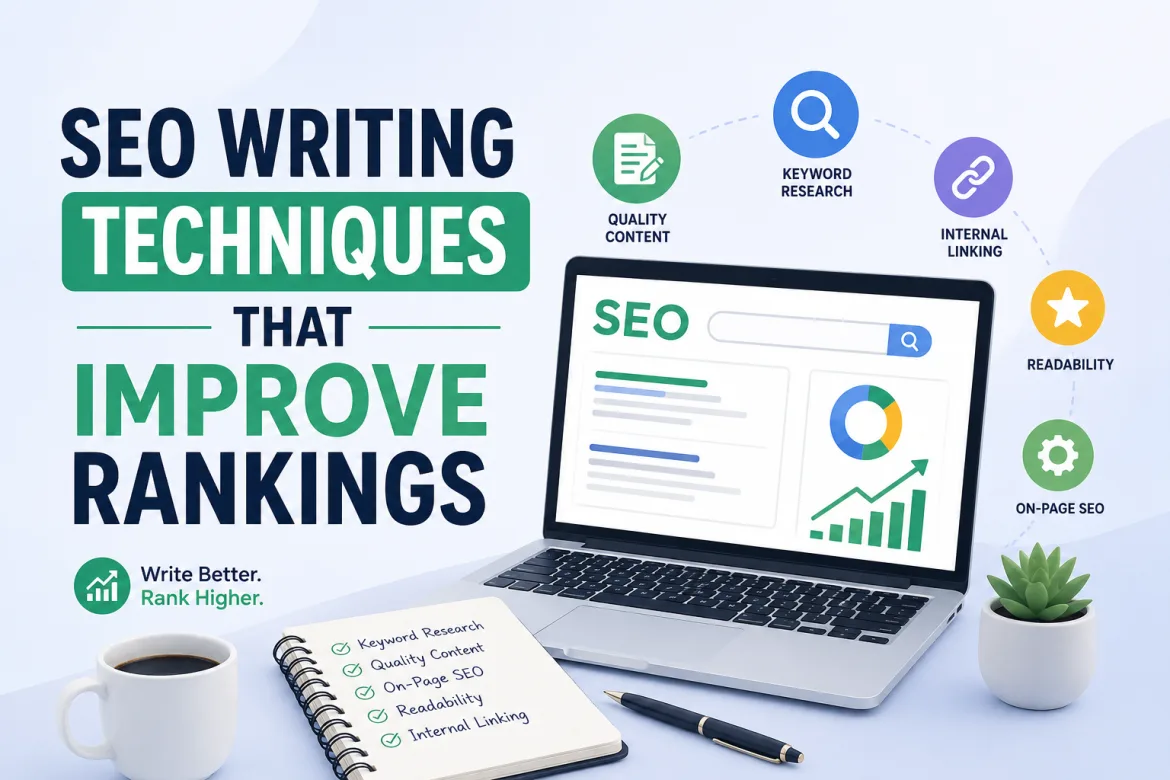
In 2026, ranking on Google will need far more than simply adding keywords onto a webpage. Search engines have gotten more complex, emphasizing content quality, user experience, expertise, and relevancy. Businesses who continue to rely on antiquated SEO strategies frequently struggle to obtain awareness, but those that invest in valuable, user-focused content experience better long-term returns.
For startups, SMEs, enterprises, and digital-first businesses, organic search is still one of the most cost-effective ways to get qualified leads. Unlike paid advertising, high-quality content can continue to drive visitors and generate economic opportunities long after it is published. However, success is dependent on understanding how modern SEO writing works and how it complies with search engine expectations.
This tutorial delves into tried-and-true SEO writing approaches that can help organizations boost rankings, increase visibility, and develop content that adds measurable value. Whether you’re creating a new content strategy or improving an old one, these ideas can help you achieve long-term growth.
Understanding Modern SEO Writing
Today’s SEO writing focuses on assisting readers in finding accurate, relevant, and valuable information. Search engines evaluate material based on how well it answers questions, solves issues, and meets user expectations. As a result, content creators must strike a balance between SEO and true value.
Modern SEO is strongly influenced by user behavior. If visitors quickly leave a page because the content is unclear or useless, rankings may decrease over time. On the other side, information that keeps readers engaged tends to do better since it exhibits relevance and usefulness.
Rather than writing simply for algorithms, effective organizations prioritize content that benefits their audience. When readers respect your material, search engines are more likely to reward it with more visibility.
Start With Search Intent
Why Search Intent Matters
Search intent is one of the most crucial aspects of SEO writing. Every search query has a specific goal, and understanding that purpose enables firms to develop content that meets user expectations. Even well-written articles may struggle to rank if they do not address the reason for the search.
For example, a user looking for software cost is most likely considering purchasing alternatives, whereas someone looking for software benefits may still be in the research stage. These viewers require diverse content experiences. Matching content to intent boosts engagement, conversions, and ranking potential.
Businesses that continuously develop intent-driven content receive higher-quality traffic because they answer real customer demands at the appropriate stage of the purchasing experience.
Example
Consider a SaaS startup that targets the keyword “project management software.” If search results are dominated by comparison articles, feature reviews, and purchase tips, writing a basic instructive piece may not be successful. Instead, developing a detailed comparison guide complete with feature breakdowns and commercial use cases is more likely to meet customer expectations and increase rankings.
Conduct Comprehensive Keyword Research
Focus on Topics, Not Just Keywords
Keyword research is still an important part of SEO, although newer tactics focus on ideas rather than specific phrases. Search engines can now grasp context and semantic relationships, allowing them to determine how extensively a topic is covered.
Instead of continuously targeting a single phrase, organizations should build content that naturally addresses related themes and frequently asked questions. This strategy increases topical relevance and allows content to rank for a broader range of search queries.
For example, an article about cloud migration could naturally include related terms such as:
- Cloud infrastructure
- Cloud security
- Migration strategy
- Hybrid cloud
- Digital transformation
- Data migration
A cloud migration article, for example, may naturally include migration planning, security considerations, infrastructure management, cost optimization, and digital transformation techniques. Such detailed coverage adds value to readers while improving SEO performance.
Prioritize Long-Tail Keywords
Long-tail keywords frequently attract highly targeted audiences because they address unique needs or issues. These searches often have lower competition and higher conversion rates than wide keywords.
A company seeking for “best CRM software for small teams” usually has a more specific goal than someone searching for “CRM.” Businesses that target detailed queries can attract visitors who are closer to making decisions and are more likely to become customers.
Create High-Quality, Original Content
Depth Wins Over Volume
Publishing lots of middling articles seldom yields the same results as writing a few excellent ones. Search engines are progressively rewarding information that indicates skill, originality, and extensive coverage of a topic.
High-ranking content usually provides:
- Comprehensive explanations
- Unique insights
- Expert perspectives
- Actionable advice
- Practical examples
Organizations should stress depth, accuracy, and relevance rather than just posting frequency. Comprehensive resources frequently generate traffic for years after their creation.
Use Real-World Examples
Practical examples make content more understandable and convincing. Readers love seeing how principles apply in real-world business settings because it allows them to relate theory to practical results.
For example, a software company that provides specific case studies explaining how clients lowered operational expenses through automation can get substantially more trust than one that merely addresses automation in broad strokes. Real-world applications demonstrate competence and provide essential context for decision-makers.
Optimize Headlines for Users and Search Engines
Write Headlines That Earn Clicks
Your headline is frequently the first interaction users have with your content. Even if an item ranks high, a poor title can reduce traffic by lowering click-through rates. Effective headlines effectively communicate value and encourage users to study more.
An effective headline should:
- Clearly communicate value
- Include the target keyword naturally
- Create curiosity
- Remain specific and relevant
Examples:
Weak Headline:
SEO Writing Guide
Strong Headline:
10 SEO Writing Techniques to Improve Rankings and Increase Traffic
The second option offers clarity and a strong reason to click.
Use Structured Headings
Well-organized material is beneficial to both readers and search engines. Headings establish a logical flow, allowing readers to swiftly scan content and find relevant sections. This is especially crucial for business audiences, who frequently consume content while managing several obligations.
- H1 for the main title
- H2 for major sections
- H3 for supporting topics
A structured structure also helps search engines grasp content hierarchy and subject relationships, which improves overall SEO efficacy. For additional guidance on creating search-friendly content, see Google’s SEO Starter Guide.
Write for Humans First
Avoid Keyword Stuffing
Keyword stuffing is one of the most effective techniques to make content appear artificial. Modern search algorithms understand context and no longer rely on excessive repetition to evaluate relevancy.
Rather than focusing on keyword density, authors should address customer questions extensively while naturally incorporating relevant terms. Content that reads easily is more engaging and likely to elicit good user feedback.
Businesses that prioritize readability tend to have better long-term success since their content is valuable to both readers and search engines.
Improve User Experience
User experience has a big impact on content performance. Readers appreciate articles that are simple to navigate, visually arranged, and uncomplicated to understand.
Best practices include:
- Short paragraphs
- Clear language
- Logical flow
- Visual hierarchy
- Scannable formatting
Simple formatting, logical progression, and succinct explanations all help to improve reading. When visitors can easily locate answers and consume information, they are more likely to remain interested and explore other content on the website.
Build Topical Authority
Become the Go-To Resource
Topical authority is achieved by continually posting high-quality content on a given subject. Search engines frequently favor websites that exhibit deep expertise over those that cover unrelated topics.
For example, a software development company could create content covering:
- Custom software development
- Cloud computing
- Artificial intelligence
- DevOps
- Digital transformation
- Cybersecurity
Over time, search engines perceive the website as a reliable source in these categories. Authority does not happen immediately, but companies who invest in a long-term content strategy can acquire a major competitive edge.
Use Topic Clusters
Topic clusters help to organize content into meaningful relationships. A primary pillar page covers a major topic, while secondary articles delve into relevant subtopics in more detail. This layout increases internal linking, strengthens topical authority, and allows search engines to better grasp your content hierarchy.
Benefits include:
- Improved internal linking
- Stronger topical relevance
- Better user navigation
- Enhanced authority signals
This structure enhances navigation, strengthens internal linking, and assists search engines in determining the depth of expertise on a page. It also improves the reading experience for those who wish to learn more about a topic.
Optimize Content for Featured Snippets
Capture Position Zero
Featured snippets offer the possibility to appear above typical search results. These prominent placements frequently boost exposure and attract high-quality traffic.
Content that responds to inquiries clearly and directly has a higher probability of being chosen. Definitions, succinct explanations, step-by-step methods, and structured answers are highly effective. Businesses that optimize for snippets can increase brand visibility in highly competitive search markets.
Example
Question:
“What is SEO writing?”
Snippet-friendly answer:
SEO writing is the process of developing content that search engines can comprehend while also providing users with meaningful and relevant information.
This format is clear, concise, and easy for search engines to display.
Use Internal Linking Strategically
Strengthen Website Architecture
Internal links assist search engines in discovering material and understanding the relationships between pages. They also motivate users to look into more resources, which increases session duration and engagement.
Effective internal linking should:
- Connect related topics
- Use descriptive anchor text
- Guide readers naturally
- Support conversion paths
A good internal linking strategy combines individual articles into a cohesive content ecosystem that serves both SEO and business goals.
Example
A digital transformation guide may naturally include links to articles about cloud migration, software modernization, cybersecurity strategy, and AI adoption. These links give value to readers while emphasizing subject relevance.
Incorporate E-E-A-T Principles
Experience, Expertise, Authoritativeness, and Trustworthiness
Trust has become a significant differentiator in search rankings. Businesses with real-world experience and industry expertise typically outperform generic content publishers.
E-E-A-T principles are especially critical for building authority in organizations that operate in technology, healthcare, finance, and other specialized industries.
Why It Matters
Decision-makers want to feel confident in the information they consume. Content that displays true expertise can influence purchasing decisions, boost brand reputation, and improve long-term SEO results. For more information, see Google’s guidance on creating helpful, reliable, people-first content.
Keep Content Fresh and Updated
Content Decay Is Real
Even successful material can become out of date, reducing its prominence. Industry trends, technologies, and user expectations change continually, necessitating regular upgrades.
Refreshing information with new examples, current statistics, and updated insights indicates that search engines will continue to find it relevant. These adjustments frequently enhance results without the need for fully new content. For many firms, improving existing assets provides a faster return on investment than beginning from zero.
Business Impact
A simple content refresh can help you regain lost rankings, increase traffic, and enhance conversion rates. Businesses who maintain their content library often have a measurable edge over competitors who ignore continuing optimization.
The Future of SEO Writing
SEO writing in 2026 will increasingly focus on user value, authority, and high-quality content that really solves problems. As search engines become more sophisticated, they prioritize information that displays experience, reliability, and real-world utility over mere keyword optimization. This change is encouraging producers to prioritize depth, clarity, and relevancy in every piece of material they create.
As AI-generated content becomes more common, uniqueness and subject matter expertise are becoming as important differentiators. Search engines are improving their capacity to detect shallow or repetitive content while rewarding publishers that provide fresh insights and relevant opinions. This means that organizations must prioritize providing content that goes beyond surface-level information and provides actual value to users.
Finally, the most effective SEO tactics will prioritize audience experience over algorithm manipulation, resulting in long-term visibility, trust, and sustainable organic growth.
Conclusion
SEO writing in 2026 focuses on providing valuable material that appeals to both readers and search engines. Understanding search intent, establishing topical authority, improving user experience, and delivering useful information on a continuous basis all contribute to success.
Organizations that view content as a strategic business asset rather than a marketing afterthought are much more likely to achieve long-term organic growth. Businesses that prioritize quality, competence, and relevance can increase their rankings while also gaining trust with their target audience.