

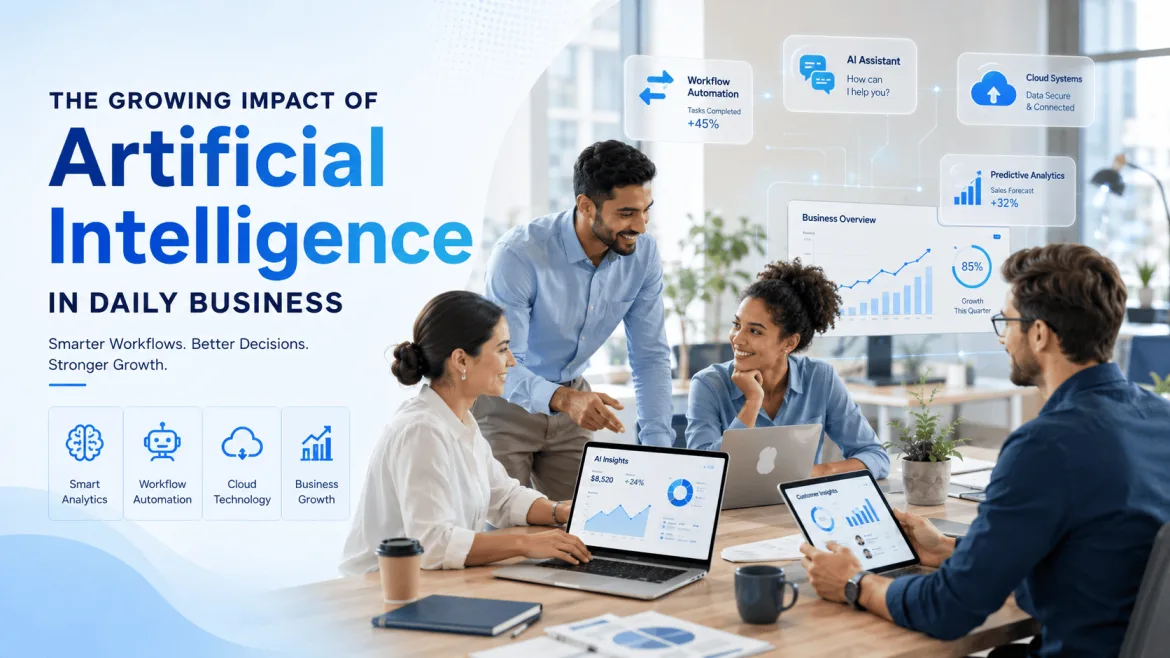
Artificial intelligence is no longer a future concept reserved for tech behemoths; it has become the daily operational backbone for organizations of all kinds. From startups automating customer care to organizations optimizing global supply chains, artificial intelligence is quietly transforming how decisions are made, services are given, and businesses develop.
In 2026, the impact of AI on regular corporate operations is more obvious than ever. Efficiency is no longer the only consideration; intelligence, adaptability, and long-term competitiveness are also important. Companies that include AI into their operations move faster, make more informed decisions, and scale with fewer resources.
At the same time, AI is inextricably linked to cloud computing, cybersecurity, automation systems, and digital transformation initiatives. Together, these technologies are creating a more intelligent corporate ecosystem in which data-driven decisions replace guesswork.
How Artificial Intelligence is Transforming Daily Business Operations
Artificial Intelligence has moved beyond experimental use cases and is now embedded into everyday business processes. Whether it is analyzing customer behavior, predicting sales trends, or automating administrative work, AI plays a silent yet powerful role.
Smarter Decision-Making with Data-Driven Insights
Modern businesses create vast volumes of data every second. Without AI, this data is underutilized. AI-powered analytics systems can now scan complicated datasets in real time, allowing decision-makers to quickly detect trends and possibilities.
Retailers, for example, utilize artificial intelligence to study purchasing habits and dynamically modify price strategies. Similarly, financial organizations utilize predictive algorithms to evaluate risk and uncover fraud early.
This change from intuition-based decisions to data-driven tactics has resulted in increased business accuracy and lower operational risks.
AI-Powered Customer Experience Enhancement
Customer experience has emerged as a crucial difference in competitive marketplaces. AI enables enterprises to provide tailored experiences at scale.
Some common applications include:
- AI chatbots providing 24/7 customer support
- Recommendation engines suggesting personalized products
- Sentiment analysis tools tracking customer feedback
- Voice assistants improving accessibility and response time
Companies such as e-commerce platforms and SaaS providers are already leveraging AI to build highly tailored journeys that boost engagement and loyalty.
The Role of Automation in Modern Business Efficiency
Automation is one of the most apparent and useful applications of Artificial Intelligence in everyday company operations. It minimizes repetitive processes, lowers human error, and enables teams to concentrate on strategic work.
Streamlining Repetitive Business Processes
AI-driven automation systems now handle tasks including invoice processing, email answers, HR onboarding, and data input. This not only saves time but also maintains consistency throughout the activities.
For example, accounting departments employ AI systems to automatically categorize spending and prepare financial reports, decreasing manual burden by more than half in many firms.
Enhancing Productivity Across Departments
AI automation is not just for back-office chores. Marketing teams utilize AI to plan campaigns, gather content insights, and optimize ad spend. Sales teams use AI-powered CRMs to prioritize prospects and increase conversion rates.
The end result is a more productive workforce, with employees devoting less time to repetitive duties and more to innovation and client interaction.
Cloud Computing and AI: A Powerful Combination
Cloud computing has become the foundation for modern artificial intelligence systems. Most AI applications would struggle to function successfully if cloud infrastructure could not provide the scale and flexibility they require.
Scalable Infrastructure for Growing Businesses
Scalability is one of the most significant advantages of cloud-based artificial intelligence systems. Businesses can scale their operations up or down according to demand without spending much on physical infrastructure.
Cloud AI solutions are especially beneficial to startups because they provide access to enterprise-level resources without incurring significant upfront fees. This leveled the playing field for small firms and huge multinationals.
Real-Time Data Processing and Accessibility
Cloud platforms enable AI systems to process and evaluate data in real time from a variety of sources. This is critical in industries such as transportation, healthcare, and finance, where timely insights can make a substantial difference in outcomes.
For example, logistics organizations utilize cloud-based AI systems to track shipments, optimize routes, and eliminate delivery delays.
Strengthening Cybersecurity with Artificial Intelligence
As firms become more digital, cybersecurity risks evolve. AI plays an important role in detecting and preventing these risks before they do harm.
Predictive Threat Detection Systems
Traditional security systems follow predefined rules, whereas AI-based cybersecurity products can learn and adapt over time. They recognize odd behavior patterns and alert to potential hazards before they escalate.
This preventive approach assists firms in avoiding data breaches, ransomware attacks, and unwanted access attempts.
Continuous Monitoring and Response Automation
AI systems are capable of monitoring networks around the clock. In the event of suspicious activity, automated response methods can isolate impacted systems instantly.
This greatly reduces response time while minimizing potential damage, particularly in large-scale enterprise environments.
Digital Transformation Driven by Artificial Intelligence
Digital transformation is no longer an option; it is necessary for survival in today’s company market. AI is at the heart of this transformative path.
Redefining Traditional Business Models
Companies are transitioning away from manual, paper-based procedures and toward fully digital ecosystems powered by AI. This includes digital customer onboarding, AI-powered supply chain management, and intelligent financial forecasting.
Businesses that embrace this transition enjoy increased efficiency, more customer happiness, and a stronger market position.
AI in Product and Service Innovation
AI is also enabling businesses to innovate more quickly. AI speeds innovation cycles by creating new products based on user data and optimizing service delivery.
For example, industrial organizations utilize AI-powered simulations to evaluate product designs before to production, resulting in significant cost and time savings.
Key Factors to Consider When Choosing an IT Service Provider
Choosing the correct IT service provider is important for effective AI and digital transformation implementation. A poor decision might result in inefficiencies, security hazards, and wasted resources.
Technical Expertise and Industry Experience
Businesses should determine whether the vendor has experience with AI, cloud computing, cybersecurity, and automation technologies. Industry-specific knowledge is also essential, as different areas require different solutions.
Scalability and Long-Term Support
A competent IT partner should provide scalable solutions that can expand with your organization. Long-term maintenance, updates, and support services are required for optimal functioning.
Security and Compliance Standards
Because AI systems handle sensitive data, compliance with worldwide security standards is required. Providers must adhere to strict cybersecurity standards and data protection rules. Businesses can also review NIST Cybersecurity Framework resources when evaluating cybersecurity practices.
Integration Capabilities
Modern firms employ several software platforms. The IT supplier should make sure that AI tools, CRM systems, ERP platforms, and cloud services all work together seamlessly.
Common Mistakes Businesses Should Avoid
Despite the benefits of artificial intelligence, many firms fail to use it owing to simple blunders.
Lack of Clear Strategy
Implementing AI without a clear business goal sometimes results in lost expenditures. Companies must specify what they aim to achieve, whether it is cost savings, increased efficiency, or improved customer experience.
Ignoring Employee Training
AI adoption is more than just a technical revolution; it is also a cultural transformation. To use AI-powered technologies efficiently, employees must receive sufficient training.
Overdependence on Automation
While automation is useful, over dependence can undermine human oversight. Businesses should strike a balance between AI-powered procedures and human decision-making.
Poor Data Management
AI systems are only as effective as the data they use. Inaccurate or inadequate data might result in incorrect insights and poor business decisions.
2026 Trends in AI and Business Technology
As we move deeper into 2026, several key trends are shaping the future of AI in business:
- Rise of generative AI in marketing and content creation
- Expansion of AI-powered virtual assistants in enterprise workflows
- Increased adoption of edge computing for real-time AI processing
- Stronger focus on ethical AI and data privacy
- Integration of AI with IoT for smart business ecosystems
These patterns suggest that AI will continue to expand from a supporting tool to a primary business driver.
Conclusion
Artificial intelligence is no longer simply improving corporate operations; it is redefining them. From automation and cybersecurity to cloud computing and digital transformation, artificial intelligence is firmly integrated in every layer of current business infrastructure.
Companies that adopt AI today are setting themselves up for long-term success in a highly competitive digital environment. However, success is dependent not just on technology adoption, but also on selecting the correct IT service provider, developing a solid plan, and avoiding frequent implementation pitfalls.
Businesses that are intelligent, adaptable, and data-driven will thrive in the future. Artificial intelligence does not replace human decision-making; rather, it empowers it.