

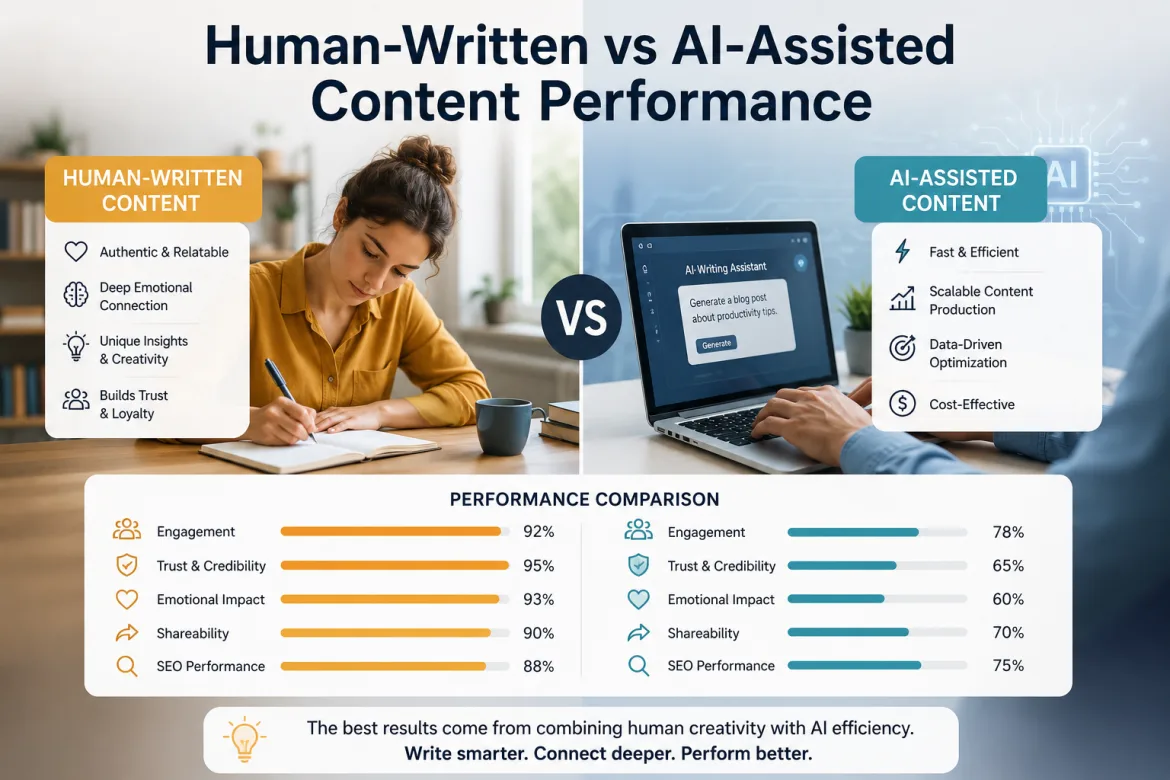
Content marketing has advanced dramatically by 2026, with AI extensively interwoven into content generation procedures. Businesses today produce blogs, emails, product descriptions, and campaigns on a large scale, but consumers and search engines place a greater emphasis on authenticity and value than volume.
This has sparked an ongoing debate about human-written, AI-generated, and hybrid content approaches. While artificial intelligence provides speed, scalability, and efficiency, human writers bring originality, storytelling, and emotional depth. For startups, SMEs, and businesses, finding the appropriate mix has a direct impact on SEO performance, trust, and brand authority.
Most successful businesses today employ a hybrid strategy that blends AI productivity with human control. In this essay, we will compare both approaches in terms of SEO, engagement, scalability, automation, and digital transformation, as well as major business use cases and difficulties.
Understanding Human-Written Content
Human-Written Content
Human-written content is defined as material created by writers, marketers, and subject matter experts using their expertise, research, creativity, and editorial judgment. Examples include blogs, whitepapers, technical documentation, and brand storytelling. Unlike automated systems, human writers add emotional depth, cultural sensitivity, humor, and contextual understanding to improve communication quality and audience connection. In 2026, these attributes will be even more desirable as audiences seek authenticity and trust in a digital ecosystem dominated by generic or highly automated material, making human insight critical for meaningful and compelling communication.
Key Strengths of Human-Written Content
Human-created information continues to dominate in fields where trust and authority are critical. Businesses in healthcare, cybersecurity, finance, SaaS consulting, and enterprise IT frequently rely on expert-generated content to build trust.
Some major advantages include:
- Strong emotional connection with readers
- Better storytelling and brand voice consistency
- Higher trust and authenticity
- More nuanced industry expertise
- Better adaptation to cultural and regional contexts
For example, a cybersecurity company that publishes incident response insights following a significant ransomware assault gains from human analysis, professional knowledge, and industry-specific interpretation. While AI can synthesize information fast, experienced professionals can provide strategic context and effective business recommendations.
Challenges of Human-Written Content
Regardless of its advantages, 100% human-generated material has limitations. High-quality authors, editors, SEO professionals, and researchers need time and money. Consistently producing big volumes of content can be expensive, particularly for startups and growing businesses.
Some common challenges include:
- Higher production costs
- Longer turnaround times
- Scalability limitations
- Resource-intensive editorial workflows
- Difficulty maintaining high publishing frequency
As businesses grow globally, relying solely on manual content creation can impede marketing execution and digital transformation activities.
What Is AI-Assisted Content?
AI-Assisted Content
AI-assisted content blends artificial intelligence technologies with human supervision, with AI assisting writers by handling repetitive duties such as subject generation, research summaries, outlining, SEO optimization, grammar refinement, and first draft creation, rather than replacing human originality. In 2026, modern AI platforms will be deeply integrated with cloud services, marketing automation tools, analytics systems, and enterprise content management solutions, allowing businesses to streamline content workflows, increase efficiency, and scale production while maintaining quality control and strategic human input.
How Businesses Use AI-Assisted Content
Companies are currently using AI at various phases of the content lifecycle. Teams use AI to accelerate and optimize their work, rather than writing everything manually.
Common use cases include:
- Generating first drafts for blog posts
- Automating product descriptions for eCommerce
- Creating multilingual marketing campaigns
- Producing SEO metadata at scale
- Supporting technical documentation workflows
For example, SaaS companies typically utilize AI to generate feature summaries and knowledge base drafts, while technical writers check the final text for clarity and correctness.
Advantages of AI-Assisted Content
AI-assisted workflows provide major operational benefits to modern enterprises. Businesses focusing on scalability and automation are increasingly using hybrid content models. Key benefits include faster content creation, lower operational costs, improved scalability and process automation, real-time SEO optimization, easy multilingual content expansion, and enhanced cloud collaboration capabilities.
For startups with lean marketing teams, AI can significantly minimize manufacturing bottlenecks while allowing for rapid market expansion.
SEO Performance: Human vs AI-Assisted Content
Search engine optimization is still one of the most critical performance factors when comparing human-written and AI-assisted content. By 2026, search engines will have advanced significantly in their ability to assess user intent, knowledge, topical authority, and engagement quality.
Human-Written Content and SEO
Human-written articles frequently outperform for competitive, high-authority keywords because they give deeper analysis, greater originality, and more interesting tales. Search engines are increasingly rewarding information that displays knowledge, experience, authority, and trustworthiness. Human-generated SEO content usually shines at:
Long-format thought leadership, expert commentary, industry analysis, case studies, opinion-based publications, and strategic business insights.
For example, a cloud computing consultant that publishes an in-depth digital transformation strategy guide is more likely to score high if the piece includes real-world implementation experience and practical recommendations.
Businesses can also use resources such as Google’s guidance on creating helpful, reliable, people-first content when developing SEO-focused content strategies.
AI-Assisted Content and SEO
When organizations want speed, volume, and consistency in optimization, AI-assisted content performs exceptionally well.
SEO keyword clustering, metadata optimization, internal linking advice, FAQ development, content gap analysis, and scalable blog production are common applications.
However, entirely AI-generated content that lacks human editing frequently issues with originality, repetition, and shallow insights. Search algorithms are increasingly capable of detecting low-value automated content with no significant user experience.
The Hybrid SEO Model in 2026
The most successful SEO tactics nowadays often mix both approaches. Businesses employ AI for research, structure, optimization, and automation, while human specialists fine-tune messaging, strategy, and storytelling.
This hybrid approach delivers: Faster publication cycles, improved SEO consistency, higher user engagement, increased content quality, and greater scalability.
As a result, hybrid content operations are becoming the norm among modern digital marketing teams.
Why Human Content Often Converts Better
Human-written material tends to elicit greater emotional involvement since it reflects real-life experiences, empathy, and persuasive communication. Readers are more likely to trust brands that appear genuine rather than highly automated.
This is particularly crucial for: B2B technology companies, enterprise software providers, cybersecurity firms and IT consultancy agencies, and high-ticket SaaS systems.
For example, a CTO assessing cloud migration providers is more likely to respond to expert-driven case studies rather than generic AI-generated summaries.
Where AI-Assisted Content Improves Engagement
AI tools are excellent at personalization and automation. Businesses may now create dynamic content experiences based on user behavior, geographical locations, and consumer intent.
AI-powered engagement strategies include: Personalized landing pages, automated email campaigns, behavioral content recommendations, smart chatbot interactions, and dynamic product messaging.
When paired with human monitoring, these tactics greatly improve the customer experience and lead nurturing results.
The Role of AI in Digital Transformation
The scope of digital transformation has expanded beyond software infrastructure and cloud migration. Content operations are increasingly an important part of enterprise transformation initiatives. Businesses are rapidly incorporating AI-powered content management solutions to boost scalability, efficiency, and cross-channel communication.
Cloud-based collaborative tools, marketing automation tools and CRM systems, customer analytics dashboards, and enterprise knowledge management solutions are increasingly important components of these workflows.
This connection increases operational efficiency while minimizing friction in content generation across departments.
Cloud Services and Content Scalability
Cloud-native AI systems enable enterprises to grow content production globally without significantly extending their own workforce. Marketing departments can cooperate from several locations while retaining centralized operations and brand consistency. This promotes speedier content delivery and reduces operational bottlenecks among distant teams. Cloud-enabled AI solutions bring significant operational benefits to organizations managing multilingual campaigns and big content libraries. They also enhance content governance, version control, and real-time cooperation in global markets.
Cybersecurity and Ethical Concerns
Cybersecurity and Ethical Considerations
As AI usage increases, firms must consider cybersecurity and ethical implications. Organizations must ensure data privacy, safe integrations, and appropriate AI use across all systems. Failure to handle these risks may result in data breaches, regulatory concerns, and a loss of customer trust.
Data Privacy Risks
Many artificial intelligence platforms handle sensitive company information, client data, and proprietary papers. Organizations should carefully evaluate:
- Data encryption standards
- Compliance certifications
- Cloud storage policies
- User access controls
- Third-party integrations
Failure to examine cybersecurity practices can leave firms vulnerable to compliance violations and data breaches.
AI Content Authenticity Challenges
Another major concern is authenticity. Over-automated content can harm a brand’s reputation if users regard it as generic, false, or manipulative. Maintaining a distinct human voice and a transparent content strategy are critical for establishing long-term trust and confidence.
Fact accuracy and human review methods, ethical AI usage, and brand voice consistency are important considerations. Companies can also review NIST’s AI Risk Management Framework for guidance related to managing AI risks and responsible AI practices.
Companies that prioritize ethical AI implementation will benefit from increased customer trust and long-term brand loyalty in 2026.
The Future of Content Performance
The debate over human-written versus AI-assisted content is fast evolving. In reality, the future belongs to both people and machines. It belongs to companies that know how to integrate the two efficiently. AI will continue to advance in automation, analytics, personalization, and scalability. At the same time, human creativity, strategic thinking, and emotional intelligence will remain vital for establishing trust and long-term consumer connections. Companies leading digital transformation in 2026 are not considering whether AI should replace authors. They want to know how AI can help teams create better, faster, and more effective content.
Conclusion
Human-written and AI-assisted content each have distinct advantages, but neither technique succeeds in every case. Human knowledge gives authenticity, trust, and emotional engagement, whereas AI offers speed, automation, scalability, and operational efficiency. For startups, SMEs, businesses, founders, and CTOs, the best option is frequently a balanced hybrid model. Businesses that mix AI-powered productivity with human creativity see improved SEO performance, higher engagement, more scalability, and more sustainable digital growth.
As content ecosystems become more competitive, firms should prioritize quality, cybersecurity, ethical AI implementation, and long-term brand authority over short-term automation gains.
For additional information about AI governance and responsible AI practices, businesses can review OECD AI Principles.