

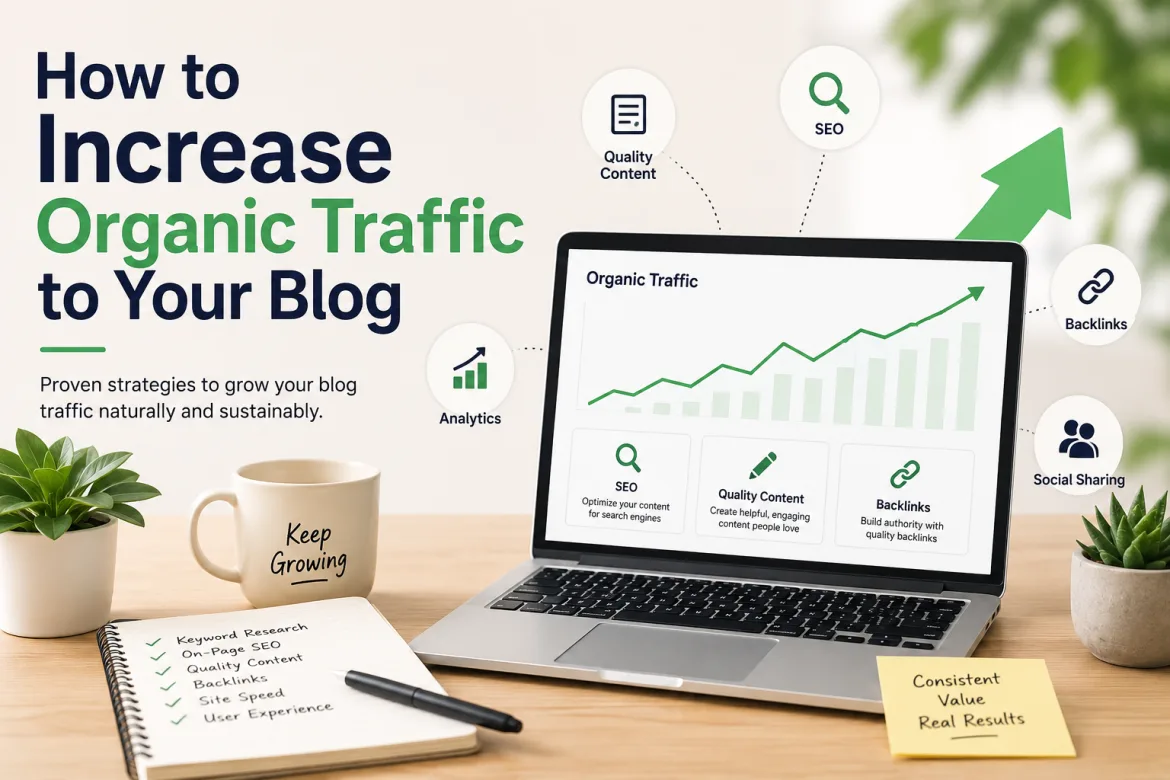
Organic traffic is one of the most significant digital marketing assets for firms in 2026. While paid advertising might bring rapid awareness, organic search offers long-term development, steady lead creation, and a higher return on investment over time. Businesses that rank high in search results frequently benefit from increased reputation because customers trust websites that appear prominently in relevant queries.
As AI-powered search experiences progress, competition for exposure has intensified dramatically. Search engines now prioritize material that exhibits knowledge, solves real-world user problems, and provides a superior browsing experience. Businesses can no longer obtain long-term success with basic SEO methods or mass-produced content.
Understanding How to Generate Organic Traffic to Your Blog
Understanding how to generate organic traffic to your blog is critical for startups creating brand awareness, SMEs expanding your digital presence, and enterprises increasing content marketing activities. This guide’s tactics will help you attract quality visitors, build authority, and lay the groundwork for long-term online growth.
Why Organic Traffic Matters More Than Ever
Organic traffic includes more than simply website visitors. It represents potential clients who are actively looking for answers, solutions, products, or services relevant to your sector. Unlike interruption-based marketing strategies, organic search links businesses with consumers who already have a need or interest, making these visitors extremely lucrative.
Organic traffic helps firms adopting digital transformation achieve numerous business goals. It promotes brand recognition, generates qualified leads, educates prospects, and builds customer trust. A well-optimized blog can become a valuable asset that continues to attract readers months or even years after publishing.
In today’s competitive environment, firms who invest in long-term SEO tactics frequently lessen their reliance on paid advertising while producing a steady stream of inbound possibilities.
Understanding How Search Engines Evaluate Content in 2026
Search engines have progressed much beyond basic keyword matching. Modern algorithms use artificial intelligence, machine learning, and user interaction signals to determine if material meets search intent. The focus has changed to providing the most helpful and trustworthy experience possible.
Successful blogs provide detailed replies, exhibit expertise, and generate great user experiences. Search engines consider a variety of elements when deciding rankings, so firms must adopt a comprehensive SEO strategy.
Search engines now focus heavily on:
- Content relevance and depth
- Search intent alignment
- Website speed and performance
- Mobile responsiveness
- Authority and trustworthiness
Other essential factors are user engagement, content freshness, and structured data implementation. Businesses that constantly develop in these areas have a better chance of achieving long-term visibility and outperforming competition.
Conduct Smarter Keyword Research
Focus on Search Intent Instead of Just Volume
One of the most typical SEO blunders is focusing on high-volume keywords without knowing their intent. A keyword may receive thousands of searches each month, but if it is not aligned with corporate objectives or audience demands, it may provide little benefit.
Modern keyword research should center on determining why users are searching and what information they expect to find. Content that is relevant to user intent often provides increased engagement, better rankings, and higher conversion rates.
Consider the differences between “cloud computing,” “best cloud migration services for healthcare companies,” and “cloud infrastructure cost optimization strategies.” The second and third examples address specific business difficulties and frequently draw decision-makers who are actively seeking answers.
When researching keywords, divide them into three categories: informational keywords for users seeking knowledge and answers, commercial keywords for consumers comparing products or services, and transactional keywords for users ready to make a purchase choice. Examples include inquiries regarding cybersecurity automation, cloud migration advantages, managed IT service providers, cloud platform comparisons, hiring software development firms, managed cybersecurity services, and enterprise cloud consulting.
A well-balanced keyword strategy allows organizations to attract visitors across the customer journey while enhancing conversion opportunities. Businesses can also use Google’s SEO Starter Guide to understand fundamental search optimization practices.
Build Topical Authority Around Core Subjects
Rather than posting random articles on unconnected themes, firms should focus on establishing authority in crucial areas. Search engines are increasingly rewarding websites for demonstrating knowledge through thorough topic coverage.
For example, a technology corporation could create topic clusters centered on cloud services, cybersecurity, and artificial intelligence. Cloud content may include migration, hybrid cloud plans, security, and multi-cloud management. Cybersecurity material could cover zero trust, endpoint protection, ransomware prevention, and compliance frameworks. AI content could include corporate automation, generative AI use cases, customer assistance, and implementation plans.
This subject cluster method increases relevance, enhances internal linking chances, and allows search engines to identify your sector expertise.
Create Exceptional Content That Solves Real Problems
Prioritize Value Over Content Volume
Publishing additional material does not always lead to more traffic. Search engines increasingly value quality, depth, and usefulness over raw quantity. A single well-researched essay can outperform dozens of generic pieces with no practical benefit.
Businesses should concentrate on producing content that answers true difficulties experienced by their target audience. Detailed instructions, industry insights, and solution-oriented articles frequently result in higher engagement and long-term rankings.
High-performing blog entries should address specific difficulties, offer concrete answers, contain examples and case studies, respond to relevant user concerns, and cover topics thoroughly. Instead of writing broad material, focus on actual business outcomes that readers can use right now.
Incorporate Real-World Examples
Real-world examples make content more relatable, trustworthy, and actionable. Readers are far more likely to engage with recommendations when they can clearly see how concepts work in practical business scenarios. This helps transform abstract ideas into actionable insights that decision-makers can confidently apply.
For example, a growing e-commerce company may use cloud scalability to handle seasonal traffic surges without infrastructure disruptions, ensuring smooth performance during peak sales periods. Similarly, an organization implementing AI-powered automation may significantly reduce manual workloads while improving operational efficiency and accuracy across repetitive tasks.
These examples help bridge the gap between theory and execution by showing how strategies perform in real environments. This not only increases content credibility but also makes it easier for business leaders to evaluate and adopt the right solutions for their own operations.
Update Existing Content Regularly
Many firms focus solely on releasing new content, ignoring current assets. However, upgrading older content can typically result in faster SEO gains than developing whole new pieces.
Refreshing material enables organizations to stay relevant, increase accuracy, and adapt to shifting search patterns. It also indicates to search engines that the content is still current and useful.
Review content on a regular basis to include current statistics, update obsolete recommendations, improve internal linking, extend thin sections, refresh screenshots and examples, and optimize for new keywords. A constant content refresh approach can boost rankings and traffic over time.
Optimize On-Page SEO Effectively
Craft Better Titles and Meta Descriptions
The title tag is frequently the first encounter people have with your content in search results. A engaging title not only boosts ranks, but it also raises click-through rates, allowing you to grab more traffic from current impressions.
Strong titles should include the target term, address user intent, express clear value, and elicit natural clicks. For example, a vague title like “SEO Tips” can be improved to “15 Proven SEO Tips to Increase Organic Traffic in 2026”. Meta descriptions should supplement the title by stating clearly what viewers can expect from the content.
Improve Heading Structure
A proper heading structure boosts readability and SEO effectiveness. Well-organized content allows consumers to rapidly access important information while also making it easier for search engines to understand page hierarchy.
Structure articles as follows: H1 for the principal title, H2 for major sections, H3 for supporting themes, and H4 for more in-depth structure. Proper content structure improves the user experience and promotes longer engagement.
Use Internal Linking Strategically
Internal links allow to connect relevant material and direct users through your website. They also spread authority across pages and increase crawlability for search engines. A well-planned internal linking structure increases the visibility of relevant pages and helps search engines understand the relationship between different themes on your website.
For example, a cybersecurity piece may organically link to materials on security audits, compliance frameworks, incident response strategy, and endpoint protection. This strengthens the content ecosystem and encourages users to explore new sites. It also simplifies content discovery and improves overall SEO performance.
Effective internal linking improves both SEO performance and user engagement by making navigation simpler and content discovery easier. This method gradually increases topical authority and contributes to your website’s reputation as a trustworthy source within its field. For additional guidance, businesses can review Google’s documentation on crawlable links.
Invest in Technical SEO
Improve Website Performance
Website speed remains an important ranking and conversion element. Slow websites cause friction, raise bounce rates, and reduce user happiness. Faster loading pages enhance the user experience and encourage users to remain longer on your website.
Companies should prioritize fast hosting infrastructure, image optimization, browser caching, code minification, and content delivery networks (CDNs). Performance optimization improves organic visibility and commercial outcomes while also providing a more seamless experience.
Ensure Mobile-First Optimization
A flawless mobile experience is vital, as the majority of searches are conducted on mobile devices. Users expect pages to load quickly, to be easy to navigate, and to have responsive designs that adapt to screen size.
A mobile-friendly blog should load quickly, look well on all platforms, have easy navigation, utilize readable fonts, and prevent unwanted popups. Strong mobile usability improves both search performance and consumer engagement.
Implement Structured Data
Structured data allows search engines to better understand material and improves how pages appear in search results. Rich results frequently grab more attention and result in better click-through rates.
Example schemas include FAQ, Article, Review, Product, and Organization. When properly implemented, structured data can increase visibility and search result presentation. Businesses can also consult Google’s structured data documentation for implementation guidance.
Leverage AI Without Sacrificing Quality
Use AI as an Assistant, Not a Replacement
AI has become an indispensable element in content production and SEO workflows. Businesses that rely solely on automated content run the danger of creating generic material devoid of uniqueness and skill. The most successful firms blend AI efficiency with human creativity and industry expertise.
AI may help with research, drafting, analysis, and workflow efficiency, but human skills, industry knowledge, editorial review, and original insights give the judgment and context required for credible content.
This balanced approach results in material that is both scalable and trustworthy.
Conclusion
Increasing organic traffic to your blog in 2026 necessitates a smart mix of content quality, technological excellence, user experience optimization, and consistent SEO execution. Businesses that focus on solving real-world consumer problems, establishing topical authority, and reacting to changing search patterns are considerably more likely to achieve long-term growth.
Organic traffic does not come from shortcuts or one-time efforts. It is the consequence of consistent investment, continual improvement, and a dedication to providing value. Organizations that adopt the tactics indicated in this article can improve their online visibility, attract qualified audiences, and gain a long-term competitive edge.