

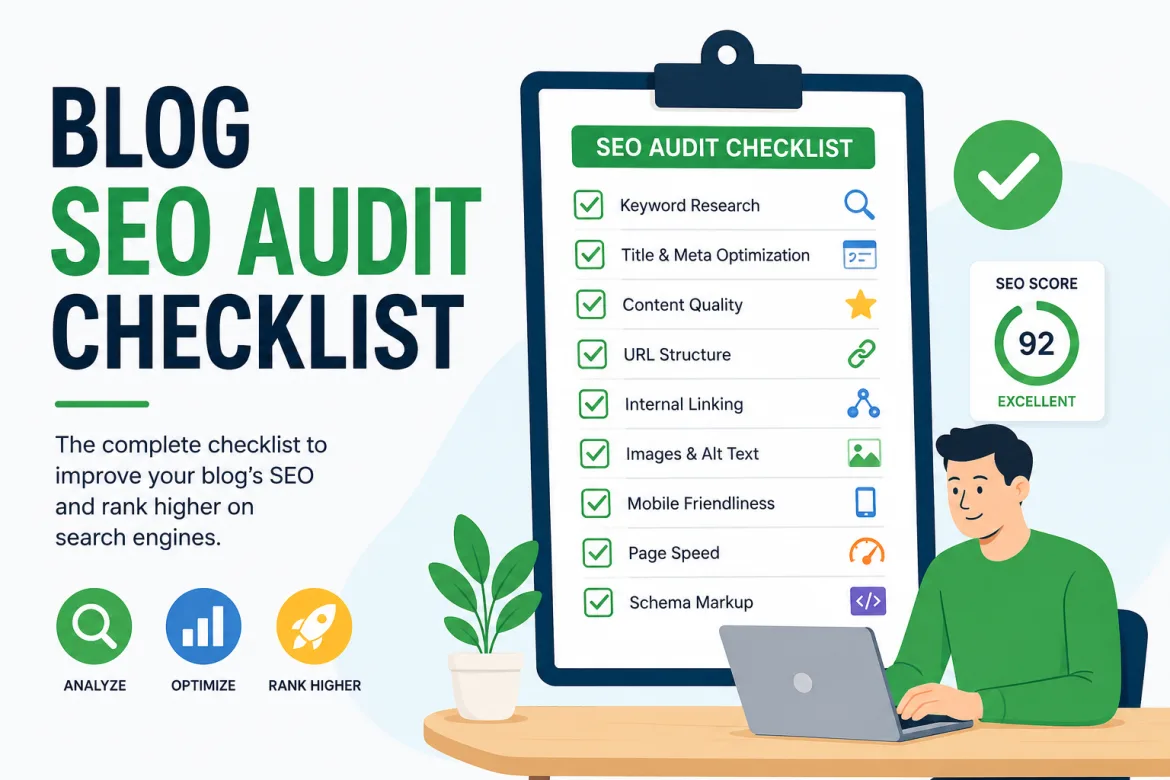
Publishing high-quality material is just one component of an effective blogging strategy. Even the most informative blog content may struggle to rank if certain SEO aspects are lacking. Search engines regularly upgrade their algorithms, competitors enhance their material, and consumer expectations shift over time. This makes regular SEO audits critical for maintaining and enhancing blog performance.
A blog SEO audit identifies flaws that may be limiting organic traffic, lowering user engagement, or preventing pages from reaching their full ranking potential. Businesses can improve their search exposure by examining their content, technical SEO, user experience, and on-page optimization. A structured assessment procedure guarantees that each blog article contributes efficiently to the overall SEO objectives.
This detailed blog SEO audit checklist can assist you in evaluating your blog, addressing common issues, and improving long-term search engine performance.
What Is a Blog SEO Audit?
A blog SEO audit is a thorough evaluation of your blog’s SEO health. It entails examining numerous elements that influence search rankings, such as content quality, keyword optimization, site structure, technological performance, user experience, and link profile. It helps to keep your blog optimized for search engines and performing well in organic search results over time.
- Identifies issues like broken links, slow pages, and duplicate content
- Evaluates keyword usage and content optimization effectiveness
- Checks site structure, internal linking, and navigation flow
- Reviews technical SEO factors like mobile usability and indexing
Overall, a blog SEO audit is critical for maintaining high search exposure, optimizing performance, and assuring long-term organic growth.
Google’s SEO Starter Guide provides additional guidance on helping search engines understand and discover website content.
Why Regular Blog SEO Audits Matter
Many firms prioritize producing new content over maintaining existing material. Blog entries can get out of date, lose rankings, or fail to meet current search intent. Regular SEO audits help to identify these issues and keep content functioning well. They help your blog stay competitive in an ever-changing search field.
- Identifies outdated or underperforming content that needs improvement
- Improves organic traffic by optimizing existing high-potential pages
- Strengthens internal linking and overall site structure
- Enhances user experience by keeping information accurate and relevant
A constant SEO audit procedure ensures that your blog remains optimized, has good ranks, and experiences continual long-term growth.
Review Organic Traffic Performance
The first step in any SEO audit is to assess how your blog is currently performing. Analyze traffic data to determine which pages are attracting visitors and which are potentially losing prominence.
Look for blog pieces that were once popular but have since declined in traffic. These pages frequently provide excellent optimization opportunities. Traffic monitoring can also identify the topics that are most popular with your audience, guiding future content plans.
Pay attention to:
- Top-performing blog posts
- Pages with declining traffic
- Organic landing pages
- User engagement metrics
- Traffic sources
Understanding these patterns allows you to prioritize audit efforts where they will have the biggest impact.
Evaluate Keyword Optimization
Keywords are still an important part of SEO, but current optimization goes well beyond merely using keywords throughout an article. Each blog article should focus on one major keyword while naturally including related terms and phrases that are relevant to the topic.
During your audit, ensure that target keywords appear strategically in places like titles, headings, introductions, and meta descriptions. At the same time, make sure the information flows organically and offers true value to readers. Search engines are progressively prioritizing content quality and relevancy over keyword density.
To increase topical relevance, a blog titled “blog SEO audit checklist” may include related phrases such as SEO review, content optimization, search rankings, technical SEO, and website performance.
Check Content Quality and Relevance
Content quality is one of the most essential ranking criteria. During an audit, thoroughly check each blog post to ensure that the information is still accurate, relevant, and consistent with user purpose.
Outdated statistics, broken references, and inadequate information can all lower credibility and rankings. Updating current content can bring considerable SEO benefits without requiring an entirely new post.
Ask the following questions:
- Is the information still accurate?
- Does the content fully answer user questions?
- Are examples and statistics current?
- Is the content more comprehensive than competing pages?
- Does the article provide clear value to readers?
High-quality content boosts rankings, trust, and conversions.
Audit Title Tags and Meta Descriptions
Title tags and meta descriptions have a significant impact on both search engine results and user clickthrough rates. Even if a page appears on the first page, a badly written title or description can dramatically decrease traffic. Optimizing these factors guarantees that your content receives more clicks and higher engagement from search results.
- Ensure every page has a unique, keyword-optimized title tag
- Write compelling meta descriptions that clearly summarize the content
- Include primary keywords naturally without keyword stuffing
- Focus on improving click-through rates (CTR) with clear messaging
Proper optimization of titles and meta descriptions can greatly increase organic traffic without modifying the page’s primary content.
Analyze Heading Structure
Headings are vital for increasing readability and helping search engines grasp your content’s structure. A well-organized heading system that includes H1, H2, H3, and H4 tags makes it easier for users and search engines to explore and analyze your blog entries.
A clear heading hierarchy enhances the user experience by making text easier to skim and digest. It emphasizes essential subjects and improves SEO by indicating content relevancy and structure to search engines.
- Check for proper use of H1, H2, H3, and H4 tags
- Ensure headings follow a logical and consistent structure
- Avoid duplicate or missing headings within content sections
- Break large sections into smaller, readable subtopics
A well-structured heading system boosts text clarity, SEO performance, and user engagement.
Review Internal Linking
Internal links help search engines find material and distribute authority throughout a website. They also direct readers to relevant information, which increases engagement and time spent on the website.
Many blogs miss out on valuable internal linking chances because they are not examined on a regular basis. During your audit, look for relevant content that can be connected naturally via contextual connections.
Effective internal linking can:
- Improve content discoverability
- Strengthen topical authority
- Increase page views
- Support search engine crawling
- Improve user navigation
A good internal linking strategy can typically result in significant SEO improvements with little effort.
Check for Broken Links
Broken links have a detrimental influence on both user experience and SEO performance, as they direct visitors to inaccessible or missing pages. Websites change URLs or remove material over time, resulting in links that are no longer relevant to your blog. Regularly evaluating these links ensures that your website is trustworthy, functional, and easy to use.
- Identify and fix broken internal links to improve site navigation
- Check external links for outdated or removed pages
- Replace or update links pointing to relevant resources
- Use tools to regularly monitor link health across your blog
Maintaining a clean and up-to-date link structure helps to preserve SEO value while also ensuring a smooth browsing experience for users.
Evaluate Image Optimization
Images play a crucial part in improving content quality, however unoptimized images can decrease page load times and reduce SEO performance. Proper image optimization promotes faster loading times, more accessibility, and higher presence in search results.
It is critical to check that photos have informative file names, suitable alt text, and optimal file sizes. These characteristics aid search engines in understanding image context while also improving the user experience, particularly for visually challenged users.
- Use descriptive file names instead of generic labels like “image1.jpg”
- Add relevant alt text to improve accessibility and SEO relevance
- Compress images to improve page loading speed
- Choose the right image format for performance (JPEG, PNG, WebP)
Proper image optimization improves both technical SEO and the overall user experience, resulting in increased engagement and search exposure.
Test Mobile Friendliness & Assess Page Speed Performance
Mobile friendliness and page speed are two important aspects that influence user experience and search engine rankings. With the majority of visitors visiting websites via mobile devices, search engines reward responsive and fast-loading pages to improve usability and engagement. Even with high-quality content, a slow or poorly optimized site will soon lose traffic.
It is critical to evaluate how your blog functions on smartphones and tablets, ensuring that the text remains readable, navigation is seamless, and any interactive aspects work properly. At the same time, page speed should be checked on a regular basis to uncover performance issues that are slowing down your website and reducing customer happiness.
- Check mobile responsiveness across different screen sizes and devices
- Ensure text, images, and buttons are properly optimized for mobile viewing
- Identify and fix speed issues caused by large images or heavy scripts
- Optimize hosting, caching, and design elements for faster load times
Improving mobile usability and site speed boosts SEO performance, lowers bounce rates, and provides a better overall user experience.
Google PageSpeed Insights can be used to evaluate page performance and identify opportunities for improving loading speed and user experience.
Review Backlink Health & Check Content Freshness
Backlink health and content freshness are both critical components of an effective SEO strategy. Backlinks help to develop authority and trust, and updated material keeps your blog current and competitive in search results. They work together to improve long-term organic visibility and rankings.
When examining backlinks, prioritize quality over quantity. Links from respectable, industry-relevant websites increase your authority, but low-quality or spammy backlinks undermine your trustworthiness. Simultaneously, frequently updating older content helps retain accuracy and increases its chances of ranking higher over time.
- Evaluate backlinks from high-authority and relevant websites
- Identify and remove or disavow harmful or low-quality backlinks
- Update older blog posts with new data, examples, and insights
- Improve formatting and readability to enhance content value
Maintaining a good backlink profile and frequently updating content promotes better SEO performance, more trust, and long-term growth.
Analyze User Experience Metrics & Create an Action Plan
SEO effectiveness is inextricably linked to user experience, as search engines rely more on interaction cues to determine content quality. At the same time, an SEO audit is only useful if the findings are translated into a clear and concrete development plan that produces tangible results.
When examining user experience, it is critical to include key engagement metrics like bounce rate, session duration, pages per visit, and interaction patterns. Low engagement frequently implies problems such as insufficient content relevancy, poor navigation, slow performance, or a mismatch between user intent and content delivery.
- Monitor bounce rate to identify pages with poor engagement
- Analyze average session duration to measure content effectiveness
- Review pages per session to understand user navigation behavior
- Identify drop-off points and improve weak-performing pages
After identifying concerns, develop a structured action plan that prioritizes remedies based on their impact and effort. Prioritize high-value upgrades such as updating obsolete material, correcting technological issues, increasing site performance, and improving internal linking.
- Prioritize high-impact SEO and content improvements first
- Fix technical issues like broken links and indexing problems
- Update outdated content with fresh data and insights
- Track progress regularly using performance metrics
A well-thought-out and systematic methodology guarantees that SEO improvements are long-lasting, measurable, and successful for organic development.
Google Search Console can help monitor search performance and identify issues affecting a website’s presence in Google Search.
Conclusion
A blog SEO audit is one of the most effective strategies to boost search visibility, increase organic traffic, and make the most of existing content. Rather of focusing simply on fresh article creation, organizations should examine the performance and health of their existing blog content on a regular basis.
By examining keyword optimization, content quality, internal linking, technical performance, mobile usability, site speed, and backlinks, you may find opportunities that will directly contribute to higher rankings and user engagement. A well-maintained blog draws more readers while also establishing authority, trust, and long-term business success.
Making SEO audits a regular part of your content strategy will keep your blog competitive, relevant, and positioned for long-term success in search results.