

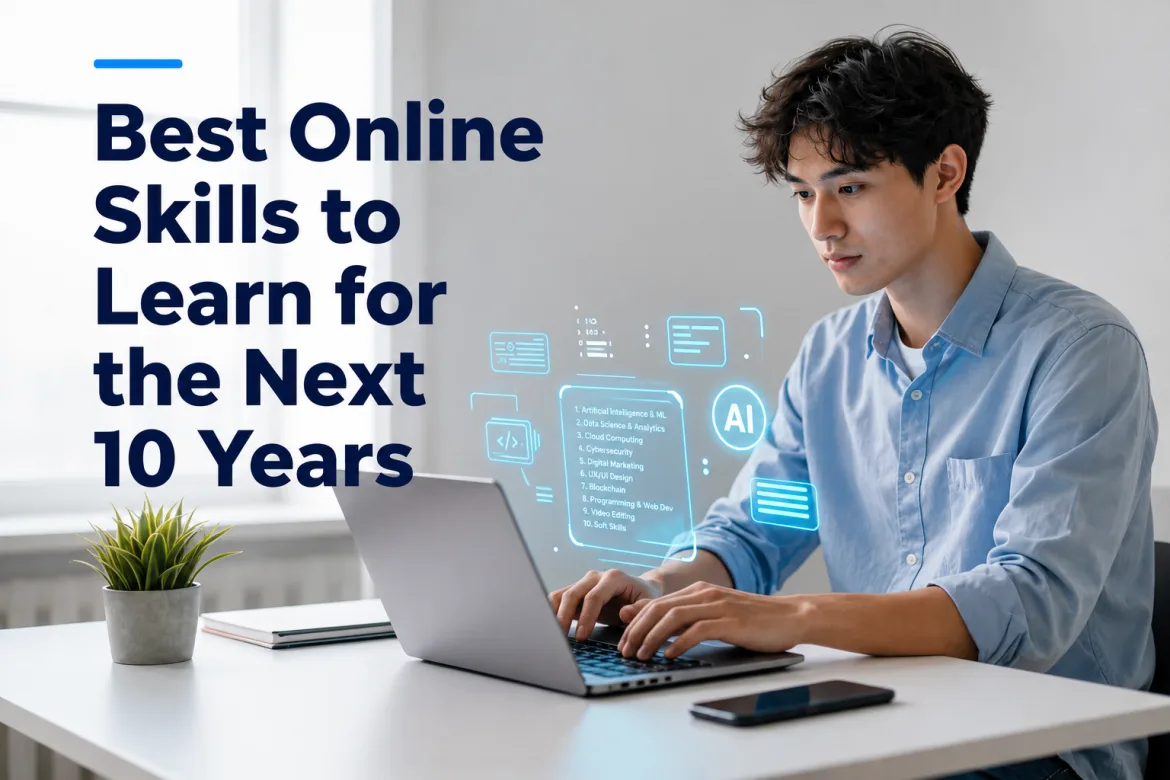
The digital economy is changing swiftly, rewarding people that adapt, learn, and collaborate with technology. Businesses are investing in artificial intelligence, cloud infrastructure, automation, cybersecurity, and scalable systems, making future-ready online skills essential for professional advancement and long-term relevance.
In 2026, hiring will increasingly favor practical digital skills, problem-solving talents, and adaptability over traditional degrees. Founders, CTOs, and experts who master these abilities can open up new options for startups, SMEs, and multinational companies.
Beyond coding, essential skills include automation workflows, data-driven decision-making, cybersecurity, cloud scalability, AI integration, and remote collaboration. This guide identifies the most valued online skills for the next decade, their real-world applications, and how professionals may build long-term careers around them.
Why Future-Ready Online Skills Matter in 2026
Technology is no longer just a support function for enterprises. It has become the foundation for expansion, customer satisfaction, operational efficiency, and scalability. Organizations that fail to adapt frequently face growing operating costs, low consumer engagement, and cybersecurity threats.
At the same time, people who constantly improve their digital abilities have access to remote employment options, worldwide freelance marketplaces, and leadership positions in rapidly expanding industries. Businesses are investing on people who can help with automation, innovation, and digital transformation, rather than repetitive manual activities.
Several major trends are shaping the demand for online skills:
- AI-driven business operations.
- Cloud-native infrastructure.
- Optimize workflows with automation.
- Data and cybersecurity protection.
- Remote collaboration systems.
These themes are predicted to drive the global economy throughout the next decade.
1. Artificial Intelligence and Machine Learning
Why AI Skills Are Dominating Every Industry
Artificial intelligence is no longer exclusive to technology enterprises. Healthcare providers, finance organizations, transportation companies, eCommerce brands, marketing agencies, and manufacturers are all incorporating AI into their daily operations.
AI is being used by organizations to automate tedious processes, improve consumer experiences, forecast market behavior, analyze data, and maximize corporate performance. This has created a huge demand for individuals who understand how AI systems work and how organizations may use them properly.
Learning AI-related abilities may include:
- Prompt engineering.
- Automate workflows with AI.
- Understanding machine learning fundamentals.
- Generative AI tools.
- AI-driven analytics.
Businesses are increasingly seeking individuals who can bridge the gap between technical AI systems and commercial strategy.
Real-World Business Example
A retail company using AI-powered customer analytics can predict buying behavior and personalize marketing campaigns automatically. This improves customer retention while reducing advertising costs.
Similarly, startups are integrating AI chatbots into customer support systems to provide 24/7 assistance without scaling support teams manually.
Best Platforms to Learn AI Skills
A retail company that uses AI-powered customer data can forecast purchasing behavior and personalize marketing efforts automatically. This increases client retention while lowering advertising expenses.
Similarly, startups are incorporating AI chatbots into customer support systems to give 24-hour assistance without manually growing support workers.
Coursera, DeepLearning.AI and Google AI offer learning resources for various levels of AI expertise and practical applications.
2. Cloud Computing and Cloud Architecture
The Backbone of Modern Digital Infrastructure
Cloud computing has become critical for enterprises requiring scalability, remote access, and operational flexibility. Companies are transitioning away from pricey on-premise servers and toward cloud-native ecosystems.
Cloud services enable enterprises to:
- Scale applications globally.
- Reduced infrastructural costs.
- Improve disaster recovery.
- Enable remote collaboration.
- Accelerate software deployment.
Professionals with cloud experience are in high demand because businesses require specialists who can manage safe and scalable digital environments.
High-Demand Cloud Skills
Cloud Platforms
Amazon Web Services, Microsoft Azure, and Google Cloud are popular cloud platforms.
Technical Areas
Cloud security, Kubernetes and containerization, serverless computing, cloud migration, DevOps automation, and infrastructure as code are among the most important technical fields.
Professionals can also strengthen their cloud knowledge through structured learning resources and hands-on projects. AWS Training provides learning resources for developing practical cloud computing and infrastructure skills.
Business Use Case
A developing SaaS firm can use cloud infrastructure to scale its application across various regions rather than purchasing physical servers. This lowers costs while increasing performance and dependability.
Building a Long-Term Digital Skill Strategy
Developing future-ready skills requires more than completing individual online courses. Professionals can create stronger career opportunities by combining technical knowledge with practical projects, business understanding, communication, and problem-solving abilities.
A useful approach is to select one core technical skill and gradually build complementary capabilities around it. For example, someone learning AI can also develop data analysis, automation, cloud computing, and business communication skills. This creates a broader skill set that can be applied to real-world business challenges.
Practical experience is equally important. Building projects, contributing to collaborative initiatives, creating automation workflows, analyzing datasets, or deploying applications can help demonstrate how digital knowledge can be applied outside a classroom environment.
Why Continuous Learning Will Matter
Digital technologies continue to evolve rapidly, meaning that skills learned today may need to be updated as tools, platforms, and business requirements change. Continuous learning allows professionals to remain familiar with emerging technologies and adapt their existing knowledge to new environments.
Businesses can also support continuous learning by providing employees with access to training, certifications, workshops, and practical technology projects. A culture of learning can help organizations respond more effectively to changes in technology and customer expectations.
Combining Technical and Human Skills
Future-ready careers will not depend only on technical expertise. Communication, creativity, critical thinking, collaboration, leadership, and adaptability remain important when implementing technology in real business environments.
Professionals who can understand technical systems and communicate their business value can contribute to projects more effectively. This combination of digital and human skills can be useful for developers, marketers, analysts, project managers, founders, consultants, and technology leaders.
Conclusion
The next decade will be dominated by people and enterprises that prioritize continuous learning, digital innovation, and scalable technological systems. Skills in AI, cloud computing, cybersecurity, automation, software development, analytics, and digital transformation are no longer optional; they are increasingly necessary across industries.
Investing in future-ready skills benefits startups, SMEs, businesses, founders, and CTOs by increasing operational resilience, scalability, and long-term competitiveness. Businesses that combine technology adoption with strategic execution will be better positioned to succeed in an increasingly digital market.
Individuals that gain these online talents now are also preparing themselves for future employment. As firms modernize operations and integrate intelligent tools into regular business processes, the demand for adaptive, tech-savvy individuals will only increase.