

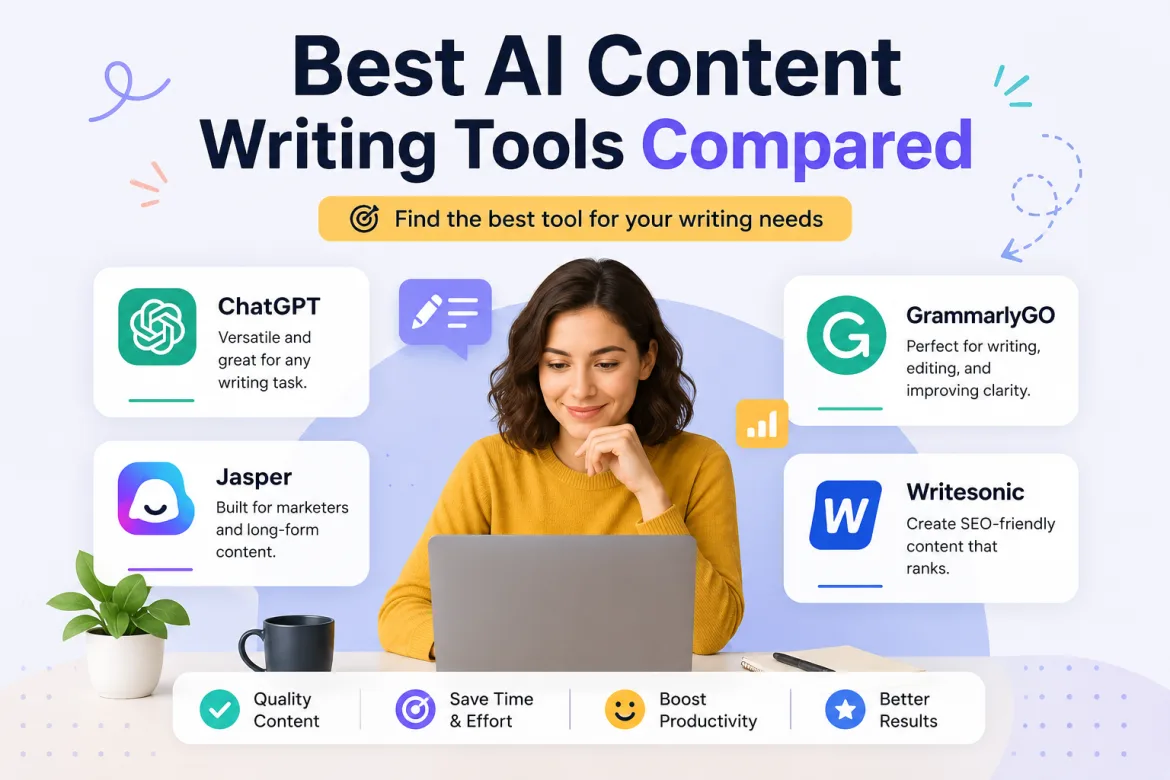
Artificial intelligence has made content generation a more efficient and scalable corporate activity. AI writing tools have become indispensable in current content strategy, from blog articles and marketing copy to emails, social media postings, and technical documentation. Businesses are increasingly embracing these solutions to improve uniformity and efficiency, as well as speed.
Generative AI has transformed the way organizations approach content workflows by incorporating automation into inspiration, research, authoring, and optimization. As competition for online visibility heats up, businesses want tools to maintain quality, brand voice, and SEO effectiveness. However, different AI platforms have varying strengths depending on the use case and requirements.
This comparison looks at the top AI content authoring tools available today. It enables firms, marketers, and artists to better understand their strengths, constraints, and perfect applications. The goal is to enable educated decision-making based on specific content and business requirements.
Why AI Content Writing Tools Matter in Modern Business
AI writing tools address a number of crucial commercial concerns. They help to minimize production time, increase content uniformity, speed up research processes, and support teams who need to publish often across many channels. For startups and small firms with limited resources, AI can act as a force multiplier, enabling lean teams to compete with larger enterprises.
The advent of search-driven content marketing has boosted the demand for content optimization. Businesses want content that not only engages readers, but also ranks well in search engines. Modern AI writing tools are progressively combining content creation with SEO advice, keyword analysis, and performance data.
Despite these benefits, AI should not be considered a substitute for human expertise. The most successful firms employ AI as a collaborative tool to boost creativity and productivity, rather than to replace strategic thinking and editorial oversight.
ChatGPT: The Most Versatile AI Writing Assistant
ChatGPT has become one of the most popular AI authoring platforms due to its versatility and wide range of capabilities. Unlike many specialist content tools, it may help with brainstorming, drafting, editing, summarizing, rewriting, and creating content strategies.
Adaptability is one of ChatGPT’s most notable strengths. Content marketers may use the same platform to develop blog posts, email sequences, landing site text, social media content, and customer support responses. The ability to provide precise prompts enables users to customize outputs for specific audiences, industries, and goals.
ChatGPT can also be used by corporations for productivity purposes other than content creation. Teams utilize it to conduct market research, competitive analysis, content preparation, and workflow automation support. This versatility makes it especially appealing to enterprises looking for an all-in-one AI solution.
Users must still verify facts, check outputs for accuracy, and refine content to ensure uniqueness and brand alignment. While ChatGPT produces extremely accessible writing, skilled human review is still necessary for professional publishing.
Best For
Businesses looking for a versatile AI assistant that can handle multiple content and communication responsibilities.
Jasper: Built for Marketing Teams
Jasper has established itself as one of the premier AI content platforms, focusing primarily on marketing applications. Unlike general-purpose AI solutions, Jasper was created specifically to assist organizations in creating conversion-oriented content across many marketing platforms.
The platform provides templates for blog posts, ads, email campaigns, product descriptions, and social media material. Its marketing-focused strategy appeals to businesses that value lead generation, customer interaction, and brand consistency.
One significant advantage is Jasper’s concentration on keeping brand voice. Businesses may train the system to use specific writing styles and messaging rules, allowing teams to produce more uniform material across departments and campaigns.
Jasper also has collaborative tools for larger marketing teams. Its content processes, approvals, and project management capabilities make it ideal for enterprises that produce content on a large scale. The biggest barrier for some customers is expense. Businesses with limited resources may find premium marketing-focused platforms more expensive than broader AI options.
Best For
Marketing firms, content teams, and organizations that value brand consistency and campaign-specific content development.
Copy.ai: Streamlining Marketing Copy Creation
Copy.ai specializes on assisting businesses in creating short-form marketing material in a timely and effective manner. The platform is especially popular among entrepreneurs, sales teams, and digital marketers who require captivating material for customer acquisition campaigns.
Its workflow-oriented approach enables users to create advertising copy, email outreach sequences, product descriptions, and social media material with little setup. This makes it especially handy for enterprises that want to produce content quickly without requiring extensive prompt engineering.
One advantage of Copy.ai is its ease of use. The platform is intended for non-technical users and frequently requires less experimenting than more powerful AI solutions. Teams can swiftly create and test many content versions and messaging methods.
While Copy.ai excels in shorter content formats, organizations that primarily rely on long-form content marketing may benefit from specialist long-form writing tools.
Best For
Sales teams, marketers, and entrepreneurs want quick delivery of customer-facing marketing content.
Writesonic: Combining AI Writing and SEO Optimization
Writesonic has grown in popularity by combining content generating with SEO-focused features. As search visibility remains a core corporate goal, technologies that bridge content production and optimization are becoming increasingly valuable.
The platform allows for blog development, website copywriting, product descriptions, advertising content, and social media content. Its SEO-focused features assist users in identifying chances to improve search performance while creating content.
One notable advantage is the ability to develop content that is consistent with keyword strategy without requiring separate optimization operations. This connection can help content marketers manage their vast publishing calendars more efficiently.
Businesses must realize, however, that SEO performance is dependent on far more than keyword placement. Search engines are progressively valuing knowledge, authority, user experience, and content quality. AI-generated content must still add value to readers.
Best For
Content marketers and organizations are focusing on organic search growth and SEO-driven content initiatives.
Grammarly: Enhancing Content Quality Rather Than Generating It
Grammarly is not primarily a content generation tool, but it is an integral part of AI-assisted writing workflows. The platform aims to improve grammar, clarity, readability, tone, and style.
Grammarly, along with other content production technologies, is used by many businesses to improve final versions before publishing. Its tips boost professionalism and readability while minimizing frequent writing faults.
Grammarly helps businesses maintain consistent quality across emails, reports, presentations, and website content. Tone analysis options on the site can also assist writers connect their material with the expectations of their intended audience.
Its restriction is obvious: Grammarly is intended for editing and polishing rather than producing big amounts of original content. Nonetheless, it is still one of the most useful tools in the content creation process.
Best For
Businesses looking to increase their writing quality, consistency, and professionalism in all communications.
Surfer SEO: AI Writing Meets Search Optimization
Surfer SEO is unusual in that it focuses mainly on content optimization for search engines. Rather than simply serving as a writing assistance, it assists users in creating content based on competitive SEO data.
The software examines high-performing content, detects optimization opportunities, and makes recommendations on structure, keywords, and topical coverage. This data-driven approach appeals to companies seeking ambitious organic growth initiatives.
When paired with AI authoring capabilities, Surfer SEO may drastically speed up article development procedures. Writers are guided on how to develop content that is relevant to search intent and competitive standards. Businesses, however, should avoid over-optimizing content for algorithms. To obtain long-term results, effective content must appeal to both search engines and humans.
Best For
SEO specialists, content strategists, and organizations focused on organic traffic growth.
Claude: Strong Long-Form Content and Research Support
Claude is becoming popular with professionals who require well-structured, thorough written content. Many people find it especially useful for long-form essays, research-based writing, corporate reports, and strategic documentation.
One of Claude’s talents is keeping cohesion over long content portions. This makes it useful for enterprises who provide in-depth educational content, white papers, industry studies, and detailed manuals.
The platform also excels at processing vast volumes of contextual information, enabling writers to work with rich source material and complex content needs. As with any AI system, outputs should be checked for factual accuracy and alignment with business goals. Human expertise is still required when publishing authoritative content.
Best For
Professionals and organizations create extensive, research-based material.
Key Factors to Consider When Choosing an AI Writing Tool
Comparing feature lists isn’t enough to choose the best AI writing platform for you. Businesses should evaluate solutions based on their content objectives, workflows, and operational needs.
Several factors deserve particular attention:
- Content type requirements.
- Capabilities for SEO and optimization.
- Team cooperation features.
- Customize your brand voice.
- Integration with existing tools.
- Scalability of content production.
- Analyzing pricing and ROI.
- Data privacy and security standards.
Organizations that generate thousands of content assets each year may prioritize workflow management and collaborative tools. Smaller enterprises may prioritize price and ease of usage.
The most successful technique is to test different platforms before making a long-term commitment.
Common Challenges of AI Content Writing
Despite significant developments, AI content writing tools have limitations that enterprises must carefully control. While they increase speed and efficiency, they cannot entirely replace human judgment, creativity, and subject knowledge. Proper monitoring is required to ensure content quality and trustworthiness.
Key challenges include:
- Potential for low creativity and repeating content patterns.
- Risk of faulty or obsolete information.
- Requires human editing for quality assurance.
- Difficulty sustaining a distinct brand voice.
Content originality can be an issue with AI-generated material, thus human editing is essential to assure uniqueness and alignment with brand voice. Accuracy also demands care, as AI might produce partial or wrong information, therefore fact-checking is critical to maintaining credibility and quality.
Best Practices for Using AI Writing Tools Effectively
Organizations that derive the most value from AI writing usually take an organized and purposeful approach. Rather than depending solely on raw AI outputs, successful content teams use AI for research, brainstorming, and drafting, with human authors refining the final material. This ensures accuracy, creativity, and consistency with the brand narrative.
Key practices include:
- Using AI as a starting point, not the end result.
- Clarifying audience, tone, and content goals in prompts.
- Providing human expertise, insights, and fact-checking.
- Optimizing material for SEO and readability prior to publishing.
Creating precise and structured prompts dramatically increases content quality, allowing AI to provide more relevant and useful results. Businesses that invest time in prompt engineering consistently produce better writing results.
Regular content audits are equally critical for assessing accuracy, performance, and engagement levels. To ensure quality, AI-generated material should be examined and refined on a regular basis. Ultimately, AI should be viewed as a productivity-enhancing technology that complements rather than replaces human inventiveness.
Future Trends in AI Content Writing
The future of AI content writing goes beyond just text generation. Emerging platforms are incorporating content strategy, audience analysis, personalization, and performance prediction into unified processes.
Businesses may anticipate AI systems to improve their grasp of brand context, customer behavior, and industry-specific requirements. Personalized content development at scale is expected to provide a significant competitive advantage. Multimodal content development is another significant trend. Future platforms will increasingly integrate text, graphics, video, music, and interactive content creation into a unified ecosystem.
Furthermore, developments in retrieval systems and real-time information access may assist reduce factual errors while increasing content relevancy and timeliness. As AI technology advances, the lines between content generation, optimization, and delivery technologies are expected to become increasingly blurred.
Final Thoughts
AI content authoring solutions are now vital for modern enterprises aiming to boost productivity, grow content operations, and increase digital marketing success. ChatGPT, Jasper, Copy.ai, Writesonic, Grammarly, Surfer SEO, and Claude are all platforms with specific strengths that cater to different content needs, workflows, and business strategies.
Each tool serves a particular use case, therefore the best option is determined by goals, content formats, and budget. While AI speeds up content development, long-term success is still dependent on human skill, editorial control, and audience understanding. Businesses that combine AI efficiency with subject matter expertise will be better positioned to develop high-performing content and remain competitive in a fast changing digital landscape.