

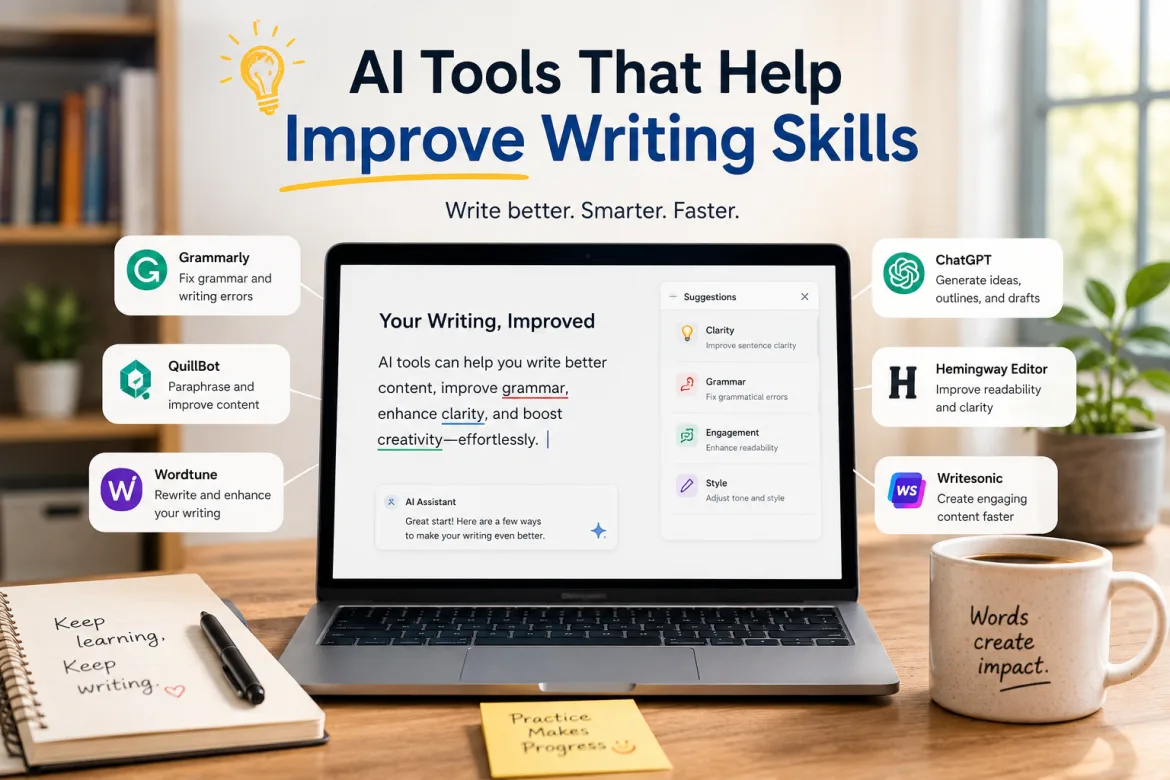
Writing remains an essential business talent for communications, marketing, reports, proposals, paperwork, and digital content. In 2026, artificial intelligence will aid with drafting, editing, summarization, optimization, and content creation. The most effective technique blends human creativity and judgment with automation, allowing teams to work more quickly while maintaining quality control.
AI writing tools have advanced beyond grammar correction to improve tone, readability, structure, SEO workflows, summaries, and brand consistency. Startups, SMEs, companies, and government organizations use these skills to eliminate repetitious work and improve communication. Businesses must also address security, privacy, integrations, and governance.
This article delves at the top AI writing tools in 2026, including how they assist professional communication, where they fit into business workflows, and what enterprises should consider before implementing. The goal is not just to create more material, but also to help teams communicate more effectively while preserving human knowledge at the forefront of key decisions.
Why AI Writing Tools Matter in 2026
The digital economy has increased the amount of content businesses must develop and manage. Organizations use several channels to produce blogs, newsletters, social postings, product descriptions, landing sites, customer responses, documentation, and sales emails. Producing everything manually can put enormous pressure on marketing, sales, support, and operations.
Natural language processing, machine learning, automation, and cloud distribution are some of the methods used by AI writing platforms to overcome this difficulty. They can assist users with transitioning from a blank page to a structured draft, refining existing material, and tailoring information for diverse audiences. Their primary position is typically as an assistant, handling monotonous tasks while humans are responsible for facts, strategy, creativity, and ultimate approval.
AI may help smaller companies extend their lean teams, while larger enterprises can use it to improve communication across departments and markets. The appropriate approach is determined by the volume of material, the level of risk, the company objectives, existing technology, and the information that people process.
How AI Is Transforming Professional Writing
Smarter Content Creation
Modern AI systems can create outlines and initial drafts based on prompts, keywords, audience information, and commercial goals. Rather than starting each assignment from fresh, authors can use AI for brainstorming, structuring, alternate views, and first wording. The writer then serves as editor and strategic director, reviewing the content and contributing the experience that makes it relevant to the organization.
For example, a SaaS company launching a cybersecurity product might utilize AI to create a blog outline, product message, an email sequence, and social media variations. The marketing team can then evaluate technical claims, incorporate company-specific expertise, and tailor the message to customers. This reduces manufacturing time while maintaining human innovation and accountability.
Real-Time Writing Assistance
AI writing aids are increasingly offering contextual advice rather than mere spelling repairs. They can propose ways to increase clarity, sentence structure, tone, conciseness, and readability while someone is writing. This is useful for emails, proposals, reports, presentations, customer interactions, and technical documents where little changes might make material more understandable.
Real-time help is especially useful for scattered teams that connect digitally all day. Employees can obtain instant suggestions rather than requesting editorial assistance for each routine correspondence. However, people should make the final decision because the correct wording is determined by audience expectations, business environment, connections, and the communication’s aim.
AI-Powered SEO Optimization
SEO is another critical application for AI-assisted writing. Businesses require content that reacts to search queries, delivers helpful information, and is legible and relevant. AI can aid with topic organization, heading improvement, metadata refinement, idea identification, and readability review. This reduces repetitious optimization effort, giving marketers more time for research and creative thinking.
Artificial intelligence should not be used to substitute an SEO strategy or subject matter expertise. Automated ideas may be broad or inappropriate for a certain business, and generated language still requires review. Strong search performance is dependent on relevant information, unique insights, accurate content, clear structure, technical website quality, and a true grasp of the audience.
Best AI Tools That Help Improve Writing Skills
1. Grammarly
Grammarly has evolved from traditional grammar checking to a more comprehensive writing productivity application. It can help with spelling, grammar, tone, rewriting, clarity, and professional communication. Organizations can use these features to improve normal emails, documents, customer communication, and other material, as well as encourage more consistent writing habits.
2. Jasper AI
Jasper is heavily related with marketing and content creation. It can help with blog drafts, campaign text, product messaging, sales emails, social content, and other marketing materials. This is beneficial for agencies or internal teams managing several campaigns since structured AI procedures can reduce first-draft time and make content generation more repeatable.
3. Notion AI
Notion integrates collaborative documentation, AI-assisted authoring, and knowledge management. Teams can use it to summarize meeting notes, organize information, generate internal documentation, and convert unstructured content into organized content. Because these features exist within a collaborative workspace, employees can use AI without continually shifting data between different tools.
4. Copy.ai
Copy.ai specializes on marketing and sales communication, including advertising copy, email campaigns, landing-page message, product descriptions, and sales outreach. Small businesses and eCommerce organizations can use these features to swiftly generate campaign variations and tailor messaging to different platforms.
5. QuillBot
Quillbot is widely used for paraphrasing, summarizing, grammatical improvement, and phrase refinement. Professionals can use it to make technical or lengthy material clearer for a wider audience. It can also assist users in generating concise versions of existing content and improving the flow of working drafts.
6. ChatGPT
ChatGPT is a conversational AI system designed to help with brainstorming, drafting, editing, summarizing, documentation, training materials, marketing concepts, and other communication chores. Its adaptability enables users to tailor prompts to specific audiences, formats, roles, and business objectives.
AI Writing Tools and Cloud-Based Scalability
Cloud delivery is critical because organizations expect AI writing tools to function across multiple locations, devices, and software ecosystems. Connections to CRM, CMS, collaboration, marketing, and support systems avoid repeated copying and make AI easier to utilize in daily operations.
Scalable cloud architecture allows businesses to accommodate more users and higher content volumes without having to construct their own AI technology. Enterprises may also require administrative controls for access, security, and governance. Architecture should take into account data requirements, integrations, geography, and internal technological standards.
Key Benefits of AI Writing Tools
- Faster drafting, editing, summarization, and content production
- Improved grammar, readability, tone, and communication consistency
- Support for SEO, personalization, multilingual content, and content reuse
- Integration with CRM, CMS, collaboration, marketing, and productivity systems
- Scalable workflows that support growing teams and higher content volumes
Cybersecurity and Data Privacy
As firms invest more information in AI systems, cybersecurity and data privacy become critical. Writing platforms can handle internal documents, customer communications, product information, contracts, and other company data. Organizations should understand what information is gathered, how it is safeguarded, where it is processed, and how long it is kept.
Authentication, access controls, encryption, audit capabilities, retention procedures, and applicable compliance requirements should all be considered while conducting a security evaluation. Businesses should also establish explicit guidelines for what employees can enter into AI systems, particularly when workflows contain confidential or regulated data.
Five Factors for Choosing an AI Writing Tool
- Scalability: The platform should support increasing users, content volumes, and workflow complexity.
- Integration: It should connect effectively with the CMS, CRM, cloud storage, communication, and marketing systems already in use.
- Ease of use: A clear interface and practical onboarding encourage adoption and reduce training friction.
- Customization: Style guidance, terminology, audience instructions, and brand voice controls can improve consistency.
- Security and compliance: Businesses should assess encryption, access management, retention, audit controls, and applicable requirements.
Common Mistakes Businesses Should Avoid
Relying Entirely on AI
Publishing AI-generated content without human review may result in factual inaccuracies, repetitious wording, poor placement, or messaging that does not reflect corporate knowledge. AI is more beneficial when it helps humans rather than taking over duty. Writers, subject matter experts, marketers, and managers should be held accountable for critical content, especially when it affects customers or company choices.
Ignoring Content Quality
Producing a significant number of generic material does not inherently generate business value. Content should respond to actual customer questions, provide useful information, demonstrate relevant knowledge, and present unique perspectives. When it comes to increasing long-term search exposure and brand authority, businesses should prioritize usefulness and accuracy over output volume.
Choosing Tools Based Only on Cost
The subscription price represents only a portion of an AI platform’s entire worth. A low-cost solution may have limits in security, integrations, administration, support, or scalability that become costly as usage increases. Organizations should analyze the entire workflow and expected operational benefit rather than relying solely on monthly pricing.
Overlooking Team Training
Successful adoption requires employees to comprehend AI’s possibilities as well as its limitations. Organizations should offer practical advice on prompting, fact-checking, privacy, permitted use cases, and content control. Training enables teams to apply AI consistently, lowering the danger of contradicting practices or poor management of sensitive information.
Real-World Business Use Cases
SaaS Companies
AI can be used by software firms to provide onboarding documentation, product updates, technical articles, help-center material, and customer support responses. This lowers repetitive tasks while allowing professionals to concentrate on complicated product and client requirements.
eCommerce Brands
Online merchants can utilize artificial intelligence for product descriptions, promotional campaigns, customer communications, category content, and seasonal marketing. AI can speed up production, but product specifications, pricing, claims, and brand language must still be reviewed before release.
Enterprises
AI can be used in large enterprises to improve internal communication, HR paperwork, executive summaries, knowledge management, and multilingual content. Standardized procedures can increase consistency, however business adoption necessitates more robust control for users, systems, data, and compliance.
Startups
Startups can employ artificial intelligence to expand their limited marketing and communication capability through ideation, initial drafts, documentation, customer communications, and content reuse. Repeatable workflows are most beneficial when they maintain the company’s own expertise.
The Future of AI Writing Tools Beyond 2026
AI writing technology is anticipated to become context-aware and integrated into ordinary commercial applications. Employees may receive assistance immediately within email, papers, customer-support systems, project tools, and marketing settings, making AI easier to integrate into everyday work.
Future workflows could include voice-to-content creation, multilingual communication, video script development, audience analysis, and personalized marketing help. These advancements will also highlight the significance of governance, source verification, privacy protections, and accountability.
Organizations may add more value by leveraging AI to supplement knowledge rather than simply increasing content volume. Long-term success is dependent on combining automation with subject matter expertise, creative judgment, reliable data, cybersecurity, and responsible operations.
Conclusion
In 2026, AI writing tools will alter professional communication by increasing the efficiency of drafting, editing, summarization, optimization, and content generation. Grammarly, Jasper, Notion AI, Copy.ai, Quillbot, and ChatGPT all contribute to different aspects of the workflow, while people are still accountable for quality and strategy.
When selecting a platform, consider scalability, integrations, usability, customisation, security, privacy, and long-term value. Businesses should also think about system compatibility and staff acceptance. A appropriate solution can help marketing, sales, support, documentation, knowledge management, and other communication-intensive tasks.
The most effective strategy mixes AI automation with human innovation, expertise, and oversight. Clear regulations, employee training, data protection, and human review enable startups, SMEs, and businesses to use AI safely. The goal isn’t just to write more, but to communicate well and foster long-term growth.