

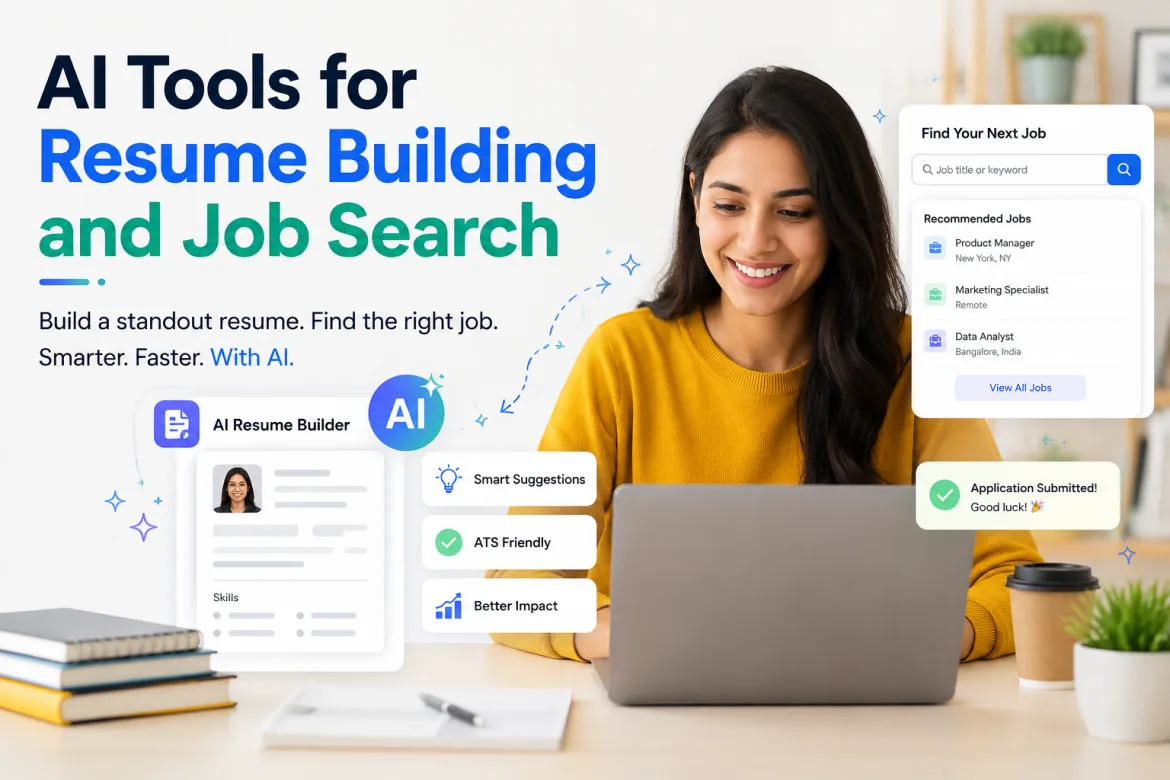
The rise of artificial intelligence has substantially altered the work sector as of 2026. Companies are now using AI-powered recruitment platforms, Applicant Tracking platforms (ATS), and automated screening technologies to hire more quickly and efficiently. As a result, job searchers must adapt by utilizing digital technologies to enhance resumes and boost visibility.
Traditional job applications are being replaced by smart platforms that customize and automate the hiring process. AI is being used to cut hiring expenses, increase accuracy, and scale recruitment by organizations ranging from startups to huge enterprises. This has boosted the demand for AI solutions that assist individuals in creating better resumes and finding suitable job prospects.
In response, professionals are utilizing AI-powered systems to optimize resumes, match job descriptions, and enhance personal branding. In this post, we’ll look at the finest AI tools for resume building and job searching in 2026, as well as the main trends and perks that will shape the future of recruitment.
Why AI Is Transforming Resume Building and Recruitment
The modern recruitment environment is becoming more data-driven. Companies may receive hundreds or even thousands of applications for a single vacancy. Manually reviewing resumes is no longer practicable for HR staff, particularly in fast-growing firms and worldwide enterprises.
AI-powered recruitment platforms now evaluate resumes using keywords, skills, experience relevance, certifications, behavioral indicators, and even writing quality. This means that resumes must be optimized for both human recruiters and clever screening systems.
AI tools help job seekers by:
- Generating professional resumes automatically
- Improving ATS compatibility
- Suggesting stronger keywords
- Recommending relevant job opportunities
- Preparing candidates for interviews
AI recruiting solutions benefit enterprises by lowering operational expenses, improving hiring accuracy, increasing scalability, and accelerating recruitment cycles.
Best AI Tools for Resume Building and Job Search
AI Resume Builders
Resume.io
Resume.io remains one of the most popular AI-powered resume platforms in 2026 due to its ease of use and ATS-specific optimization tools. The program employs artificial intelligence to recommend professional layouts, improve phrasing, and personalize resumes to specific employment roles.
Professionals can easily build resumes for a variety of industries, including software development, cybersecurity, cloud computing, finance, healthcare, and digital marketing. Its clever formatting engine ensures that resumes are compatible with modern ATS systems utilized by organizations globally.
AI content suggestions, ATS optimization, cloud-based resume storage, real-time editing, professional templates, and cover letter assistance are some of the key capabilities.
This application is especially valuable for startups and SMEs looking to hire quickly because it allows candidates to build clean, professional resumes without the need for design skills.
Rezi AI
Rezi AI focuses mostly on keyword optimization and ATS score. It scans job descriptions and automatically modifies resumes to increase exposure during AI-powered recruiting screening.
In fields such as cybersecurity, DevOps, cloud engineering, and AI development, where technical skills are critical, Rezi assists candidates in aligning their resumes with current hiring trends.
Some notable features include AI keyword targeting, ATS score analysis, resume rewrite suggestions, skill matching automation, and AI-generated summaries.
Professionals applying to enterprise IT businesses frequently utilize Rezi to better the alignment of their resumes and target job descriptions.
Kickresume
Kickresume combines AI writing powers with current design aspects. Unlike standard resume builders, it focuses on storytelling and personal branding.
Its AI assistant can create professional work experience descriptions based on job titles and industry categories. This is especially useful for grads, career changers, and company founders entering new industries.
The software also allows for portfolio integration, AI cover letter authoring, professional website development, LinkedIn profile optimization, and cloud synchronization.
AI Job Search Platforms Revolutionizing Hiring
LinkedIn AI Career Tools
LinkedIn has progressed well beyond professional networking. In 2026, its AI-powered job search ecosystem will include intelligent suggestions, recruiter matching, automatic profile optimization, and AI-generated career insights.
The platform employs predictive algorithms to suggest job openings based on skill gaps, industry growth, hiring demand, user activity patterns, and recruiter involvement.
LinkedIn Talent Solutions offers businesses powerful hiring data, automation workflows, and scalable recruitment infrastructure via cloud services.
Startups and companies are increasingly relying on LinkedIn AI technologies to speed up global hiring and remote workforce expansion.
Teal
Teal has emerged as a valuable color for professionals managing large-scale employment searches. It acts as a personal AI-powered career management system, assisting users in tracking applications, organizing resumes, and quickly tailoring job applications. Its AI technologies also aid to improve resume quality and connect people with suitable job openings.
Teal enables users to track job applications, store job advertisements, create personalized resumes, plan interview dates, and track networking activities.
The platform automates monotonous administrative activities involved with job hunting. This makes it easier and more efficient for experts to apply to several firms at the same time.
Huntr
Huntr prioritizes productivity and workflow automation. Its cloud-based dashboard allows users to manage applications, notes, interview stages, and networking possibilities through a single interface.
The AI features include information about resume efficacy, recruiting trends, application performance, follow-up scheduling, and industry-specific keywords.
Professionals seeking for remote technology or enterprise-level employment benefit from Huntr’s organizational capabilities.
How AI Improves ATS Optimization
Understanding ATS Systems
Applicant tracking systems are now commonplace in businesses, recruiting agencies, and large-scale hiring organizations. These systems scan resumes before they are reviewed by human recruiters.
AI resume solutions improve resumes by appropriately structuring material, increasing keyword relevance, reducing formatting errors, boosting readability, and matching industry terminology.
Even highly qualified candidates may fail to advance to the interview stage if their ATS is not optimized.
AI Keyword Matching
Modern AI resume platforms evaluate job descriptions and automatically detect missing keywords. For example, if a cloud engineering position prioritizes talents such as Kubernetes, AWS, DevOps automation, or cybersecurity compliance, AI systems can suggest include those terms in the resume.
This clever alignment can increase a resume’s relevance to automated screening criteria while maintaining the material legible by human recruiters.
The Role of Cloud Services in Modern Recruitment
AI-powered recruitment tools rely heavily on cloud technologies. Most resume builders and hiring sites now use scalable cloud infrastructure. This allows real-time data access, smooth upgrades, and increased system stability for worldwide hiring teams.
Benefits of cloud-based recruitment systems include:
- Real-time collaboration across distributed hiring teams
- Global accessibility for recruiters and candidates
- Secure document storage and automated backups
- Faster scalability during high-volume recruitment
- Remote hiring support and system integration
Businesses operating abroad are increasingly relying on cloud recruitment ecosystems to effectively manage distant hiring teams.
Cloud services also enable the integration of HR software, payroll systems, communication tools, and AI analytics platforms.
Cybersecurity in AI Recruitment Platforms
As recruitment becomes more digital, cybersecurity has become a top priority for both employers and job seekers. Protecting sensitive personal data such as resumes, identity documents, and employment history has become a primary issue. Companies must guarantee that their data is stored securely, that communications are encrypted, and that they follow global privacy rules.
AI recruitment systems often process sensitive information such as personal identification data, employment history, financial information, background checks, and professional certifications.
Businesses that have an inadequate security architecture are vulnerable to compliance concerns, data breaches, and reputational damage.
Key Security Features Businesses Should Prioritize
When selecting AI recruiting or HR solutions, firms should consider the following security concerns.
Data Encryption
Platforms should employ robust encryption to safeguard candidate data during storage and transfer.
Compliance Standards
Businesses should comply with all applicable standards and privacy obligations, such as GDPR, SOC 2, ISO certifications, and data privacy rules.
Multi-Factor Authentication
Secure login systems help to limit the risk of illegal access.
Cloud Security Infrastructure
Reliable providers invest in cybersecurity frameworks and threat detection technologies.
In 2026, startups and SMEs that use digital recruitment platforms will no longer be able to prioritize cybersecurity.
Automation and Scalability in Recruitment
Why Automation Matters
Hiring practices can rapidly become complex as a firm grows. AI automation enables firms to streamline repetitive operations such as resume screening, candidate communication, interview scheduling, skill assessments, and recruitment reporting.
Automation minimizes the HR workload while increasing operational efficiency.
Enterprise Scalability
Large organizations with thousands of applications require scalable recruitment systems capable of rapidly processing enormous datasets.
AI-powered hiring platforms provide real-time analytics, automated rating systems, workforce forecasting, worldwide hiring coordination, and multilingual support.
This type of scalability is critical for IT companies, SaaS providers, digital agency, and global corporations.
Real-World Business Use Cases
Startup Hiring Acceleration
A rapidly developing SaaS firm may receive hundreds of applications for a single developer post. AI recruitment software can automatically shortlist competent individuals based on their technical skills, qualifications, and project history.
This enables founders and CTOs to focus on strategic hiring decisions rather than manual resume screening.
Enterprise Digital Transformation
Global companies are using AI recruitment tools into larger digital transformation programs. These solutions can be integrated with cloud HR platforms, workforce analytics tools, ERP systems, cybersecurity frameworks, and automation applications.
This results in a cohesive hiring ecosystem capable of facilitating rapid corporate expansion.
Remote Workforce Expansion
Remote employment continues to influence worldwide hiring patterns in 2026. AI employment platforms assist businesses in identifying competent workers throughout the world while also streamlining remote onboarding and collaboration processes.
Businesses that use AI-powered recruitment tools have access to a larger talent pool that is not limited by geography.
Key Factors to Consider When Choosing an AI Recruitment Platform
Industry-Specific Capabilities
Hiring strategies varies depending on the industry. Businesses should select platforms that meet their specific recruitment requirements. Industry-specific features enhance applicant matching, compliance management, and overall hiring efficiency.
For example, cybersecurity firms may want technical talent validation, cloud service providers may require infrastructure certifications, healthcare businesses may emphasize compliance verification, and startups frequently require flexible scalability.
Integration with Existing Systems
AI recruitment technologies should be smoothly integrated with CRM systems, HR software, cloud infrastructure, communication platforms, and payroll solutions.
Poor integration can lead to operational inefficiencies and workflow disruptions.
Scalability and Performance
Businesses must ensure that their platforms can expand in tandem with their organizations. A startup-friendly recruitment solution may not be able to meet future enterprise-level hiring needs. Scalable systems help to retain performance, dependability, and efficiency as hiring demands rise.
Scalable cloud architecture is critical for long-term flexibility. It ensures smooth expansion, improved resource management, and a consistent user experience during peak recruitment periods.
Security and Compliance
When dealing with sensitive candidate information, it is vital to maintain strong cybersecurity standards. Organizations should carefully consider security certifications, compliance rules, and data protection procedures.
User Experience
A negative candidate experience can harm employer branding. AI platforms should provide applicants intuitive interfaces, responsive design, and efficient workflows. A smooth application process also improves candidate engagement and lowers drop-off rates.
Modern professionals expect seamless digital experiences throughout the hiring process. This includes fast navigation, clear communication, and real-time application updates.
The Future of AI Tools for Job Seekers
The future of recruiting will focus on intelligent automation, predictive analytics, and cloud-native hiring ecosystems. AI systems will increasingly serve as career assistants, allowing users to manage resumes, applications, networking, skill development, and interview preparation all from one platform.
Professionals must progressively adapt to AI-driven recruitment methods. Job seekers who understand ATS optimization, personal branding, automated workflows, and digital career tools can better display their qualifications.
Businesses will need to invest in scalable, secure, and intelligent hiring technology to attract and evaluate talent in an increasingly digital economy.
Preparing for an AI-Driven Hiring Environment
Success in an AI-driven employment market requires combining technology with genuine professional expertise. Candidates should employ AI to increase resume clarity, relevance, and organization rather than merely filling them out with keywords. Employers should also keep human control when utilizing automated screening and evaluation methods. A balanced strategy can increase efficiency while maintaining transparency, fairness, privacy, and meaningful candidate evaluation.
Conclusion
AI technologies for resume creation and job searching are transforming recruiting in 2026, with resume optimization, ATS enhancement, and predictive hiring analytics. These tools enable professionals apply more efficiently while also allowing firms to expedite and automate hiring processes in a highly competitive market.
Organizations that use AI-driven recruiting might profit from increased scalability, cloud integration, and more efficient hiring processes. Job searchers also benefit from improved tools for visibility and applications. However, choosing the correct platform necessitates weighing security, integration, and long-term objectives, as well as balancing AI efficiency with human-centered employment procedures to ensure long-term success.