

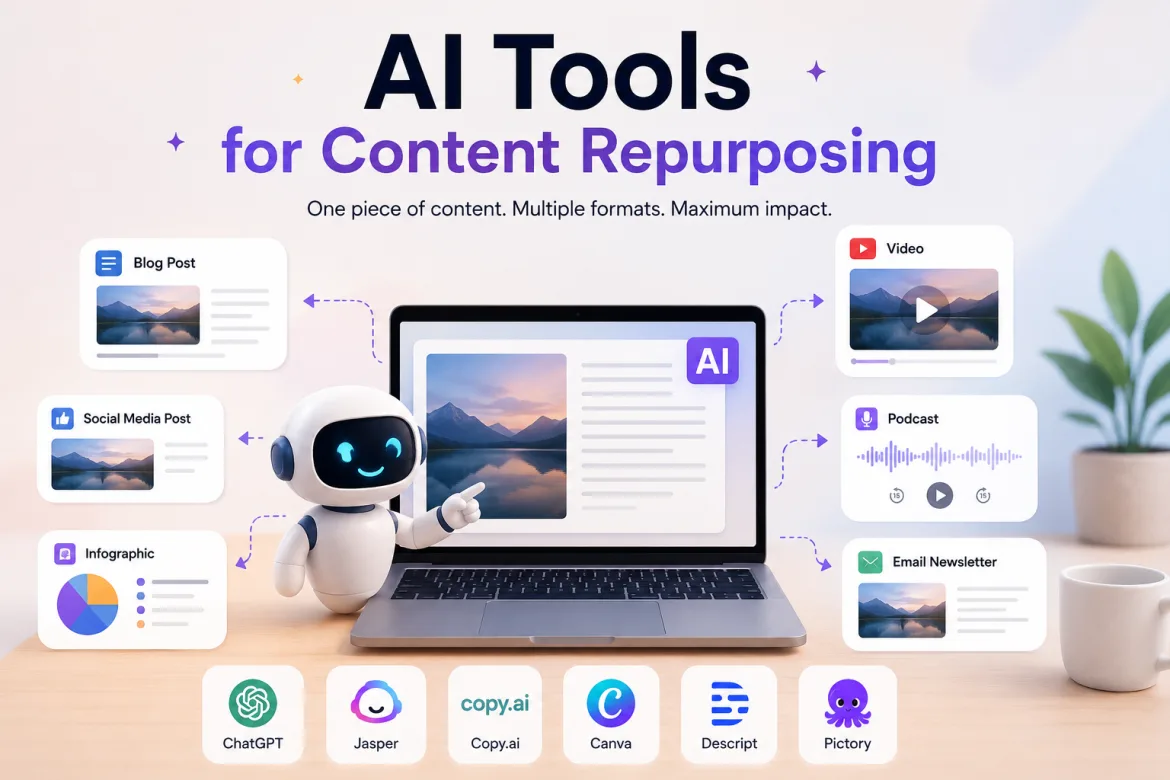
Content marketing in 2026 is no longer about producing large volumes of new content every day. Businesses are now focused on maximizing value from every blog, webinar, podcast, or video they create, while distributing it across multiple platforms where customers actively engage. This shift has increased the demand for faster and more scalable content workflows.
AI-powered content repurposing tools are transforming how businesses operate by turning a single piece of content into multiple formats within minutes. Instead of manual rewriting or redesigning, AI can convert webinars into blogs, social posts, videos, and email campaigns, reducing production effort and time.
For startups, SMEs, and enterprises, this is becoming a strategic advantage that improves efficiency, reduces costs, and increases content reach. Companies using AI repurposing tools effectively can scale faster while maintaining consistent brand messaging across all channels. This guide explores the best AI tools, trends, use cases, and key selection factors for 2026.
Why Content Repurposing Matters More Than Ever
The Shift from Content Creation to Content Multiplication
Modern businesses are moving away from the traditional “create once and forget” approach to content marketing. Instead, successful brands are building systems that continuously multiply the value of every content asset they produce. This strategy helps organizations maintain visibility across platforms without constantly increasing production budgets or expanding internal teams.
For example, a single podcast episode can now fuel an entire week of marketing campaigns. Companies can extract key quotes for LinkedIn posts, create video snippets for Instagram Reels, publish SEO-focused blog articles, and generate email newsletters from the same source material. This not only improves efficiency but also strengthens consistency in messaging and branding across channels.
A podcast episode can become:
- A blog article
- LinkedIn thought leadership posts
- Instagram Reels
- TikTok clips
- Email newsletters
- Twitter/X threads
- Sales presentation content
A webinar can become:
- SEO landing pages
- Customer onboarding resources
- Internal training material
- Video snippets
- Lead magnets
Businesses are increasingly realizing that repurposing high-performing content generates significantly better ROI than constantly producing new content from scratch. In highly competitive industries, this approach also helps brands stay active online without overwhelming internal marketing teams.
AI Is Solving the Biggest Content Bottlenecks
One of the biggest challenges companies face today is maintaining a steady flow of high-quality content while managing limited resources and tighter budgets. Marketing teams often struggle to meet growing demands for videos, blogs, newsletters, social media posts, and SEO campaigns simultaneously. Manual repurposing processes can slow down publishing schedules and create operational inefficiencies.
AI tools help solve these bottlenecks by automating repetitive tasks such as summarizing videos, generating captions, extracting highlights, rewriting copy, and optimizing content for different platforms. Instead of spending hours editing or reformatting content manually, businesses can streamline workflows and focus more on strategy, creativity, and audience engagement.
- Limited content teams
- High production costs
- Slow publishing cycles
- Maintaining consistency across platforms
- Repurposing long-form content manually
- Scaling multilingual content
In 2026, businesses that fail to adopt AI-assisted workflows risk falling behind competitors that can publish faster, optimize campaigns more efficiently, and adapt content dynamically for different audiences.
What Are AI Content Repurposing Tools?
AI content repurposing tools use technologies such as machine learning, natural language processing, generative AI, and speech recognition to transform existing content into new formats. These platforms are designed to reduce manual effort while helping businesses distribute content more effectively across multiple digital channels.
Instead of creating entirely new campaigns for every platform, companies can use AI to automatically adapt existing content for different audience behaviors and formats. This improves content scalability while maintaining consistent communication and brand positioning.
These tools can:
- Convert videos into articles
- Generate social captions
- Extract highlights from podcasts
- Create short-form video clips
- Rewrite blogs for SEO
- Translate content into multiple languages
- Generate email campaigns from webinars
- Produce summaries and key insights
For businesses managing large-scale digital marketing operations, these tools significantly reduce turnaround times while increasing overall content productivity.
Best AI Tools for Content Repurposing in 2026
1. Jasper AI
Best for Enterprise Marketing Teams
Jasper AI remains one of the leading enterprise-grade AI content platforms in 2026 because of its advanced workflow automation, brand voice training, and scalable content generation features. Large organizations use Jasper to maintain consistency across global marketing campaigns while reducing manual content production efforts.
Businesses commonly use Jasper to repurpose long-form blogs into social campaigns, create multilingual content variations, and generate SEO-focused articles tailored to different customer segments. Its collaborative capabilities also make it valuable for distributed marketing teams working across multiple departments or regions.
Real-World Use Case
A SaaS company hosting weekly webinars can use Jasper to automatically create SEO blog articles, webinar summaries, onboarding emails, LinkedIn posts, and customer nurture campaigns from a single recording. This dramatically improves content output while allowing marketing teams to focus on strategy rather than repetitive production tasks.
2. Descript
Best for Video and Podcast Repurposing
Descript has become one of the most valuable tools for businesses investing heavily in podcasts, webinars, YouTube content, and video marketing. Its text-based editing system allows users to edit videos simply by editing transcripts, making the production process significantly faster and easier.
Marketing teams use Descript to generate captions, remove filler words, create highlight clips, and repurpose podcast conversations into written articles or social content. This makes it especially useful for companies aiming to maximize the value of educational or thought leadership content.
Why Businesses Love It
Short-form video content continues to dominate audience engagement across digital platforms. Descript helps businesses quickly turn long recordings into platform-ready content for Instagram Reels, TikTok, YouTube Shorts, and LinkedIn without requiring large editing teams or advanced production skills.
3. Canva AI Suite
Best for Visual Content Repurposing
Canva has evolved into a powerful AI-driven visual content platform that enables businesses to repurpose written content into professional graphics, presentations, infographics, and branded social assets. For startups and SMEs, it offers a highly accessible way to scale visual marketing without hiring full-time designers.
Teams can quickly convert blog articles into social graphics, resize creatives for multiple platforms, and generate marketing visuals using AI prompts. This helps businesses maintain visual consistency while speeding up design workflows across campaigns.
Real-World Use Case
A digital marketing agency uses Canva AI to transform a single blog post into LinkedIn carousels, Instagram posts, and presentation slides for client pitches. This allows the team to deliver multi-platform campaigns in a fraction of the time while maintaining consistent branding and design quality.
4. Opus Clip
Best for AI Video Clipping
Opus Clip is helping brands capitalize on the explosive growth of short-form video marketing. The platform uses AI to identify high-engagement moments from long-form videos and automatically convert them into optimized clips for social platforms.
- TikTok
- Instagram Reels
- YouTube Shorts
- LinkedIn video posts
This enables businesses to increase visibility, audience engagement, and social reach without manually editing hours of footage.
Key Benefits of AI Content Repurposing
AI content repurposing helps businesses turn a single piece of content into multiple formats quickly and efficiently. This approach reduces production time, improves marketing reach, and ensures consistent messaging across different platforms. It also allows companies to get more value from existing content assets while reducing overall content creation costs.
- Faster content production across blogs, videos, and social media formats
- Improved SEO performance through multiple search and content touchpoints
- Better ROI by maximizing the value of existing high-performing content
- Stronger omnichannel presence across platforms like LinkedIn, YouTube, and email
- Reduced workload by automating editing, formatting, and content adaptation
Overall, AI content repurposing helps businesses scale their content strategy without increasing effort or resources. It enables consistent growth while maintaining quality and efficiency across all channels.
Trends Shaping AI Content Repurposing
AI content repurposing is rapidly evolving as businesses demand faster, more scalable, and multi-format content workflows. In 2026, automation and generative AI are making it easier to transform a single piece of content into blogs, videos, social posts, and marketing assets instantly. At the same time, personalization and platform-specific optimization are becoming key trends driving better engagement and performance.
Hyper-Personalized AI Content
AI platforms are becoming increasingly advanced at tailoring content for different audience segments. Businesses can now automatically generate variations of content based on industry, customer behavior, demographics, or engagement history, creating more personalized user experiences.
AI Video Dominance
Video remains the fastest-growing content format in 2026. Businesses are prioritizing AI-powered subtitles, short-form video clipping, video summaries, AI avatars, and interactive visual content to improve audience engagement across social and educational platforms.
Multilingual Content Expansion
Global businesses are using AI to rapidly localize campaigns for international audiences. Modern tools can translate content naturally, adapt messaging culturally, and create multilingual SEO assets that help brands expand into new markets more efficiently.
AI + Human Collaboration Models
The most successful companies are combining AI automation with human creativity and strategic oversight. While AI improves speed and scalability, human teams remain essential for storytelling, brand positioning, editorial quality, and customer trust.
How to Choose the Right AI Content Repurposing Tool
Selecting the right AI content repurposing tool starts with clearly understanding your business goals and operational needs. Different organizations require different capabilities—startups often look for affordability and automation, while enterprises prioritize security, governance, and integrations. Choosing without a defined strategy can lead to inefficiency and limited long-term value.
It is also important to evaluate how well the tool fits into your existing workflow and supports consistent brand communication. The platform should simplify content distribution, maintain tone consistency, and scale as your business grows.
- Startups prioritize affordability and automation features
- Enterprises focus on governance, security, and integrations
- Agencies need collaboration and workflow management tools
- Media brands require strong multi-format content support
Example:
A marketing agency uses an AI content repurposing tool to turn a single blog post into LinkedIn posts, email campaigns, and short-form video scripts, ensuring consistent messaging across all channels while saving production time.
Common Mistakes Businesses Should Avoid
Many businesses struggle with AI content repurposing because they rely too heavily on automation without proper strategy or oversight. While AI can significantly speed up content creation, it still requires human review to ensure accuracy, brand alignment, and quality consistency. Ignoring these aspects can reduce trust and weaken overall content performance.
- Inconsistent messaging across platforms
- Generic or low-quality AI-generated outputs
- Brand tone and voice misalignment
- Factual inaccuracies without human review
- Reduced audience trust over time
SEO is another area often overlooked during content repurposing. Even when content is automated, businesses must still follow optimization best practices to maintain visibility and ranking performance.
- Duplicate content issues affecting search rankings
- Weak or missing keyword targeting
- Poor internal linking structure
- Lack of proper metadata optimization
- Low-quality or unstructured formatting
Another common mistake is choosing AI tools based only on price instead of long-term value. Factors like scalability, integration, support, and security are equally important for sustainable growth. Over-automation is also risky, as it can make content feel generic and reduce emotional connection with the audience.
Successful AI content repurposing requires balance between automation and human creativity to maintain quality, trust, and long-term impact.
Why Choosing the Right Technology Partner Matters
Implementing AI content systems successfully requires more than simply purchasing software. Businesses need strategic planning, workflow optimization, integration expertise, and long-term scalability support to achieve measurable results.
The right technology partner can help organizations build efficient AI-powered workflows, integrate automation tools properly, improve SEO performance, strengthen data security, and align digital transformation strategies with business objectives. This becomes especially important for companies scaling rapidly or managing large content operations.
Businesses should prioritize partners with:
- Proven AI implementation expertise
- Strong development capabilities
- Marketing technology experience
- Cloud integration knowledge
- Automation strategy consulting
- Long-term support services
Choosing the right digital transformation partner today can significantly impact operational efficiency, marketing performance, and long-term competitive growth.
Conclusion
AI content repurposing tools are redefining how businesses create, distribute, and scale digital content in 2026. Instead of relying on slow and resource-heavy production cycles, companies are building smarter workflows that maximize the value of every webinar, article, podcast, presentation, and video they create.
For startups, SMEs, enterprises, and digital-first organizations, AI-powered content workflows offer faster production, improved SEO performance, stronger omnichannel visibility, and better marketing ROI. However, long-term success depends on choosing the right tools, maintaining human oversight, and implementing scalable digital strategies that align with business goals.
Businesses that embrace AI-powered content repurposing today are positioning themselves for stronger customer engagement, greater operational efficiency, and sustainable growth in an increasingly competitive digital economy.