

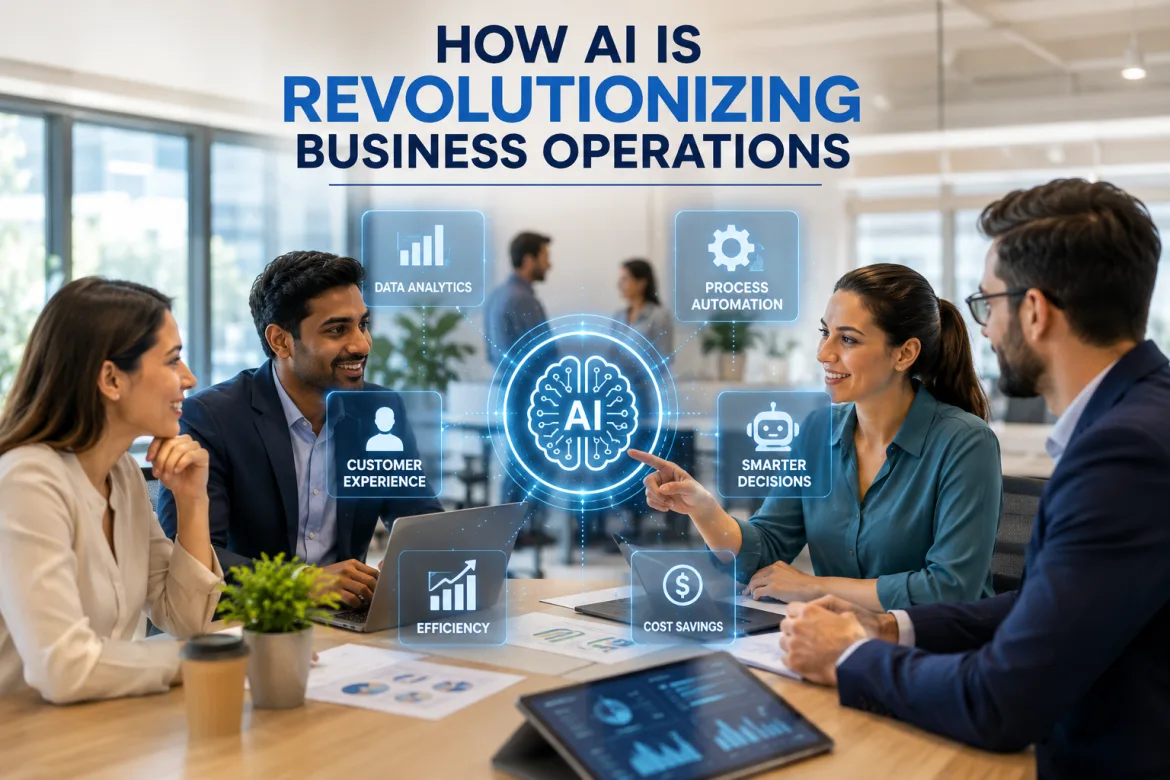
Artificial intelligence has progressed well beyond being a future concept, becoming the foundation of modern commercial processes. From automating monotonous processes to enabling predictive decision-making, AI is changing the way organizations operate at all levels. Businesses today are wondering how quickly they can integrate AI into their operations in order to remain competitive, rather than whether they should adopt it at all.
In a world dominated by data, speed, and personalization, AI enables businesses to work smarter, faster, and more efficiently. Whether it’s a startup maximizing customer engagement or a big corporation simplifying supply chains, AI is becoming the primary driver of transformation. Along with cloud computing, cybersecurity, and automation technologies, AI is ushering in a new era of digital-first business ecosystems.
This article delves into how AI is transforming corporate operations, significant industry trends for 2026, real-world applications, and how firms may select the best IT service provider to effectively manage this shift.
The Rise of AI in Modern Business Operations
AI use has skyrocketed in recent years, thanks to advances in machine learning, natural language processing, and cloud infrastructure. Businesses are using AI not only to innovate, but also to survive in a highly competitive digital economy.
One of the most major developments has been the transition from human decision-making to data-driven intelligence. AI systems can already scan large datasets in seconds, identifying patterns and providing actionable insights that people may overlook. This has revolutionized the way businesses approach everything from marketing strategy to operational efficiency.
Furthermore, AI is no longer exclusive to huge businesses. With scalable cloud-based AI services, even small and medium-sized enterprises may now gain access to powerful tools without making significant infrastructure investments. The democratization of AI is one of the most important drivers of digital transformation in 2026.
How AI Is Transforming Core Business Functions
AI is firmly integrated into many commercial activities, increasing efficiency, accuracy, and speed. Let’s look at the primary areas where its impact is most noticeable. From automation to data-driven decision-making, AI is assisting firms to function more efficiently and remain competitive in a continuously changing market.
1. Business Process Automation
Automation has always been a goal for businesses, but AI has taken it to new heights. Unlike traditional rule-based systems, AI-powered automation learns and adapts over time, improving process intelligence and efficiency.
Businesses are using AI to automate tasks such as:
- Invoice processing and financial reporting
- Customer support through intelligent chatbots
- HR onboarding and recruitment screening
- Supply chain tracking and inventory management
This decreases human workload, minimizes errors, and dramatically increases operational speed. Companies such as global eCommerce platforms and logistics companies currently rely significantly on AI automation to process millions of transactions per day.
2. Data-Driven Decision Making
In 2026, data will be the new competitive advantage. However, raw data is useless unless properly understood. AI enables organizations to translate complex datasets into relevant insights. This enables firms to better discover opportunities and improve their strategic planning.
Machine learning algorithms use customer behavior, market trends, and internal performance measures to forecast outcomes with high accuracy. This allows executives to make educated decisions more quickly than ever before. AI-driven insights can also help firms reduce uncertainty and increase overall operational efficiency.
Retailers, for example, employ artificial intelligence to forecast demand and improve pricing strategies, whereas financial institutions utilize predictive analytics to detect fraud and analyze risk. These applications enable businesses to boost profitability, reduce losses, and provide better customer experiences.
3. Customer Experience Personalization
Customer expectations have shifted dramatically, and customisation has become a critical difference. AI enables businesses to provide highly personalized experiences based on user behavior, preferences, and previous interactions.
E-commerce platforms utilize recommendation engines to recommend products, streaming services tailor content, and banking apps provide personalized financial advise. This level of customisation boosts client happiness and loyalty while increasing conversions.
AI-powered CRM solutions also help firms understand client journeys in real time, allowing for proactive involvement and better relationship management.
4. Cybersecurity Enhancement
Cybersecurity dangers have grown in tandem with firms’ digital transformation. AI plays an important role in detecting and stopping cyberattacks before they do damage. It can detect anomalous behavior, evaluate vast amounts of security data, and respond to attacks in real time. AI-powered systems can also assist firms improve data security, risk management, and general cybersecurity.
Modern AI-driven security systems can:
- Detect unusual network activity in real time
- Identify potential phishing attacks
- Prevent unauthorized access through behavioral analysis
- Respond automatically to security breaches
This proactive method is significantly more successful than standard reactive security solutions. Enterprises are already making significant investments in AI-powered cybersecurity solutions to protect sensitive data and preserve confidence.
5. Cloud Computing and Scalability
Cloud computing and artificial intelligence go hand in hand. In 2026, the majority of AI applications will be hosted via cloud platforms, allowing enterprises to scale operations without incurring significant infrastructure costs. This also leads to speedier implementation and easier management of modern technologies.
Cloud-based AI services offer flexibility, allowing enterprises to increase or decrease resources based on demand. This is especially useful for startups and SMEs that need cost-effective scaling. It enables organizations to retain performance even during unexpected spikes in consumption.
Furthermore, cloud platforms enable the seamless integration of AI technologies with existing systems, making digital transformation easier and faster. This improves communication across company functions and increases overall operational efficiency.
Real-World AI Use Cases Across Industries
AI is not limited to a single industry; it is transforming practically every one.
Healthcare
AI helps with medical imaging, disease prediction, and patient data management. Hospitals deploy AI technology to increase diagnosis accuracy and shorten treatment times.
Finance
Banks and fintech companies employ artificial intelligence (AI) for fraud detection, credit scoring, and automated trading. This enhances both security and operational efficiency.
Retail & eCommerce
AI improves inventory management, demand forecasting, and customer tailoring, resulting in increased sales and better customer retention.
Manufacturing
Smart factories integrate AI-powered robotics and predictive maintenance solutions to reduce downtime and increase efficiency.
Logistics
AI optimizes delivery routes, tracks shipments in real time, and increases supply chain efficiency.
These real-world applications show how AI is no longer optional, but rather required for economic success.
Key Trends Shaping AI in Business Operations (2026)
As we approach 2026, numerous developing themes are influencing how corporations use artificial intelligence.
Hyper-Automation
Companies are merging artificial intelligence (AI), robotic process automation (RPA), and machine learning to automate entire business operations.
AI-Driven Decision Intelligence
AI systems that deliver real-time predictive analytics recommendations are increasingly being used to aid decision-making.
Generative AI in Business Workflows
Generative AI is being used to develop marketing copy, software code, product designs, and even business reports.
Edge AI Adoption
Processing data closer to the source (edge computing) lowers latency and improves real-time decision-making.
AI Governance & Ethics
Businesses are putting increased emphasis on responsible AI usage, transparency, and compliance with global legislation. Organizations can also refer to the NIST AI Risk Management Framework for guidance on managing AI-related risks and incorporating trustworthiness considerations into AI systems.
Choosing the Right IT Service Provider for AI Transformation
While AI has huge prospects, its deployment is dependent on selecting the correct IT service provider. A reliable technology partner ensures seamless integration, scalability, and long-term success.
Here are key factors businesses should consider:
Technical Expertise
The provider should have prior experience with AI, cloud computing, cybersecurity, and enterprise software development. Deep technical understanding promotes better implementation and lower risk.
Industry Experience
A provider who understands your sector can provide more specialized solutions that correspond with corporate objectives and compliance requirements.
Scalability of Solutions
The IT partner should provide scalable solutions that can develop with your company, particularly in dynamic markets.
Security Standards
Strong cybersecurity practices are necessary. Ensure the provider adheres to worldwide security frameworks and data protection protocols.
Support & Maintenance
Ongoing support is essential for AI systems. Select a service that provides ongoing monitoring, updates, and optimization.
Innovation Capability
The greatest IT partners do more than just implement solutions; they constantly innovate to keep your company ahead of the competition.
Common Mistakes Businesses Should Avoid
Despite the benefits of AI, many organizations fail owing to inadequate implementation tactics. Avoiding common mistakes is critical to success.
- Ignoring data quality and structure before implementing AI
- Choosing tools without a clear business objective
- Underestimating cybersecurity risks
- Failing to train employees for AI adoption
- Relying on outdated legacy systems without integration planning
- Expecting immediate ROI without long-term strategy
Businesses that solve these difficulties early are more likely to achieve long-term success with AI transformation.
The Future of AI-Driven Business Operations
The future of business will be highly intelligent, linked, and automated. AI will continue to expand from a support tool to an essential decision-making engine for businesses. This transformation will fundamentally alter how firms plan, execute, and optimize their strategy.
More autonomous systems will manage entire processes, including supply chains and consumer engagement. Human roles will transition to strategic thinking, creativity, and innovation, with AI handling execution and analysis. This partnership will result in speedier, more adaptable, and extremely efficient business ecosystems. Additionally, it will considerably cut operational delays and enhance accuracy.
Early adoption of AI will provide organizations with a major competitive advantage in terms of efficiency, cost savings, and customer experience. Early adoption would also assist them to remain resilient in a data-driven and competitive global economy. This will position them as forerunners in long-term digital transformation.
Conclusion
AI is no longer just affecting corporate operations; it is reshaping them entirely. From automation and cybersecurity to cloud computing and data analytics, AI is allowing organizations to function more intelligently and efficiently than ever before.
However, successful transformation necessitates the appropriate strategy, tools, and technological partners. Businesses must invest in scalable solutions, prioritize security, and have a long-term strategy for digital growth.
Companies that properly integrate AI will lead their sectors in 2026 and beyond, while those that wait too long risk falling behind. The time to act is now.