

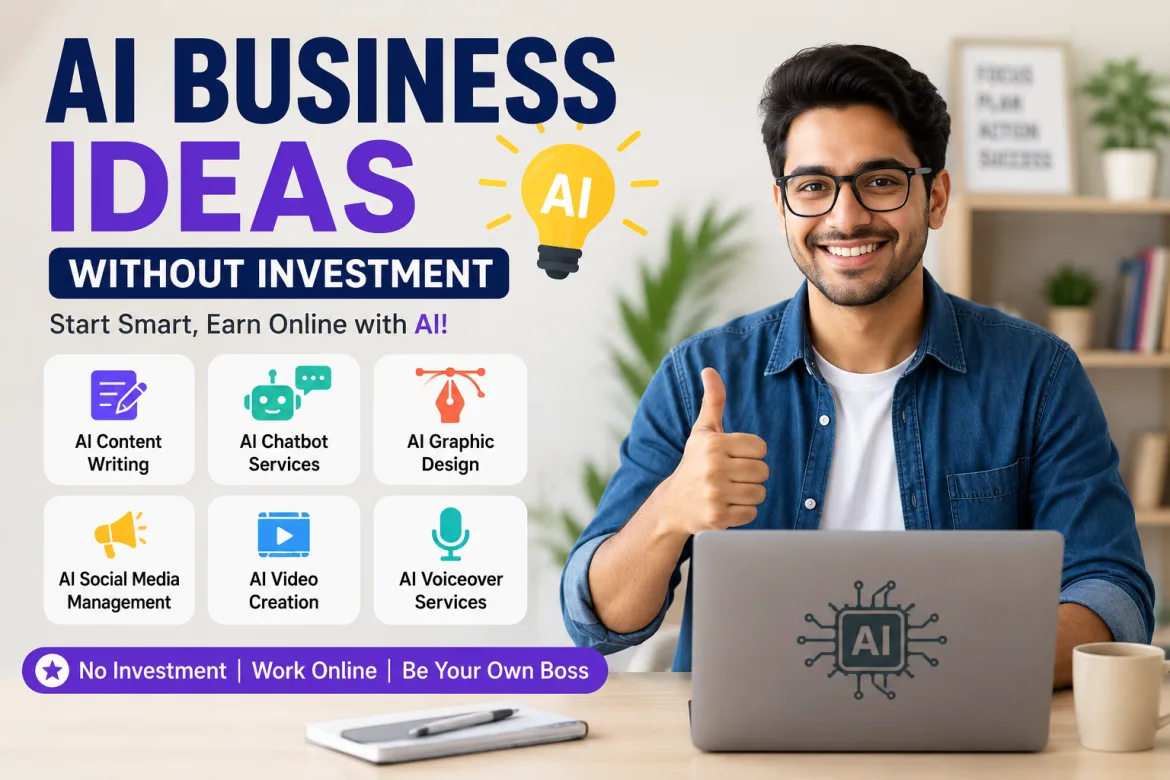
Artificial intelligence is no longer reserved for major corporations with large technical resources. By 2026, it has become one of the most accessible prospects for entrepreneurs, startups, freelancers, and expanding businesses. With free AI tools, no-code platforms, and cloud-based solutions, starting an AI-powered business can be done with little initial expenditure.
This trend has altered the entrepreneurial landscape, enabling solo CEOs to construct scalable services, automate operations, and create digital products with AI. Businesses across industries are actively pursuing faster and more cost-effective ways to operate, resulting in a demand for realistic AI-powered solutions.
The worldwide AI market is growing, and small firms are increasingly using AI for marketing, customer service, content creation, analytics, and workflow automation. Many AI business models can be created by merging current platforms with human skills, rather than developing unique technology from scratch.
Why AI Businesses Are Growing Faster Than Traditional Startups
Traditional firms frequently require physical goods, office space, logistics, and big operational staff. AI-powered firms function differently. Most are digital-first, scalable, and highly automated, reducing costs while boosting productivity.
Accessibility is another important consideration. AI capabilities that previously required technical expertise are now accessible via user-friendly interfaces. Entrepreneurs can automate monotonous tasks, create professional content, develop workflows, analyze data, and deliver services more quickly.
This opens up opportunities for entrepreneurs and SMEs to develop specific AI-driven services. Instead of creating a complex AI infrastructure, founders can combine existing tools with specialized knowledge, robust processes, and customer service.
1. AI Content Creation Agency
Content remains a key driver of internet business success. Companies require continuous blogging, social media updates, newsletters, website text, product descriptions, and video scripts. An AI-assisted content agency can help firms produce these products more effectively while keeping human strategy and editing at the forefront.
SEO content, social media copy, email campaigns, product descriptions, video scripts, website copy, and LinkedIn content are all examples of services offered. The primary differentiation should not be raw AI generation, but rather research, fact-checking, brand alignment, editing, optimization, and measurable content objectives.
Entrepreneurs can focus on a certain industry, such as eCommerce, SaaS, real estate, healthcare, professional services, or local companies. A particular emphasis can help you develop repeatable operations, pinpoint consumer pain spots, and create recurring service bundles.
2. AI Social Media Management Services
Social media administration is time-consuming for businesses that require constant updating and interaction. AI can help with content ideation, captioning, repurposing, scheduling, audience analysis, and creative production.
An entrepreneur can integrate AI techniques with a defined content strategy to provide monthly management packages. The service includes content calendars, platform-specific pieces, creative briefs, performance reports, and engagement assistance.
Small businesses, consultants, restaurants, startups, and professional service firms may benefit from low-cost AI-assisted social media support that is tailored to their target audience and business goals.
3. AI-Powered Virtual Assistant Business
AI has increased the function of virtual assistants from manual administrative tasks to workflow support. AI-powered virtual assistants can aid with inbox management, scheduling, meeting preparation, data organization, CRM updates, customer questions, and reporting.
The company might start with one or two services and grow as processes are standardized. Entrepreneurs can serve clients remotely and automate monotonous operations, saving human attention for exceptions and critical client encounters.
The most compelling value offer is dependability and time savings. Clients should obtain clearly established workflows, regular contact, and human monitoring rather than a fully automated service.
4. AI Chatbot Setup Services
AI chatbot setup is a viable business potential because many businesses want to provide faster customer responses without increasing support staff. A chatbot can provide answers to simple questions, direct visitors, collect leads, qualify inquiries, and route difficult requests to human workers.
Entrepreneurs can begin by learning about no-code chatbot platforms and concentrate on implementation rather than software development. Understanding the client’s frequently asked questions, creating a knowledge base, building conversation flows, linking forms or CRM systems, testing responses, and monitoring performance are all examples of common project tasks.
Quality control is vital. Businesses should specify what the chatbot may answer, identify scenarios that necessitate human intervention, examine inaccurate responses, and safeguard customer data. Monitoring, updates, and conversation analysis can help turn ongoing optimization into a recurrent service.
5. AI Video Content Repurposing Services
Businesses and creators frequently have valuable long-form content but little time to convert it into various marketing pieces. AI video solutions can speed up transcription, clipping, captioning, summarizing, and content reuse.
Instead of selling individual deliverables, the company can sell packages based on the amount of source content produced each month. This establishes a repeatable approach and makes the business easier to scale as the client base expands.
Human review is still necessary since automated clips can lose context, generate awkward cuts, or select weak situations. Editing, storytelling, platform-specific formatting, and brand consistency may become the primary differentiators.
6. AI Resume and LinkedIn Optimization Services
Job searchers are increasingly using digital profiles and applicant monitoring systems during the hiring process. AI can assist in analyzing job descriptions, identifying relevant keywords, improving wording, and organizing professional experiences.
The service should refrain from making unjustified claims about qualifications. The client’s real-world experience should remain the source of truth, with AI utilized to increase clarity, relevance, structure, and presentation.
Specializing by occupation can enhance service. Technology, marketing, finance, healthcare, sales, and CEO profiles all use distinct terminology and achievement patterns, allowing for tailored packages.
7. AI Website Optimization Consulting
Many businesses currently have websites but suffer with performance, SEO visibility, user engagement, and conversion rates. AI can aid with website audits by organizing findings, analyzing content, identifying patterns, and generating test ideas.
The consultant can identify bottlenecks, prioritize changes, implement enhancements, and assess outcomes.
AI should aid in analysis rather than replace professional judgment. Technical SEO, accessibility, analytics configuration, privacy concerns, and conversion monitoring all demand careful thought. Entrepreneurs can also refer to Google’s SEO Starter Guide when reviewing fundamental website optimization practices.
8. AI-Powered Online Course Creation
AI can drastically cut the time spent organizing educational content. Course makers can utilize artificial intelligence to create outlines, course structures, quizzes, examples, scripts, summaries, presentation drafts, and study materials.
Entrepreneurs can create courses based on their professional experience and utilize AI as a production assistant. This method is particularly effective for consultants, coaches, trainers, agencies, and subject matter experts who already have knowledge but need assistance packaging it.
A course business can offer recorded lectures, downloadable tools, exams, templates, community access, and live sessions. AI can help with production, but precise knowledge, practical examples, and a clear learning path are what provide instructional value.
Before publication, each lesson should be checked for accuracy, uniqueness, readability, and utility. When using AI-generated or third-party content, course developers must adhere to copyright, licensing, privacy, and platform regulations. Entrepreneurs can review the World Intellectual Property Organization’s AI and intellectual property resources for additional information about AI and intellectual property considerations.
9. AI Automation Consulting for Small Businesses
Small businesses often know that automation could save time but do not know which processes to automate first. An AI automation consultant can identify repetitive tasks and connect existing business tools into practical workflows.
The consultant can begin with a workflow audit, identify high-volume repetitive tasks, estimate potential time savings, and recommend an implementation plan. Starting with one measurable workflow can make the value easier for a client to understand.
Successful automation requires monitoring and fallback processes. Human review should remain available for exceptions, sensitive decisions, unusual customer requests, and tasks where inaccurate automation could create financial or reputational problems.
10. AI-Powered Graphic Design Services
AI image-generation and design tools have made artistic expression more accessible. Entrepreneurs can provide visual content services without relying on a traditional design studio or huge production staff.
Services may include social media graphics, presentation visuals, advertising designs, product banners, campaign variations, brand mockups, and marketing illustrations. AI can accelerate brainstorming and first drafts, while human direction guarantees consistency.
A quality service should contain creative briefs, brand guidelines, revision processes, file preparation, and platform-specific specifications. Clients typically require usable commercial assets rather than random AI-generated graphics.
Designers should additionally consider licensing, trademarks, copyright, likeness rights, and platform guidelines. Clear agreements regarding ownership and permissible usage can help to minimize misunderstandings.
How to Start an AI Business Without Major Investment
Starting an AI-powered firm demands more strategic thinking than a hefty technical spend. The goal is to tackle a specific consumer problem utilizing existing tools.
Begin by recognizing a real business problem and selecting a specific target audience. Then choose free or low-cost tools, design a simple service workflow, establish a professional online presence, and test the offer with a small group of clients.
Recurring revenue can help the business become more viable. Monthly content, chatbot monitoring, automation maintenance, website optimization, and continual creative development can all lead to long-term service agreements.
Key Starting Steps
- Identify a specific customer problem and target niche.
- Choose free or low-cost AI and automation tools.
- Create one clear service package with measurable deliverables.
- Build a simple online presence and portfolio.
- Test the offer with early customers and improve the workflow.
Common Mistakes to Avoid
AI enterprises can fail if entrepreneurs prioritize tools over client outcomes. A client is usually concerned in saving time, increasing leads, improving content quality, or reducing repetitious work—not which AI model was employed.
It is also critical to avoid excessive automation. Some workflows require human inspection, especially those involving customer interactions, financial information, employment papers, or other sensitive corporate operations.
Knowledge of a specific niche is also important. An entrepreneur who understands a particular business may frequently produce better prompts, workflows, quality controls, and recommendations than someone who provides a general AI solution.
Five Practical Rules
- Do not rely on unreviewed AI output.
- Choose a niche where you can understand customer needs.
- Measure business results rather than tool usage.
- Protect confidential and personal information.
- Keep improving the service as AI tools and client needs change.
The Future of AI Entrepreneurship
AI entrepreneurship is moving beyond experimentation and into mainstream corporate strategy. As technologies grow more user-friendly, entrepreneurs will gain a competitive advantage by applying them effectively to specific client needs.
Future AI enterprises are anticipated to mix automation with human skills, industry knowledge, high-quality service delivery, and recurring optimization. The opportunity is not merely to offer access to an AI tool, but also to package technology into a valuable commercial outcome.
Five Areas to Watch
- AI-powered business process automation.
- Industry-specific AI assistants and chatbots.
- AI content and media production workflows.
- AI-enabled analytics and decision support.
- Human-led services enhanced by AI productivity tools.
Conclusion
Artificial intelligence is revolutionizing how businesses work, market, interact, and grow. This transition creates opportunity for entrepreneurs who can combine accessible technology and real business skills.
Many AI-powered services, including content generation and chatbot deployment, video repurposing, professional optimization, website consultation, online education, automation, and graphic design, can be launched without the need to construct expensive infrastructure from the ground up.
The most promising prospects revolve on real-world customer problems. Entrepreneurs may establish effective digital services with minimal initial investment by combining AI efficiency with human judgment, dependable processes, and continual improvement. For entrepreneurs evaluating AI tools and business opportunities, NIST’s artificial intelligence resources can also provide useful information about AI-related practices and considerations.