

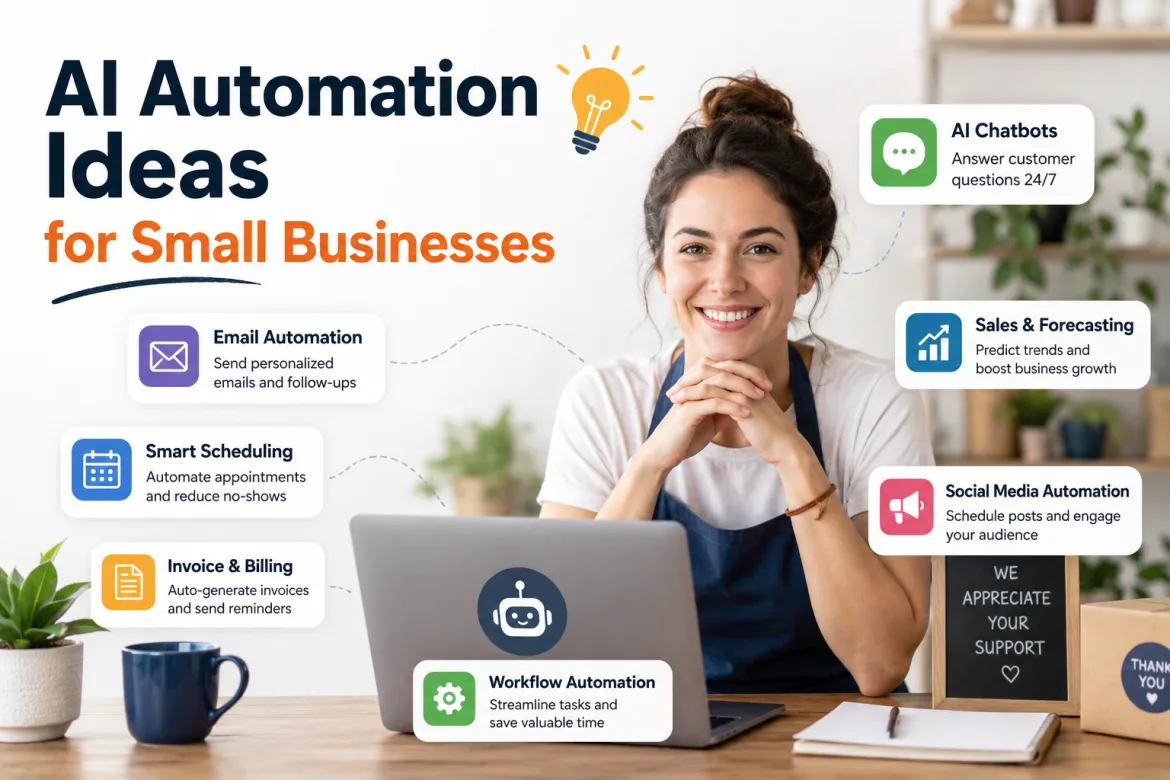
Artificial intelligence is no longer just for major corporations with big IT resources. By 2026, AI automation has evolved into a useful and cost-effective growth tool for small firms and startups. It reduces manual effort and improves overall efficiency in a variety of areas, including customer service and sales processes, cybersecurity, and cloud administration.
Small businesses operate in a highly competitive digital market in which clients expect prompt replies and tailored experiences. At the same time, proprietors must manage expenses while preserving productivity. AI-powered automation offers a significant benefit by balancing efficiency, scalability, and improved service delivery.
Modern artificial intelligence (AI) systems can automate repetitive operations, analyze data, and optimize workflows in real time. Whether it’s managing bills, executing marketing campaigns, detecting risks, or enhancing operations, AI helps organizations operate smarter and scale quicker. This paper looks at the finest AI automation methodologies, real-world use cases, and implementation tips for 2026.
Why AI Automation Matters for Small Businesses
AI automation is changing the way businesses run by eliminating tedious manual work and allowing teams to focus on key objectives. Small firms frequently deal with limited staff and restricted budgets, making automation especially useful for increasing efficiency without recruiting more people.
The proliferation of low-cost cloud-based AI platforms has made advanced technologies more accessible than ever before. Businesses can now integrate automation technologies into their existing systems rather than creating sophisticated infrastructure from start. This flexibility allows startups and SMEs to compete more successfully with larger corporations.
Customer expectations are also an essential element. Consumers in 2026 anticipate faster service, personalized recommendations, secure online experiences, and seamless digital communication. AI automation enables firms to achieve these requirements consistently while retaining operational efficiency.
Some of the biggest benefits of AI automation include:
- Reduced operational costs
- Faster response times
- Improved customer satisfaction
- Better business insights through analytics
- Enhanced cybersecurity protection
Businesses that implement automation early on generally enjoy a major competitive advantage because they can move faster, adapt more quickly, and service customers more efficiently.
Best AI Automation Ideas for Small Businesses
AI-Powered Customer Support Automation
Customer service is one of the most prominent areas in which firms use AI automation. AI chatbots and virtual assistants can currently manage the majority of client inquiries without human interaction. These systems may answer frequently asked questions, schedule appointments, manage refunds, track orders, and even provide product recommendations.
By 2026, conversational AI has moved far beyond regular chatbots. Modern artificial intelligence assistants interpret natural language, evaluate client intent, and deliver highly tailored interactions across websites, apps, WhatsApp, and social media platforms.
For small firms, this means 24-hour customer service without the expense of keeping a huge support staff. AI-powered customer service also significantly reduces response times, which increases customer happiness and retention.
Real-World Example
An eCommerce firm that employs AI support automation can respond promptly to order status requests, recommend relevant products, and handle returns automatically. This decreases the effort of support staff while enhancing client engagement.
AI Marketing Automation
With the incorporation of artificial intelligence, marketing automation has progressed dramatically. Small businesses may now use AI-powered technologies to automate email marketing, social media posting, customer segmentation, lead nurturing, and ad optimization.
AI marketing solutions evaluate customer behavior to determine which content, goods, or offers are most likely to convert. This enables organizations to generate highly tailored marketing efforts without having to manually analyze massive volumes of data.
AI also enhances SEO efforts by detecting popular keywords, refining article structure, and predicting search intent. Businesses that mix AI automation with content marketing generally see increased online visibility and lead creation.
Key Marketing Automation Use Cases
- AI-generated email personalization
- Automated social media scheduling
- Smart ad targeting and optimization
- Predictive customer behavior analysis
- AI-powered SEO recommendations
For small organizations with limited marketing resources, AI automation can significantly increase campaign performance while lowering manual labor requirements.
AI-Based Sales Automation
Sales teams spend a lot of time doing repetitive administrative duties. AI sales automation enables firms to streamline lead handling, CRM updates, proposal production, and follow-up communications.
Modern artificial intelligence solutions can automatically qualify leads based on consumer behavior and interaction data. This allows sales teams to focus on high-potential prospects rather than wasting time with unqualified leads. AI-powered CRMs also give predictive analytics, allowing firms to spot opportunities, forecast sales trends, and enhance conversion rates.
Business Use Case
A SaaS firm can utilize AI to automatically identify website visitors who are likely to purchase a subscription package. When a lead has significant purchasing intent, the system can send out personalized follow-up emails and notify the sales staff.
This form of automation boosts efficiency and sales prospects.
AI Automation for Cloud Services and IT Operations
In 2026, cloud computing will continue to play an important role in digital transformation plans. Businesses are increasingly using AI automation to manage cloud infrastructure, monitor performance, and decrease operational complexity.
AI-powered cloud management solutions can automatically assign resources, detect anomalous activity, improve server performance, and reduce downtime risks. This is especially critical for firms that use scalable applications or manage big amounts of client data.
Businesses can also explore AI workflow automation to understand how AI-powered technologies can automate tasks and streamline organizational activities.
Benefits of AI in Cloud Operations
- Automated server monitoring
- Predictive maintenance and issue detection
- Cost optimization for cloud resources
- Faster disaster recovery management
- Intelligent workload balancing
For startups and SMEs, AI-powered cloud automation solves many technical management difficulties while increasing dependability and productivity.
Cybersecurity Automation for Small Businesses
Cybersecurity risks are expected to increase quickly in 2026, with small enterprises being particularly vulnerable due to a lack of effective protection equipment. AI automation is key to upgrading cybersecurity defenses.
Modern AI cybersecurity systems can detect suspicious behavior, identify dangers in real time, and automatically respond to attacks before they cause significant damage. AI may also examine trends across networks and devices to proactively detect vulnerabilities.
Common AI Cybersecurity Solutions
- Threat Detection Automation
- Automated Security Monitoring
- Fraud Detection Systems
- Phishing Protection
- Automated vulnerability detection
For small firms, investing in cybersecurity automation is no longer a choice. Data breaches can result in financial loss, reputational damage, and legal penalties.
AI Workflow Automation for Daily Operations
One of the most practical applications of AI automation is to streamline daily company operations. Many businesses still rely on manual processes, which waste time and impair production. AI workflow automation systems enable firms to automate tedious administrative activities, document management, and internal communication processes.
Examples of Workflow Automation
- Automated invoice processing
- AI-based appointment scheduling
- Smart inventory management
- Employee onboarding automation
- Document approval workflows
Example
A logistics company can utilize artificial intelligence (AI) to manage shipments, automatically notify clients, create invoices, and estimate delivery delays based on weather or traffic data.
This increases efficiency and consumer happiness.
AI Automation Trends Shaping Businesses in 2026
AI automation is rapidly transforming how businesses operate and produce value. Companies are increasingly implementing smarter, more adaptable technologies to improve customer experience, decision-making, and operational efficiency. These trends make AI more accessible and useful for businesses of all sizes.
Hyper-Personalization
Businesses are increasingly leveraging AI to provide highly tailored customer experiences based on behavior, preferences, and purchasing history.
Voice and Conversational AI
Voice assistants and conversational AI are increasingly being integrated into customer support, internal operations, and eCommerce experiences.
AI + Human Collaboration
Rather of displacing employees, AI is increasingly being utilized to help teams with monotonous chores while humans focus on strategy and creativity.
Low-Code and No-Code AI Platforms
Businesses can now adopt automation solutions without requiring extensive technical knowledge by utilizing user-friendly AI platforms.
Predictive Business Intelligence
AI analytics technologies provide more accurate forecasts of trends, customer behavior, and operational hazards than traditional reporting methods.
These developments indicate that automation is becoming increasingly accessible and integrated into daily business activities.
Key Factors to Consider When Choosing an AI Automation Partner
Choosing the correct technology partner is critical for a successful AI implementation. Many firms fail because they rely solely on tools without considering scalability, integration, and long-term support. A great partner provides a seamless implementation and ongoing automation growth.
Key factors include:
- Industry experience relevant to your business domain
- Scalable solutions that grow with business expansion
- Strong integration with existing tools and systems
- High standards of security and compliance
- Customization options for unique business workflows
Choosing the proper partner lowers implementation risks while increasing long-term ROI. A trustworthy provider ensures that your AI systems are efficient, secure, and future-ready.
Common AI Automation Mistakes Businesses Should Avoid
While AI automation presents great benefits, ineffective implementation can result in lost resources and poor outcomes. Many firms rush toward automation without first analyzing existing procedures and properly training their workers. Successful adoption necessitates planning, training, and the appropriate technology selection.
Common mistakes include:
- Automating broken or inefficient processes instead of fixing them first
- Ignoring employee training and adoption needs
- Choosing tools based only on price instead of long-term value
- Overcomplicating automation by applying AI where it is not needed
- Neglecting cybersecurity and data protection measures
Avoiding these pitfalls promotes a smoother implementation and a higher ROI from AI automation. Businesses that prioritize strategy and security generate more sustainable and scalable outcomes.
How Small Businesses Can Start With AI Automation
Many business owners believe that AI adoption is expensive or too sophisticated, but modern technologies are significantly more accessible than they were only a few years ago.
The best way is to start small and gradually expand.
Step 1: Identify Repetitive Tasks
Look for time-consuming jobs including customer service, invoicing, scheduling, and data entry.
Step 2: Choose High-Impact Areas
Prioritize automations that increase the customer experience, productivity, or operational efficiency first.
Step 3: Select Scalable Tools
Choose platforms that can expand as your company expands, rather than requiring a total replacement later.
Step 4: Measure Performance
Keep track of KPIs like time saves, cost reductions, client satisfaction, and conversion improvements.
Businesses can also review practical AI use cases for businesses to identify potential applications across marketing, IT operations, customer service, and other areas.
Step 5: Continuously Optimize
AI systems grow over time as firms review performance data and tweak procedures on a regular basis.
Small organizations can successfully integrate automation by employing a gradual strategy that does not overwhelm their workforce or budget.
Conclusion
AI technology is changing the way small firms function in 2026. AI allows businesses to enhance productivity, decrease costs, and grow operations more intelligently in a variety of areas, including customer service, marketing automation, cloud management, and cybersecurity.
Businesses that embrace automation early will be better positioned to compete in an increasingly digital environment. However, successful implementation needs more than just using new technologies. To optimize long-term value, businesses require a clear strategy, scalable infrastructure, robust cybersecurity policies, and the proper technology partner.
Whether you’re a startup founder, CTO, enterprise leader, or small business owner, AI automation may help your company operate smarter, service consumers better, and develop faster in a rapidly changing marketplace.