

In today’s extremely competitive digital world, blogging success is defined by more than just publishing frequency and content quality. Search engines have grown into intelligent algorithms that assess intent, user experience, technical performance, and authority signals before ranking a website. For bloggers, this means that data-driven optimization is no longer an optional technique.
Google Search Console is especially useful in this situation. It provides bloggers with a direct picture of how Google perceives their website, what keywords are driving visibility, and which technical difficulties may be impeding performance. Instead of guessing what works, you receive practical recommendations based on real search data.
AI-powered search engines, automation tools, and user behavior signals will all have a significant impact on SEO by 2026. Bloggers that understand how to successfully evaluate Search Console data may adjust faster, enhance ranks strategically, and grow organic traffic more sustainably. This guide explains all you need to know in a practical, business-oriented manner.
What is Google Search Console?
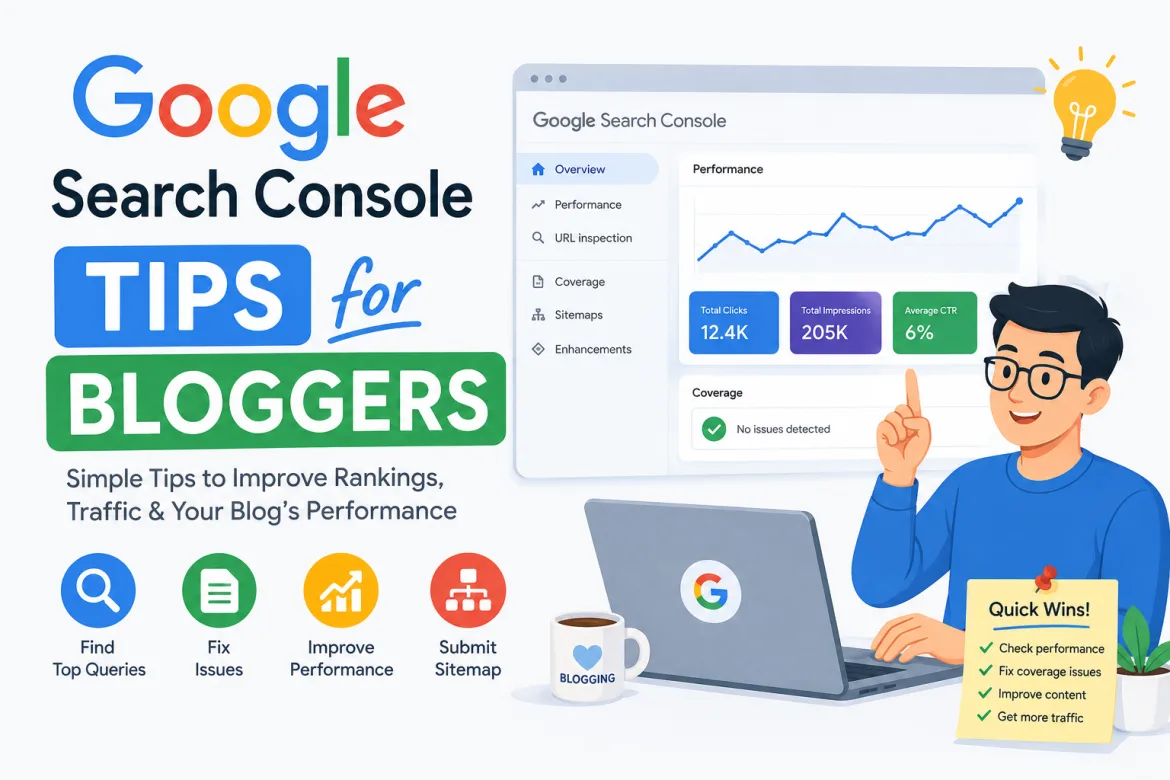
Google Search Console is a free but sophisticated platform given by Google that allows website owners to monitor, manage, and improve their search presence. It serves as a real-time feedback system for your website and Google’s indexing infrastructure. You can get started with the official Google Search Console platform.
It offers bloggers and digital businesses information that goes well beyond simple analytics. You may learn which search queries drive traffic, how frequently your pages appear in search results, and whether Google is properly indexing your material.
Some of the most valuable insights include:
- Keywords driving organic traffic to your site.
- Indexing status of each page or article.
- Comparing search impressions to actual clicks.
- Technical issues impacting visibility.
- Enhanced mobile usability and page performance.
- Backlink and internal linking signals.
Unlike other analytics solutions, Search Console focuses solely on search engine performance. It allows you to learn not just what users are doing on your website, but also how they found you in the first place.
Why Google Search Console Matters in 2026 SEO
AI-driven ranking systems in 2026 shape SEO by prioritizing user delight, contextual relevance, and technological dependability. This means that websites are evaluated not only on material quality, but also on how efficiently they provide information to consumers.
Search Console plays an important role in this context by giving direct indications from Google. It allows bloggers to identify what works and what needs to be improved in real time.
Key areas where it adds value include:
- Understanding search intent alignment and keyword relevancy.
- Improving click-through rates with performance insights.
- Identifying indexing delays and crawl inefficiencies.
- Tracking Core Web Vitals and user experience metrics.
- Identifying declines in rankings beforehand.
For example, a blog post might receive thousands of impressions but very few clicks. Search Console helps diagnose whether the issue is weak metadata, poor positioning, or misaligned keyword targeting. This level of clarity is critical for scaling SEO in competitive niches.
Setting Up Google Search Console Correctly
Proper setup is the cornerstone for accurate SEO tracking. Many bloggers overlook configuration steps or set up tools incorrectly, resulting in incomplete or inaccurate data later on.
To create a robust foundation, adopt these important setup practices:
- Verify your website using domain-level or URL prefix verification.
- Submit an XML sitemap to improve Google’s content discovery process.
- Integrate Search Console and Google Analytics for uniform insights.
- Ensure HTTPS is correctly implemented for trust and security.
- Maintain consistent URL formats, including www and non-www versions where applicable.
Key Google Search Console Features Every Blogger Must Use
1. Performance Report (Keyword Insights)
The Performance Report is one of the most useful services for bloggers because it shows how users discovered your material. It displays search queries, impressions, clicks, CTR, and average rankings.
Using this data, you can determine which keywords are doing well and which pages require improvements. For example, if a blog post ranks on page one but has a poor CTR, it is likely due to weak titles or unconvincing meta descriptions.
Over time, optimizing based on this report can result in considerable increases in organic traffic without the creation of new content.
2. Indexing and Coverage Report
The Indexing and Coverage Report explains whether your pages are correctly included in Google’s search index. If a page is not indexed, it does not appear in search results, regardless of its quality.
This section highlights the following:
- Valid indexed pages.
- Pages excluded from indexing.
- Issues with crawling and server performance.
- Duplicate or canonicalization issues.
For bloggers who manage vast content libraries, this report is crucial for assuring visibility and avoiding hidden SEO losses.
3. URL Inspection Tool
The URL Inspection Tool provides precise information on how Google sees a certain page. It is especially beneficial when publishing fresh content or revising older blog posts. The tool confirms that a page has been correctly indexed and flags any flaws that may hinder visibility in search results.
It also allows bloggers to request indexing for newly published or modified pages, which helps Google detect changes faster. It can also detect crawl difficulties and indexing issues that may affect overall SEO performance.
You can use it to:
- Request indexing of updated information.
- Identify issues affecting mobile usability or structured data.
- Verify crawl status and indexing eligibility.
- Validate schema markup for improved search presentation.
This technology is especially useful for time-sensitive material, where speedy indexing is critical for traffic collection. For additional guidance, consult Google’s official URL Inspection documentation.
4. Sitemaps
Submitting a sitemap allows Google to efficiently crawl and comprehend your website structure. It serves as a roadmap for search engines, allowing them to discover fresh content faster. A well-maintained sitemap also helps Google discover important pages, particularly on websites with a lot of material.
For blogs that publish frequently, keeping an updated sitemap helps indexing performance and guarantees that no crucial pages are missed. It also allows for better organizing of big content archives. Regularly evaluating your sitemap helps discover crawl difficulties and ensures that search engines have access to your most recent content.
5. Core Web Vitals Report
Core Web Vitals assesses user experience performance, which is an important ranking consideration. This encompasses loading speed, interactivity, and visual stability. These analytics assist website owners in understanding how real visitors interact with their pages and discovering performance issues that may affect rankings.
Improving these indicators not only supports a better user experience but may also contribute to stronger search performance. For bloggers, quicker webpages can translate into improved engagement and fewer frustrated visitors. A smooth browsing experience can also boost page views, session duration, and reader satisfaction, resulting in stronger long-term organic development.
Advanced Google Search Console Tips for Bloggers
Google Search Console provides useful data that extends far beyond simple performance measurement. By proactively evaluating search data, bloggers can identify opportunities to enhance traffic, improve rankings, and improve overall SEO performance. Small adjustments based on Search Console insights frequently yield large long-term benefits.
- Improve CTR by optimizing titles and meta descriptions: Review pages with high impressions but low click-through rates. Create relevant, descriptive titles and compelling meta descriptions that accurately represent the content.
- Identify content gaps from ranking keywords: Examine the queries generating impressions to discover relevant topics that your existing articles do not fully address.
- Fix keyword cannibalization issues: Identify multiple pages appearing for similar queries and evaluate whether their search intent overlaps. Improve their differentiation or consolidate content where appropriate.
Regularly reviewing these areas helps bloggers maximize existing search visibility, capture additional traffic opportunities, and build a stronger foundation for sustainable organic growth.
Common Google Search Console Mistakes Bloggers Make
Even experienced bloggers frequently underuse Google Search Console or fail to capitalize on the data it provides. Simply evaluating data is insufficient; the true value comes from identifying problems and implementing solutions based on the findings. Ignoring critical reports might stifle organic development and prevent pages from reaching their true ranking potential.
- Ignoring indexing failures for longer periods.
- Neglecting to assess CTR performance regularly.
- Ignoring mobile usability and page experience issues.
- Inconsistently updating or submitting sitemaps.
- Ignoring falling impressions.
- Relying on traffic data without actionable insights.
Correcting these issues can lead to faster SEO improvements and more stable search performance.
SEO in 2026: AI, Automation, and Digital Transformation
Modern SEO is heavily affected by artificial intelligence, automation technologies, and cloud-based infrastructure. Search engines now evaluate material using complex models that consider context, authority, and user satisfaction.
This shift means bloggers must adapt to new developments such as:
- AI-generated search summaries that may reduce clicks to websites for some queries.
- Voice and visual search optimization becoming more important for certain audiences.
- Automated SEO auditing tools improving efficiency.
- Cloud-based analytics supporting ongoing performance monitoring.
- Improved cybersecurity and website trust signals.
In this context, SEO is no longer only about content. It necessitates technological knowledge, automated integration, and adaptable digital systems.
Choosing the Right Digital or IT Service Partner
For bloggers, startups, and businesses looking for long-term SEO success, selecting the proper technical partner can have a big impact on growth results. A strong partner ensures that your website is optimized not just for content, but also for performance, scalability, and security.
Key factors to evaluate include:
- Extensive experience in SEO and performance optimization.
- Experience with AI-powered marketing and automation technologies.
- Experience with cloud infrastructure and scalability solutions.
- Strong cybersecurity standards for website protection.
- Effective integration of analytics tools such as Search Console.
- A proven track record of supporting long-term organic growth.
The proper partner can help your blog become a high-performing digital asset rather than just a content platform.
Real-World Use Case Example
Consider a blogger who runs a flourishing website with over 200 articles. Despite constant publication, traffic remains flat and grows slowly over time.
After examining Google Search Console, they uncover numerous important issues:
- High impressions but low CTR across numerous posts.
- Several key pages are not properly indexed.
- Mobile usability concerns impacting user experience.
Within three months of optimizing metadata, resolving indexing issues, and increasing mobile performance, the blog’s organic traffic increased by 65%. This illustrates how effectively using Search Console data can help identify and address SEO problems. The 65% increase is an illustrative example, not a guaranteed result.
Conclusion
In today’s SEO world, success is dependent on the combination of high-quality content and data-driven decision-making. Bloggers can use tools like Google Search Console to study search behavior, resolve technical difficulties, and precisely optimize their websites.
When used consistently, Search Console becomes more than just an analytics tool; it is a strategic growth engine. Bloggers may establish long-term authority and sustained traffic development by monitoring performance, increasing CTR, addressing indexing concerns, and adjusting to AI-driven search trends.
Finally, in 2026, SEO performance will depend on clarity, consistency, and continual optimization.