

In today’s fast-paced digital economy, founders are expected to oversee much more than just product development and sales. Modern business executives are responsible for operations, marketing, customer connections, team cooperation, financial management, cybersecurity, and strategic planning. As businesses expand, manual processes can quickly become bottlenecks, reducing productivity and slowing growth.
This reality has elevated internet business tools from optional conveniences to critical corporate infrastructure. Whether you’re starting a business or managing an existing one, the appropriate technology stack can boost productivity, save operating expenses, and promote long-term growth.
The rise of remote work, artificial intelligence, automation, and cloud computing has fueled the desire for integrated corporate solutions. Founders who effectively use current business technologies can make faster decisions, increase customer satisfaction, and devote more attention to strategic growth projects.
Why Online Business Tools Matter More Than Ever
The corporate environment has become more competitive. Customers demand quick responses, smooth experiences, and tailored interactions. At the same time, teams are growing more dispersed, markets are becoming more global, and operational complexity grows.
Online business tools assist entrepreneurs in overcoming these problems by centralizing information, automating repetitive operations, and offering real-time visibility into company performance. Businesses can use integrated digital ecosystems instead of spreadsheets, isolated software, or manual operations.
The most successful founders recognize that technology is more than just a support function. It’s become a strategic advantage. Businesses that invest in the proper tools typically enjoy higher efficiency, better customer insights, stronger cooperation, and improved scalability than competitors who rely on obsolete technologies.
Project Management and Team Collaboration Tools
Every developing business eventually faces coordination issues. Tasks become harder to track, deadlines slide, and communication fragments into emails, messages, and meetings.
Project management and collaboration tools enable entrepreneurs to keep track of ongoing work while boosting team accountability. These solutions integrate project planning, work assignment, progress tracking, and internal communication.
Benefits of Collaboration Tools
Effective collaboration tools provide several business benefits:
- Improved project visibility and transparency
- Better accountability among team members
- Faster communication and decision-making
- Reduced operational confusion
- Enhanced remote and hybrid work support
Project management solutions become more beneficial as firms grow because they develop structured workflows and standardized processes. Teams can collaborate more effectively, while leaders gain a better understanding of productivity and resource allocation.
The increasing incorporation of artificial intelligence into collaboration platforms enables firms to automate regular administrative operations, generate summaries, identify dangers, and prioritize jobs more effectively.
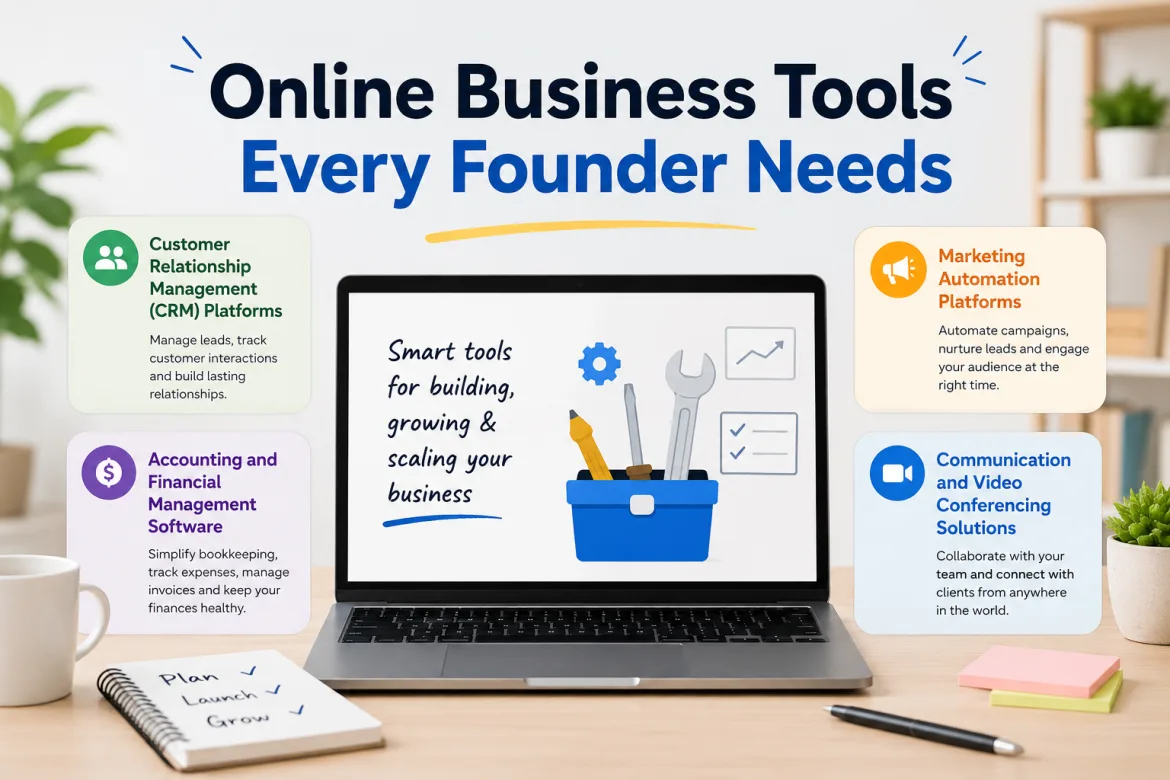
Customer Relationship Management (CRM) Platforms
Customer relationships are the foundation for corporate expansion. Without a disciplined method to managing leads, prospects, and customers, entrepreneurs risk losing opportunities and decreasing customer satisfaction.
CRM solutions enable firms to organize customer information, track interactions, manage sales pipelines, and increase communication across the customer lifetime. CRM platforms such as Salesforce provide businesses with tools for organizing customer data and managing relationships.
Benefits of CRM Platforms
A well-implemented CRM provides significant advantages:
- Client data centralization
- Improved sales forecasting
- Lead management
- Increased client retention
- More personalized customer experiences
CRM technologies provide entrepreneurs with visibility into sales performance and consumer behavior. Rather than relying on memory or fragmented information, teams may access detailed client histories and make better educated judgments.
As consumer expectations shift, CRM systems are increasingly adding predictive analytics and AI-powered recommendations to help firms better identify opportunities and anticipate customer demands.
Accounting and Financial Management Software
Financial visibility is a vital component of running a successful business. However, many founders struggle with cash flow management, spending tracking, invoicing, budgeting, and financial reporting. Cloud-based accounting tools make financial administration easier by automating regular tasks and allowing real-time access to critical financial data.
Key Functions of Accounting Software
Modern accounting software can help businesses:
- Track income and expenses accurately
- Generate professional invoices
- Monitor cash flow
- Prepare tax documentation
- Produce financial reports quickly
Access to accurate financial information is critical for startups and developing organizations when it comes to strategic planning, funding, and operational decisions.
One of the primary advantages of digital accounting solutions is their ability to decrease human errors while increasing compliance and transparency. As firms grow, these systems become increasingly important for preserving financial management and enabling long-term scalability.
Marketing Automation Platforms
Marketing has become more data-driven and multichannel. Businesses must handle multiple channels at once, including websites, email campaigns, social media, content marketing, paid advertising, and consumer involvement.
Marketing automation systems enable founders to streamline these processes while providing more consistent consumer experiences. They also allow organizations to effectively increase their marketing activities without considerably increasing operational workload.
Common Marketing Automation Uses
These technologies are often used for email marketing automation, lead nurturing campaigns, audience segmentation, customer journey monitoring, and performance analytics.
Automation allows organizations to engage clients at the optimal time without requiring constant personal intervention. Prospects can get individualized messaging based on their behavior, preferences, and interaction patterns.
As artificial intelligence gains traction in digital marketing, automation tools become more advanced, providing predictive targeting, content recommendations, and performance optimization features that boost campaign efficacy.
Communication and Video Conferencing Solutions
Effective communication is critical for corporate success. Communication solutions enable teams stay aligned and collaborate whether they work remotely, hybridally, or in-office. Modern communication platforms integrate chat, video conferencing, file sharing, and meeting management into a cohesive environment.
The benefits go beyond convenience. Businesses frequently experience:
- Faster decision-making
- Higher employee engagement
- Better cross-location collaboration
- Fewer communication hurdles
- Increased corporate transparency
With the trend to remote workforces, communication technology has become a key company investment. Founders who build strong communication channels early on can promote growth while preserving organizational coherence.
Future improvements are anticipated to include additional AI-powered meeting summaries, real-time language translation, and intelligent collaboration capabilities that increase efficiency.
Cloud Storage and Document Management Systems
Data accessibility and security are critical for modern organizations. Traditional file storage solutions can result in version control issues, security dangers, and collaboration challenges. Cloud storage solutions enable secure, centralized access to company documents from almost anywhere.
Secure file sharing, automatic backups, version control, increased collaboration, and a reduction in reliance on physical infrastructure are all significant advantages. Cloud storage services such as OneDrive can support centralized document access and collaboration.
Document management solutions also assist firms in maintaining compliance, streamlining workflows, and ensuring that vital information is accessible when needed.
As data volumes expand, founders should consider scalable storage solutions that can meet future company needs while keeping high security standards.
Cybersecurity and Data Protection Tools
Cybersecurity is no longer a problem only for huge corporations. Small businesses and startups are increasingly being targeted by cybercriminals due to their limited security resources and weaker defenses.
Business leaders must see cybersecurity as a critical operational requirement, not a technological afterthought. A proactive security plan protects important assets, fosters consumer trust, and ensures long-term business continuity.
Essential Cybersecurity Measures
Multi-factor authentication, password management systems, endpoint protection software, secure cloud architecture, and threat monitoring tools are all examples of essential cybersecurity procedures.
Strong cybersecurity measures safeguard consumer data, financial information, intellectual property, and company continuity.
Business Analytics and Reporting Platforms
Data-driven decision-making has become an essential competitive tool. Businesses create vast amounts of data in sales, marketing, finance, operations, and consumer interactions. Analytics platforms convert raw data into meaningful insights.
These tools assist founders in measuring business performance, identifying growth prospects, monitoring key performance indicators, increasing forecasting accuracy, and optimizing resource allocation.
Without solid analytics, corporate decisions are frequently based on assumptions rather than evidence. Reporting solutions provide the visibility required to determine what works, what needs to be improved, and where future expenditures should be focused.
The growing use of AI-powered analytics allows firms to detect patterns, generate projections, and spot opportunities more quickly and accurately than ever before.
E-Commerce and Payment Processing Solutions
E-commerce and payment systems are an essential component of the customer experience for businesses that sell items or services online. Consumers demand a smooth purchase experience, safe payment choices, and quick transaction processing. Founders must ensure that their technology can meet these requirements.
Modern e-commerce solutions include online shop management, inventory tracking, payment processing, customer account management, and sales reporting.
Integrated payment systems also make revenue collection easier while accepting different payment types and foreign transactions. As digital commerce grows globally, organizations that invest in dependable e-commerce infrastructure position themselves for increased scalability and consumer pleasure.
Automation and Workflow Management Tools
One of the most significant benefits of current corporate technology is automation. Founders frequently devote significant time to monotonous administrative procedures that add little strategic value. Workflow automation technologies integrate many corporate platforms and automate typical tasks.
Common Workflow Automation Uses
Automation is commonly used for lead management, customer onboarding, invoice processing, data synchronization, and internal approvals.
Businesses that eliminate manual effort can enhance productivity, reduce errors, and free up personnel to focus on higher-value activities.
Automation is projected to play an increasingly important role in company operations as artificial intelligence advances. Organizations that strategically adopt automation are expected to see significant productivity increases in the coming years.
Challenges When Selecting Business Tools
Although online tools provide numerous advantages, innovators frequently confront problems when developing their technology stack. One common problem is to implement too many disconnected solutions. Excessive software complexity might lead to inefficiencies rather than reducing them.
Other obstacles include integration difficulties, staff adoption issues, escalating subscription costs, data transfer concerns, and security and compliance needs.
To prevent these issues, entrepreneurs should emphasize technologies that work well with existing systems, provide adequate support, and are aligned with long-term business goals.
A comprehensive technology strategy helps to avoid wasteful investment while increasing operational value.
Best Practices for Building an Effective Technology Stack
The most efficient business IT ecosystems are carefully planned rather than constructed at random. Founders should start by recognizing operational challenges and business priorities. Technology expenditures should address specific issues and provide demonstrable results.
Key Technology Stack Best Practices
Several best practices can improve success:
- Prioritize scalability and flexibility
- Choose tools with strong integration capabilities
- Focus on user adoption and training
- Regularly review software utilization
- Maintain cybersecurity standards
When examining their technological stack, founders should also regularly examine return on investment (ROI). Technology should complement company strategy rather than dictate it. Founders that preserve this attitude are more likely to create efficient and long-lasting digital infrastructures.
Future Trends Shaping Business Tools
Artificial intelligence, automation, predictive analytics, and deeper software integration are transforming online business tools.
AI-powered assistants are becoming capable of creating reports, evaluating trends, automating workflows, and assisting with decision-making. Low-code and no-code platforms can allow organizations to design customized solutions without requiring extensive technical knowledge.
Other rising themes include intelligent process automation, predictive business analytics, improved cybersecurity automation, unified business platforms, AI-powered customer engagement, and real-time operational intelligence.
As these technologies evolve, founders will gain access to more sophisticated tools for streamlining operations and accelerating growth.
Businesses that stay adaptive and receptive to innovation will be better positioned to take advantage of future opportunities.
Final Thoughts
Online business tools have become crucial components of current corporate success. From project management and customer relationship management to accounting, cybersecurity, analytics, and automation, the appropriate technology stack enables entrepreneurs to work more effectively, make better decisions, and scale confidently. Businesses that invest in the right digital technologies are frequently better positioned to boost productivity, streamline processes, and drive long-term growth.
Looking ahead, artificial intelligence, automation, and interconnected digital ecosystems will continue to reshape the way firms function. Founders who embrace these innovations strategically can better react to shifting market needs, improve consumer experiences, and gain a long-term competitive advantage in an increasingly digital company landscape.