

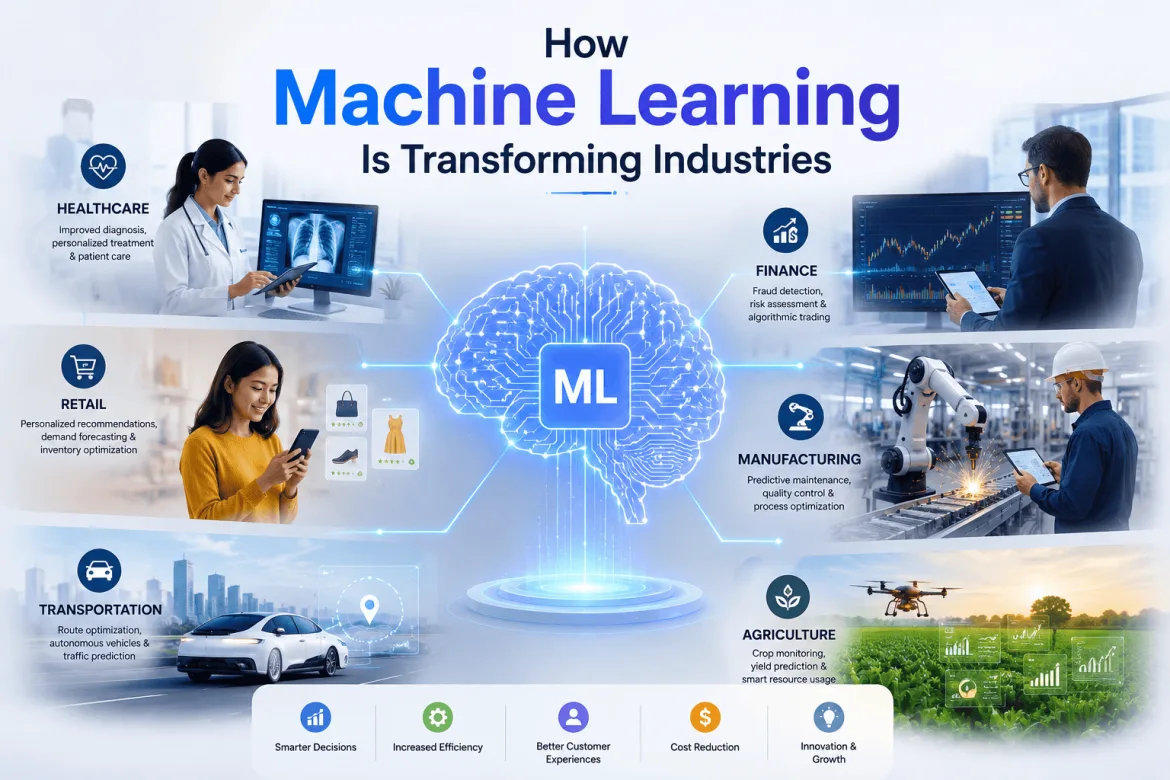
Machine learning has evolved from an emerging trend into a core business necessity. In 2026, companies across industries use it to improve efficiency, automate processes, enhance customer experience, and make faster, data-driven decisions. It is no longer limited to large tech firms—startups and SMEs are also adopting it to modernize operations.
Businesses today generate massive amounts of data from customers, transactions, and digital platforms. The main challenge is not data collection but turning it into useful insights. Machine learning helps convert raw data into actionable intelligence that drives growth and better decision-making.
Across sectors like healthcare, finance, retail, logistics, and manufacturing, organizations use machine learning to predict behavior, reduce risks, and optimize performance. Companies that adopt it early gain a competitive edge by responding more quickly to market changes.
What Is Machine Learning?
Machine learning is a branch of artificial intelligence that allows computer systems to learn from data and improve performance over time without being manually programmed for every situation. Instead of relying only on predefined rules, machine learning systems identify patterns, analyze trends, and make predictions based on historical and real-time information.
This ability to continuously learn makes machine learning highly valuable for businesses operating in dynamic and fast-changing industries. The more relevant data a system processes, the more accurate and efficient its predictions and recommendations become. This creates smarter systems capable of improving business operations over time.
Machine learning generally works through three major components:
- Data collection
- Algorithm training
- Prediction and optimization
Businesses use these capabilities to automate decision-making, improve customer experiences, optimize processes, and identify opportunities that would be difficult to detect manually. As organizations continue generating more data, machine learning is becoming increasingly essential for extracting meaningful business insights.
Why Machine Learning Matters for Modern Businesses
Modern businesses are expected to move faster, operate more efficiently, and deliver highly personalized customer experiences. Traditional systems often struggle to keep up with the growing complexity of digital operations. Machine learning helps businesses overcome these challenges by enabling smarter automation and advanced data analysis.
Improved Decision-Making
Machine learning enables businesses to process large volumes of data quickly and accurately. Instead of relying on assumptions or outdated reports, companies can use predictive analytics to understand trends, forecast demand, and make better strategic decisions. This reduces uncertainty and helps organizations respond more effectively to changing market conditions.
Key Benefits:
- Identifies patterns and trends in large datasets
- Improves demand forecasting and planning
- Supports faster and more informed decision-making
- Reduces risks caused by uncertainty and guesswork
For example, retailers can predict seasonal demand patterns, while financial institutions can assess risk more accurately. These insights allow businesses to allocate resources more effectively and improve long-term planning.
Operational Efficiency
Machine learning helps businesses automate repetitive and time-consuming tasks that once required heavy manual effort. This leads to higher productivity while reducing operational costs and minimizing human error. As a result, organizations can operate more efficiently and consistently.
Key Areas of Automation:
- Document verification and processing
- Inventory and supply chain management
- Customer support and chatbot systems
- Workflow approvals and task routing
Machine learning improves efficiency through intelligent automation.
Better Customer Experiences
Modern customers expect personalized and seamless digital experiences. Machine learning helps businesses understand customer behavior, preferences, and purchasing patterns more effectively. This enables companies to deliver more relevant and timely interactions across digital platforms.
Key Applications:
- Targeted product recommendations
- Customized marketing campaigns
- Improved customer support systems
- Enhanced user experience on apps and websites
Machine learning is transforming customer engagement and driving stronger business relationships..
Competitive Advantage
- Enables faster innovation and product development
- Improves operational efficiency and cost optimization
- Helps respond quickly to changing customer needs
- Strengthens long-term growth and profitability
- Provides a strong edge in competitive markets
How Machine Learning Is Transforming Major Industries
Healthcare Industry
The healthcare sector is experiencing major transformation through machine learning technologies. Hospitals, healthcare providers, and research organizations are using intelligent systems to improve diagnostics, treatment planning, and patient management.
Predictive Diagnostics
Machine learning models can analyze medical images, patient history, and diagnostic reports with remarkable accuracy. These systems help doctors detect diseases such as cancer, cardiovascular conditions, and neurological disorders at earlier stages. Early detection often leads to faster treatment and better patient outcomes.
Personalized Treatment Plans
Healthcare providers are increasingly using machine learning to create customized treatment strategies based on patient data and medical history. Personalized healthcare improves treatment effectiveness while minimizing unnecessary procedures and medications.
Hospital Operations Optimization
Machine learning also helps hospitals improve scheduling, staffing, and resource allocation. Intelligent systems can predict patient admission rates and optimize operational workflows, helping healthcare organizations reduce delays and improve service quality.
Financial Services Industry
Financial institutions are using machine learning to improve security, customer service, and decision-making. As digital banking continues expanding, intelligent systems are becoming critical for managing financial operations effectively.
Fraud Detection
Machine learning systems can monitor transactions in real time and detect suspicious activity instantly. These systems analyze spending behavior and identify unusual patterns that may indicate fraud. This improves security while protecting customers and financial institutions from major financial losses.
Risk Assessment
Banks and lending institutions use machine learning to evaluate creditworthiness and financial risk more accurately. Predictive models help organizations make smarter lending decisions while reducing potential risks.
Personalized Banking
Modern financial platforms use machine learning to offer personalized investment recommendations, savings insights, and customer experiences. This creates more engaging and customer-focused banking services.
Retail and E-Commerce
Retail businesses are using machine learning to improve customer experiences, optimize inventory, and increase sales performance in highly competitive markets. It also enables personalized recommendations that enhance customer satisfaction and loyalty.
Product Recommendations
Machine learning powers recommendation systems used by companies like Amazon and Netflix. These systems analyze browsing history, purchasing behavior, and customer interests to suggest relevant products or content. Personalized recommendations often lead to higher engagement and increased conversions.
Demand Forecasting
Retailers can predict customer demand patterns more accurately using machine learning models. This helps businesses manage inventory effectively, reduce waste, and avoid stock shortages during peak seasons.
Dynamic Pricing
Many eCommerce businesses now use machine learning to adjust pricing based on demand, customer behavior, and market conditions. Dynamic pricing strategies help companies remain competitive while maximizing profitability.
Manufacturing Industry
Manufacturing companies are integrating machine learning into production environments to improve operational efficiency, quality control, and predictive maintenance. This helps reduce downtime, detect defects early, and optimize overall production processes.
Predictive Maintenance
Machine learning systems monitor equipment performance and identify potential failures before they happen. This reduces downtime, prevents costly disruptions, and improves production reliability.
Quality Assurance
AI-powered inspection systems can identify manufacturing defects much faster and more accurately than traditional manual inspection methods. This improves product consistency while reducing operational waste.
Supply Chain Optimization
Manufacturers use machine learning to improve logistics planning, supplier management, and inventory forecasting. These improvements create more efficient and resilient supply chains.
Logistics and Transportation
The logistics sector depends heavily on efficiency, speed, and operational accuracy. Machine learning is helping transportation companies improve delivery performance and reduce operational costs.
Route Optimization
Machine learning algorithms analyze traffic conditions, weather patterns, and delivery schedules to identify the most efficient transportation routes. This reduces fuel consumption and improves delivery times.
Fleet Management
Transportation companies use intelligent systems to monitor vehicle performance, maintenance schedules, and driver behavior in real time. This improves safety and operational efficiency.
Warehouse Automation
Machine learning also powers smart warehouse systems that optimize inventory movement, packaging, and order fulfillment processes.
Education Industry
Machine learning is helping educational institutions create more personalized and efficient learning experiences for students and educators. It also supports adaptive learning systems that adjust content based on individual student performance, making learning more effective and engaging.
Adaptive Learning Platforms
Educational platforms now use machine learning to customize learning experiences based on individual student performance and progress. This improves engagement and learning outcomes.
Automated Administrative Tasks
Schools and universities are automating tasks such as grading, attendance tracking, and scheduling using intelligent systems. This allows educators to spend more time focusing on teaching and student development.
Student Performance Prediction
Machine learning systems can identify students who may need additional support by analyzing academic patterns and engagement levels. This helps institutions improve student success rates.
The Rise of Intelligent Automation
Machine learning is driving a new era of intelligent automation across industries. Unlike traditional automation systems that follow fixed rules, machine learning-based automation can learn, adapt, and improve continuously.
Businesses are now automating:
- Customer support through AI chatbots
- Invoice processing
- Email classification
- Data entry
- HR recruitment screening
- Marketing personalization
- Sales forecasting
This level of automation helps organizations improve speed, reduce operational costs, and increase productivity. Startups and growing businesses especially benefit from intelligent automation because it allows them to scale operations without significantly increasing workforce costs.
Machine Learning and Data-Driven Business Strategy
Modern organizations are increasingly becoming data-driven businesses. Machine learning helps companies turn complex datasets into valuable business insights that support growth and innovation.
Businesses use machine learning to:
- Understand customer behavior
- Predict future trends
- Improve operational performance
- Detect inefficiencies
- Optimize marketing campaigns
- Identify new revenue opportunities
These insights help business leaders make smarter strategic decisions backed by accurate data instead of assumptions. Organizations that effectively use data often become more agile and competitive in rapidly changing markets.
Challenges Businesses Face When Implementing Machine Learning
Although machine learning offers significant advantages, successful implementation requires careful planning and the right technical expertise.
Data Quality Issues
Machine learning systems rely heavily on clean and structured data. Poor-quality or incomplete data can lead to inaccurate predictions and ineffective outcomes.
Integration Complexity
Integrating machine learning into existing business systems can be technically challenging. Companies often need experienced technology partners to ensure smooth implementation.
Talent Shortages
The growing demand for AI professionals has created a shortage of skilled machine learning experts. Many businesses struggle to build experienced in-house AI teams.
Security and Compliance
Businesses handling customer data must maintain strong security standards and comply with data privacy regulations when implementing machine learning solutions.
Why Startups and SMEs Are Adopting Machine Learning Faster
Machine learning technologies are becoming more accessible through cloud computing platforms, open-source frameworks, and AI development tools. This has made adoption easier for startups and SMEs.
Smaller businesses are using machine learning for:
- Customer analytics
- Marketing automation
- Sales prediction
- Chatbots
- Inventory management
- Fraud prevention
- Personalized customer engagement
These technologies help smaller companies improve efficiency, compete with larger enterprises, and scale operations more effectively without requiring massive infrastructure investments.
Future Trends in Machine Learning
Machine learning continues evolving rapidly, and businesses are already preparing for the next wave of AI-driven innovation. Advancements in automation, generative AI, and real-time analytics are reshaping how organizations operate.
Generative AI Integration
Businesses are integrating generative AI into customer service, content creation, software development, and workflow automation processes.
Edge AI
Machine learning models are increasingly running closer to devices and sensors, improving processing speed and real-time performance.
Explainable AI
Organizations are demanding more transparent AI systems that clearly explain how predictions and decisions are made.
AI-Powered Cybersecurity
Machine learning is helping businesses detect cybersecurity threats faster and respond proactively to suspicious activity.
Hyper-Personalization
Businesses are using advanced machine learning to create highly personalized customer experiences across digital platforms and services.
Choosing the Right Technology Partner for Machine Learning
Successful machine learning adoption requires more than just implementing software tools. Businesses need experienced technology partners who understand both technical development and industry-specific challenges.
The right development partner can help organizations:
- Identify valuable AI opportunities
- Build scalable machine learning solutions
- Ensure secure implementation
- Integrate systems smoothly
- Optimize long-term performance
An experienced technology company can significantly reduce implementation risks while accelerating digital transformation goals.
Conclusion
Machine learning is transforming industries by helping businesses become more intelligent, efficient, and customer-focused. From healthcare and finance to retail and manufacturing, organizations are using machine learning to improve operations, automate processes, reduce costs, and unlock new growth opportunities.
As digital transformation continues accelerating, machine learning is no longer optional for businesses that want to remain competitive. Companies that adopt AI-driven technologies strategically are better positioned to innovate, improve customer experiences, and adapt quickly to changing market demands.
Whether you are a startup exploring automation opportunities or an enterprise planning large-scale digital transformation, machine learning can provide the tools needed to build smarter and future-ready business operations.